 A wonderful Flash movie. (Click on the image to go to the site where you can watch it!)
I expect you'll be amazed, as I was, at how various empires extended their reach. . . .
A wonderful Flash movie. (Click on the image to go to the site where you can watch it!)|
|
2.5 |
Posted on Saturday, November 15, 2008 9:34:43 AM by dvan
A New Element Discovered
Lawrence Livermore Laboratories has discovered the heaviest element yet known to science.
The new element, Governmentium (Gv), has one neutron, 25 assistant neutrons, 88 deputy neutrons, and 198 assistant deputy neutrons, giving it an atomic mass of 312.
These 312 particles are held together by forces called morons, which are surrounded by vast quantities of lepton-like particles called peons.
Since Governmentium has no electrons, it is inert; however, it can be detected, because it impedes every reaction with which it comes into contact. A tiny amount of Governmentium can cause a reaction that would normally take less than a second, to take from 4 days to 4 years to complete.
Governmentium has a normal half-life [in the United States] of 2-6 years. It does not decay, but instead undergoes a reorganization in which a portion of the assistant neutrons and deputy neutrons exchange places. In fact, Governmentium's mass will actually increase over time, since each reorganization will cause more morons to become neutrons, forming isodopes.
This characteristic of morons promotion leads some scientists to believe that Governmentium is formed whenever morons reach a critical concentration. This hypothetical quantity is referred to as critical morass.
When catalyzed with money, Governmentium becomes Administratium, an element that radiates just as much energy as Governmentium, since it has half as many peons but twice as many morons.
|
|
2.5 |
Bailing out Detroit would be a bad use of public money. It would be bad in principle, because it would be an open invitation to companies everywhere to apply for aid to survive the recession. Banks qualify for help because the entire economy depends upon their services. They are vulnerable to sudden collapses in confidence that can spread to other banks that are perfectly solvent. A good car company does not face the same threat. And although Detroit employs a network of suppliers, which would suffer if production shuts down, nothing would sap a recovery and job-creating enterprise like locking up badly used resources in poorly performing companies.My answer: Amen! Please! Let it be! Let them fail!
America’s carmakers accept the principle, but they argue that in practice they too are a special case.. . . [And] with one last shove from the taxpayer, it will be alright.
There is something to this--but not because of what is happening in America. As our special report explains, the global car industry is shifting from the saturated markets of rich countries to the huge potential of fast-growing emerging markets. As recently as 2005, America bought 10m more cars than the total of the BRICs--Brazil, Russia, India and China. This year, sales of cars in the BRICs should overtake those in America.. . .
In the next 40 years, the world’s fleet of cars is expected to increase from around 700m today to nearly 3 billion.
Some greens and pedestrians may find that a terrifying prospect. But for today’s embattled carmakers it is an extraordinarily exciting one--and that includes the giants from Detroit. GM has been as nimble abroad as it has been flat-footed at home, an early-mover in China, Brazil and Russia, it holds strong positions in all three markets. Ford is not far behind.
The next Chapter
But is that justification for a bail-out? Not at all. The United States created Chapter 11 precisely to help companies that need protection from their creditors while they restructure their liabilities and winnow out the good business from the bad. If the North American businesses of GM and Ford filed for Chapter 11, their activities elsewhere would be largely unaffected. Even in North America, their businesses could continue to make vehicles as they shed costs and renegotiated contracts.
The carmakers retort that being in Chapter 11 will poison their business. Buying a new car is a long-term gamble on there being dealers, spare parts and a thriving second-hand market for your vehicle. Drivers overwhelmingly tell surveys that they would not take the risk when Mercedes and Toyota make perfectly good alternatives. But $50 billion is a lot to stake on a hunch. A wiser bet is that whatever consumers say today, the stigma of being in Chapter 11 would fade, obscured by price cuts, advertising and most of all news that the car companies were tackling their remaining problems. Remember that, in many ways, Chapter 11 is more stable and predictable than depending upon the government.
That is an unpopular message. It is almost certain to be ignored by Congress, which is itching to “save jobs” and to counter the public-relations disaster of bailing out Wall Street. If the state is determined to keep the industry out of Chapter 11, it should set up a special fund and demand preferred equity to deter shareholders in other industries from asking for money. But it would still do better to let the car firms fail.
|
|
2.5 |
[I] was mentored by the Rhodes Scholar turned legendary mutual fund manager Sir John Templeton, about whom [I have written] two books.
Mr. Templeton was not only respected for his unusual gifts for making money but also as one of the most devout and ethical men on Wall Street. Mr. Templeton died last year. But he had always celebrated Thanksgiving by sending greetings and presents for that day as he believed gratitude and generosity are absolutely crucial for enriching our worldviews and then our lives. That also allowed him to keep Christmas spiritual and focused on God’s Gift to us. It is in that spirit--and in memory of Mr. Templeton--that The Financial Seminary sent this [article]. . . so it might be shared with [others].. . .
As in the ancient story [Numbers 13], Mr. Templeton was famous for focusing on the milk and honey in the Promised Land while the majority focused on the giants.
During the early eighties, people thought inflation would impoverish us; but Mr. Templeton predicted a soaring stock market. During the early nineties, people thought the federal debt was earthshaking; but Mr. Templeton predicted “the twenty most prosperous years in history” for our world. Yet he was very much a realist. In the late nineties, he predicted that if you invested in the Dow Jones, you would be lucky to break even in ten years, which has also been prophetic. Being a serious student of the Bible, Mr. Templeton knew fat years and lean years are simply the order of things [Genesis 41]. Yet God knows we are again seeing giant-sized problems and are again feeling rather hopeless.
Our natural tendency to focus on our challenges can be demonstrated by my holding a piece of paper aloft and asking what you see. You’ll probably respond “a sheet of paper.” But if I take a magic marker, place a dot in the middle and ask again, you’ll likely reply you see “a dot.” Of course, what you really see is a very large piece of paper with a relatively small dot. That’s precisely why our media focus on the very small number of plane crashes rather than the much larger number of planes that arrive safely each day. Unfortunately, after a while, that focus on the negative becomes a habit and begins to shape our worldview, including how we see the economy and our finances.
For example, let me ask if you’ve ever seen the size of our federal debt.. . . Virtually all of us have, of course. There’s even a billboard about it on Times Square that we often see updated on the evening news. It’s now about $10 trillion, which sounds so giant-sized it can frighten any of us. But [it's like the dot on the paper. N]ow let me ask this: Have you even once seen the size of our nation’s assets?. . . Very, very few of us have. Yet the same people who estimate the federal debt also estimate our nation’s assets, which are much, much larger. I’ll get to those assets in a moment. [They are like the paper surrounding the dot.]
But my point is that while [God] teaches us to count our blessings, the world usually teaches us to count our challenges. That’s been true since the very beginning, as explained in this beautiful passage Mark Buchanan wrote in Christianity Today a few years ago:In the Garden of Eden the first thing the serpent did was create in Adam and Eve a sense of scarcity. "Did God really say you must not eat any of the fruit in the garden?" (Gen. 3:1).God had a divine plan to deal with our human tendencies to focus on the economic negative. It is called the Book of Numbers. It seems a boring book but it’s a crucial one as it was essentially summarized by St. Paul when he counseled us to “put your minds on the things that are good...that deserve praise” [Philippians 4:8].
God did say--commanded, in fact--that they "may freely eat any fruit in the garden except fruit from the tree of the knowledge of good and evil. If you eat of its fruit, you will surely die" (Gen. 2:16). The serpent's trick, then as now, is to turn this staggering abundance and gracious protection into frightening scarcity and bullying deprivation, the stinginess of a despot.
The serpent lied, and we got taken in. Now, despite the overwhelming evidence that we live amidst overflowing abundance—abundant food, clothes, warmth, friends, things—we always feel it's not enough. We sense it's running out, it's insufficient.. . . [T]he deepest theological concept is thankfulness; because to know God is to thank God.
You see, it’s always been true that to know God, who is Ultimate Reality, you have to know not only our economic challenges but also our blessings.
By today’s standards, the Hebrews didn’t have many economic blessings. But they did have what economists call “human capital,” or people with rudimentary skills. So God had Moses number, or count, those blessings.
We, too, need to carefully consider the “overwhelming evidence” of our “overflowing abundance” before we can cross over to our own Promised Land. But first, let’s put our blessings into the larger perspective, both historically and globally, just so we know how very, very thankful we should be.
Economic historians tell us that at the time of Christ, the average human lived on the equivalent of about $600 per year. Due to limited diet, poor health care and seemingly endless war, Jesus was relatively old when he was crucified at thirty-three. At the end of the first millennium, people around the world were still living on the same $600 per year. And as hard as it is for us to imagine, when the Pilgrims and Native Americans celebrated the first Thanksgiving, they were living on even less.
Importantly, while historians tell us the American economy has seen its share of fat years and lean years since the first thanks/giving season, our economy has been growing at a fairly steady 2% per year for the past two hundred years. Yet, always remember, a minister named Thomas Malthus famously predicted back then that we would have starved long ago as food production could not keep up with population growth. As with most worldly-minded economists, the good reverend forgot that people are not simply mouths to feed but are created in the image of God to be co-creators. That’s basically why economics is called “the dismal science” and we Christians need to practice “spiritual economics.”
From a global perspective, the average human now lives on less than $8,000 a year. The Economist magazine recently estimated the average net worth of a human being is less than $2,500. Let me repeat those realities: Today, the average person in our world lives on less than $8,000 and has a net worth of less than $2,500.
Now, let’s number our blessings. As to income, the average American today lives on nearly $50,000, or nearly one-hundred times what people did at the time of Christ.
In its most recent report, which is very rarely seen, but a small, relevant portion of which is available here, The Office of Management and Budget in the White House estimated that America’s total wealth is $120 trillion, with a “T.” Subtract the $8 trillion America owes other nations and our net wealth is an astounding $112 trillion. Yes, that figure has fallen some in 2008, as it always does during recessions. It may fall even further, as it did from 2000 to 2002. Still it is an amazing number.
The report says the average American enjoys about $370,000 of wealth. No, what we call “private wealth” or our personal wealth, isn’t that large. It’s about half of that. But you need to add the value of your portion of [your] church, for example--a value that is in what economists call the “independent sector” of the economy. And you need to add your portion of the roads that [permit you to travel from place to place and that enable shipping companies to transport goods from factories to your favorite retailer . . . and from the retailer to your home. --These are all resources that] are in the “public sector.”
All that wealth--plus our parks, schools, military, libraries, foundations, Red Cross and so on--is very real wealth that enriches us each day. Yet we seldom think about it as we focus on the twin giants of deficits and debt.
So I hope that you’ll open a copy of the OMB report, study it, and, each time someone talks about the huge deficit our federal government will run this year and next, and it will, to stimulate us out of recession, or the size of our federal debt, you will put those giants into perspective by sharing the size of our assets. There is no need to argue the deficit or our debt “doesn’t matter.” They do. And they will matter more as the boomers retire, particularly if our wars continue. Guns and butter are expensive. Difficult stewardship decisions must be made. So pray for our leaders. But as the story of the Hebrews indicates, there is never reason for the children of an almighty God to feel “small as grasshoppers” when contemplating such giants.
In fact, it will surprise those who’ve lived in fear of the federal debt, but the White House report says that as a percentage of our national wealth, the federal debt has actually been in decline for nearly fifty years. Yes, as reported nearly every day, the nominal size of the debt has been growing. Yet as has rarely been reported, the size of our assets has been growing even faster, hence the increase in our net wealth. The same pattern has been repeated in households so household wealth is also at an all-time record despite the much reported increase in personal debt. As a percentage of our nation’s assets, the federal debt is only 6.8%, down from 10.4% in 1960. That is, if the federal debt was a mortgage and our American home was valued at $100,000, our mortgage would be $6,800.
Still, economists who study human nature tell us today’s realities amount to little if people falsely assume they will not have enough tomorrow. They will still hoard what they have, reducing both giving for today’s challenges and investing for the future. They thereby turn their worst fears into future realities, just as the Hebrews did when their fear of the giants, and not the giants themselves, kept them out of the land that God had promised for over four hundred years.
So it seems very timely to share with you what might have been Mr. Templeton’s last and most important economic prediction. Yes, he told the financial media our stock market would likely be flat during this decade as he knew our economy was running low on “spiritual capital,” or the virtues of thrift, prudence, patience, trust and so on. But understanding the somewhat cyclical nature of economic reality, he also knew that would pass, however painfully. So he also asked [me] to co-author an article for Equities magazine about why the Dow Jones Industrial Average might rise to the one million level by the year 2100. Yes, he saw milk and honey in our future even after numbering the giants.
So Mr. Templeton left us one sure-fired investment recommendation for sharing in that milk and honey rather than wandering the dry desert of despair when he counseled:In all my years of investment counseling, there was only one investment which never proved faulty, and that was tithing--giving at least 10% of your income to churches and charities. In all my history, I have never seen a family who tithed for as long as ten years that didn’t become both prosperous and happy. That is the best investment anyone can select.Thanks be to God indeed.
--Reprinted by permission of the author. Emboldened emphases added.
|
|
2.5 |
In an era of billion-dollar space telescopes, gene machines and city-size particle accelerators, some scientists just have to make do with tub toys. From Greenland's glaciers to the boundless Pacific main, researchers are tracking thousands of rubber ducks, frogs, beer bottles and wooden tops set adrift around the world to solve critical questions of oceanography, glaciology and global warming.The field got its start back in 1992 when a Pacific storm dumped 28,200 plastic ducks, turtles and frogs from their shipping container into the ocean. Each of the toys had a unique manufacturing code that positively identified its origin
[They] call it flotsam science.
one of the plastic ducks turned up in Maine, while one of the plastic frogs washed up in Scotland, more than 7,000 miles from where it started.And the latest deliberate release of such flotsam? In August, Dr. Alberto Behar of NASA's Jet Propulsion Laboratory in Pasadena, California, placed
Dr. Behar tosses some rubber ducks into the Jakobshavn Isbrae. Each duck has been imprinted with an email address and, in three languages, offers a reward for its return.90 yellow rubber ducks into the melt water flowing down a chasm in the largest of Greenland's 200 glaciers -- the Jakobshavn Isbrae -- which has been thinning rapidly since 1997. Each duck was imprinted with an email address and, in three languages, the offer of a reward. If all goes well, Dr. Behar hopes that one day they will emerge 30 miles or so away at the glacier's edge in the open water of Disko Bay near Ilulissat, bobbing brightly amid the icebergs north of the Arctic Circle, each one a significant clue to just how warming temperatures may speed the glacier's slide to the sea.
|
|
2.5 |
 Aroma Borealis in Alberta, Edmonton (and elsewhere), |
 Brew Ha Ha of Phoenix, Arizona, |
 Espresso Yourself in Juneau, Alaska (and elsewhere; photo from Anchorage), |
| and Pony Espresso of Dubois, Wyoming |
| to hot dog stands like |
| Franks for the Memories of Mundelein, Illinois, |
 Mustards Last Stand of Evanston, Illinois, |
| Puppy Love of Plymouth, New Hampshire, and |
 Relish the Thought of Chicago, |
| to Asian restaurants |
| Beau Thai in Portland, Oregon, or |
| Seoul Food (Korean barbecue) in Denver, Colorado |
| to establishments that indicate what they serve: |
| Adams Rib of Riverdale, Illinois, |
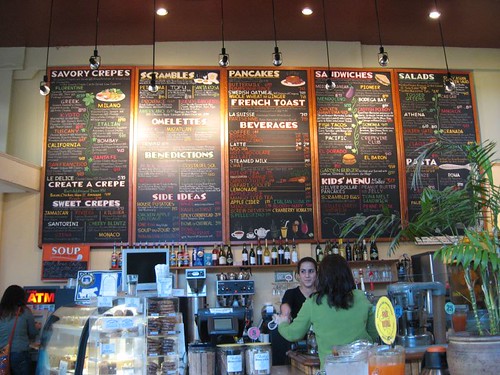 the Crepevine in San Francisco, |
| Grateful Bread of Seattle, and |
| Jonathan Livingston Seafood of Chicago |
| to places whose names leave you wondering: |
| Eaton Gogh in Norfolk, Virginia, |
| The Hearty Boys of Chicago, and |
 The Perfect Wife, Manchester, Vermont |
| these and a hundred more all here for your bemusement! |
|
|
2.5 |
 Introducing the pStyle: a device to enable women to pee comfortably standing up
|
|
2.5 |
 How about this one from Mirna in Eastern Siberia: the Mirny Diamond Mine: 525 meters deep and 1.25 km in diameter! Air currents, due to convection, are so strong above the mine, that several helicopters have crashed. So at this time, all flights above the hole are being prohibited! |
 Or the Kimberley Big Hole in South Africa: Reportedly the largest hand-dug excavation in the world. 1097 meters--a bit over five-eighths of a mile--deep. |
 The Bingham Canyon Mine southwest of Salt Lake City in Utah. (According to Wikipedia, "As of 2004, ore from the mine has yielded more than 17 million tons (15.4 Mt) of copper, 23 million ounces (715 t) of gold, 190 million ounces (5,900 t) of silver, and 850 million pounds (386 kt) of molybdenum. The gold and silver are impurities removed from the copper during refining. The value of the resources extracted from the Bingham Canyon Mine is greater than the Comstock Lode, Klondike, and California gold rush mining regions combined." |
 And then, finally, this pretty one: the Great Blue Hole in Belize--close to a quarter mile across and 145 meters deep in the center. |
|
|
2.5 |
 I've been working on a "200-year plan" for our family on my StrategicInheritance.com website. In one of my recent posts, "numbering our days"--simply beginning our plan with an acknowledgment of approximately how long we might expect to live
 One weakness in the site: it doesn't tell you how many seconds in a week (604,800), a month (approximately 2.5 million), or a year (31.5 million). So I could easily calculate that I'm looking at only about 20 more years, based on somebody's actuarial averages. (That sounds low to me--it has me dying at 74 years of age; but whether it's a bit low or about right, it's eye-opening.)
 Even if I live to an "optimistic" age of not-quite-87, it's still eye-opening.
 Reduce your BMI (Body Mass Index) below 25. [The site even includes a handy BMI calculator.]
|
|
2.5 |
It’s the most famous chord in rock 'n' roll, an instantly recognizable twang rolling through the open strings on George Harrison’s 12-string Rickenbacker. It evokes a Pavlovian response from music fans as they sing along to the refrain that follows:Professor Jason Brown of Dalhousie University’s Department of Mathematics decided to apply a mathematical calculation known as a Fourier transform to solve the problem"It’s been a hard day’s nightThe opening chord to "A Hard Day’s Night" is also famous because, for 40 years, no one quite knew exactly what chord Harrison was playing.
And I’ve been working like a dog"
The resulting chord was completely different than anything found in the literature about the song to date, which is one reason why Dr. Brown’s findings garnered international attention. He laughs that he may be the only mathematician ever to be published in Guitar Player magazine.For the full technical presentation of Brown's triumph, see CHAAAAAAAAG...It's been a hard day's night! and, perhaps, Wired's How Math Unraveled the 'Hard Day's Night' Mystery.
|
|
2.5 |
According to most historians and economists, that depression had more to do with over-large factory inventories, a stock-market crash, and Germany's inability to pay back war debts, which then led to continuing strain on British gold reserves. None of those factors is really an issue now.I found the details Nelson puts forward quite fascinating
Contemporary industries have very sensitive controls for trimming production as consumption declines; our current stock-market dip followed bank problems that emerged more than a year ago; and there are no serious international problems with gold reserves, simply because banks no longer peg their lending to them.
In fact, the current economic woes look a lot like what my 96-year-old grandmother still calls "the real Great Depression." She pinched pennies in the 1930s, but she says that times were not nearly so bad as the depression her grandparents went through. That crash came in 1873 and lasted more than four years. It looks much more like our current crisis.
|
|
2.5 |
|
|
2.5 |
|
|
2.5 |
In Germany, when Hitler came to power, it was a time of terrible financial depression. Money was worth nothing. In Germany people lost homes and jobs, just like in the American Depression in the 1930s, which we have read about in [Bodie and Brock] Thoene’s Shiloh books.Read more here.
In those days, in my homeland, Adolph Hitler was elected to power by promising “Change.”
He blamed the “Zionists” around the world for all our problems. He told everyone it was greedy Zionist Bankers who had caused every problem we had. He promised when he was leader, the greedy Zionist bankers would be punished. The Zionists, he promised, would be wiped off the face of the earth.
So Hitler was elected. . . .
Yes. Change came to my homeland as the new leader promised it would.
The teachers in German schools began to teach the children to sing songs in praise of Hitler. This was the beginning of the Hitler Youth movement. It began with praise of the Fuhrer’s programs on the lips of innocent children. Hymns in praise of Hitler and his programs were being sung in the schoolrooms and in the playyard. Little girls and boys joined hands and sang these songs as they walked home from school. . . .
|
|
2.5 |

|
|
2.5 |
“We have a good deal of comfort about the capital cushions at these firms at the moment,” [said] Christopher Cox, chairman of the Securities and Exchange Commission, [on] March 11, 2008.Read the story of an April 28, 2004, meeting of the five-member Securities & Exchange Commission at which the biggest brokerage and banking houses asked for an exemption for their brokerage units from an old regulation that limited the amount of debt they could take on.
As rumors swirled that Bear Stearns faced imminent collapse in early March, Christopher Cox was told by his staff that Bear Stearns had $17 billion in cash and other assets — more than enough to weather the storm.
[But then, d]rained of most of its cash three days later, Bear Stearns was forced into a hastily arranged marriage with JPMorgan Chase — backed by a $29 billion taxpayer dowry.
Within six months, other lions of Wall Street would also either disappear or transform themselves to survive the financial maelstrom — Merrill Lynch sold itself to Bank of America, Lehman Brothers filed for bankruptcy protection, and Goldman Sachs and Morgan Stanley converted to commercial banks.
How could Mr. Cox have been so wrong?
One commissioner, Harvey J. Goldschmid, questioned the staff about the consequences of the proposed exemption. It would only be available for the largest firms, he was reassuringly told — those with assets greater than $5 billion.In other words, if the market declined by only 3%, Bear Stearns would become completely devoid of all assets.
“We’ve said these are the big guys,” Mr. Goldschmid said, provoking nervous laughter, “but that means if anything goes wrong, it’s going to be an awfully big mess.” . . .
After 55 minutes of discussion, which can now be heard on the Web sites of the agency and The Times, the chairman, William H. Donaldson, a veteran Wall Street executive, called for a vote. It was unanimous. The decision, changing what was known as the net capital rule, was completed and published in The Federal Register a few months later.
With that, the five big independent investment firms were unleashed.
In loosening the capital rules, which are supposed to provide a buffer in turbulent times, the agency also decided to rely on the firms’ own computer models for determining the riskiness of investments, essentially outsourcing the job of monitoring risk to the banks themselves.
Over the following months and years, each of the firms would take advantage of the looser rules. At Bear Stearns, the leverage ratio — a measurement of how much the firm was borrowing compared to its total assets — rose sharply, to 33 to 1. In other words, for every dollar in equity, it had $33 of debt.
|
|
2.5 |
|
|
2.5 |


|
|
2.5 |
Merrill Lynch & Co., UBS AG and JPMorgan & Chase Co. are telling senior bankers in Asia to fly coach on short-haul flights and reduce non-essential travel as they step up cost cuts, officials at the firms said.And so it goes.
UBS advised bankers this month to travel economy class for flights of up to five hours, two officials at the biggest Swiss bank said, asking not to be identified because it's an internal policy. Merrill employees have been told to travel economy for flights of as much as three hours since mid-September, two executives at the firm said. . . .
JPMorgan, the biggest U.S. bank, has requested senior bankers fly economy on flights of less than three hours since late August, said an official who declined to be identified. . . .
Royal Bank of Scotland Plc, which ceded majority control to the U.K. government this month, in an Oct. 16 memo asked workers worldwide to fly economy on regional routes and to cut back on travel, said an RBS banker who's seen the document. RBS spokeswoman Hui Yukmin declined to comment.
HSBC Holdings Plc's Asia unit asked its Hong Kong department heads and branch managers to cut travel expenses by 15 percent to 20 percent next year, two officials at the bank said, citing a Sept. 23 memo sent by Chief Operating Officer Jon Addis. . . .
|
|
2.5 |
Greetings!Check it out!
We all bring our instinctive, conative talents to our jobs. John McCain and Barack Obama are no exception, but do we know who they are?
Kolbe Corp's new website, www.presidentialinstincts.com, is a fun way for you to say how you think the candidates solve problems, and to see what others are saying.
Although we're sprinkling some science into our approach, we aren't claiming the results are scientific – just compelling. You can see how other people voted based on age, gender, race and who they plan to vote for in the election. Since the results are continuously updated, you'll be able to see any potential shifts in the electorate as we get closer to Election Day.
We aren't endorsing or supporting either candidate. We're just curious to see how you and others view them. You can decide whether you agree or disagree with the results, and whether it will affect your vote on November 4th. We hope that by focusing on instinctive talents, people who visit the survey can find something positive about both candidates.
Maybe Senators Obama and McCain will take us up on our offer to get their Kolbe results for free so each can better understand this part of what will drive his success should he have the honor of being our next President.
I encourage you to take a moment to cast your ballot at www.presidentialinstincts.com. It will change the way you look at selecting people for a job, including the upcoming opening in the Oval Office.
Sincerely,
David Kolbe
CEO, Kolbe Corp
|
|
2.5 |


