Showing posts with label history. Show all posts

Thursday, July 21, 2011

Precision . . . Corrections . . . and Apologies

As someone who deals with words, I was struck by this article from The Atlantic.
Osama bin Laden was dead, and Frank Lindh -- father of John Walker Lindh, the "American Taliban" -- had been invited on [San Francisco's KQED Forum show] to discuss a New York Times op-ed piece he'd just published about his son's 20-year prison sentence. The moment host Dave Iverson completed his introduction about the politically and emotionally charged case, Lindh cut in: "Can I add a really important correction to what you just said?"

Iverson had just described John Walker Lindh's 2002 guilty plea as "one count of providing services to a terrorist organization." That, Frank Lindh said, was simply wrong.

Yes, his son had pled guilty to providing services to the Taliban, in whose army he had enlisted. Doing so was a crime because the Taliban government was under U.S. economic sanctions for harboring Al Qaeda. But the Taliban was not (and has never been) classified by the U.S. government as a terrorist organization itself.

This distinction might seem picayune. But it cut to the heart of the disagreement between Americans who have viewed John Walker Lindh as a traitor and a terrorist and those, like his father, who believe he was a fervent Muslim who never intended to take up arms against his own country.

That morning, the clash over this one fact set host and guest on a collision course for the remainder of the 30-minute interview. . . . The collision was set in motion nine years before by 14 erroneous words in the New York Times.
The 14 erroneous words? "Mr. Lindh agreed to plead guilty to one of the 10 counts in the indictment against him. It charged he had provided service to the Taliban, which is a felony because President Bush and former President Bill Clinton had declared the party a terrorist organization."

Reality: Neither president, Bush or Clinton, ever formally declared the Taliban to be a terrorist organization. Okay. But in most Americans' minds, does it really matter whether the Taliban was formally declared to be a terrorist organization? After all, the Taliban gave Al Qaeda a haven and Al Qaeda attacked the United States. So aren't we merely splitting hairs to try to distinguish whether the Taliban was a terrorist organization?

Absolutely not! says Frank Lindh.
"It is no small thing to accuse a person of being a terrorist, or of providing assistance to or conspiring with a terrorist organization. . . . It's basically calling the person a murderer." His son, John, maintained that his purpose in joining the Taliban army had been to defend Muslim civilians from attacks by the insurgents who would later come to be known as the U.S.-allied Northern Alliance.

The record of the Lindh legal proceeding shows that federal prosecutors wanted very badly to hang the "terrorist" label on Lindh, but they [didn't]: either they didn't have the evidence, or they had some other reason to drop all of the terrorism-related charges. As New York Times Justice Department correspondent David Johnston reported in a front page companion piece to [the] story [that contained the error], U.S. officials "had grown skeptical that Mr. Lindh played any meaningful role in Islamic terrorism." They allowed Lindh to limit his guilty plea to two violations of the Taliban economic sanctions.

Lindh's statement to the court carefully maintained this distinction. He said: "I provided my services as a soldier to the Taliban last year from about August to December. In the course of doing so, I carried a rifle and two grenades. I did so knowingly and willingly knowing that it was illegal."

The [Times'] mistaken description of the Taliban as a federally sanctioned terrorist organization was therefore far from a minor detail. For Lindh and his sympathizers, it was the crux of the story.
Besides the fine legal distinction, I am intrigued by The Atlantic article's discussion about making corrections in news stories online.
After the KQED show hoisted the mistake into the spotlight, MediaBugs, an online service for recording and fixing problems in news coverage, filed an error report and contacted the Times about the matter. And within a week, the Times had corrected the error--in a way.

If you look up that July 16, 2002, story today, you find the words "correction appended" inserted, a little awkwardly, between the byline and the first paragraph. And if you press "next page" three more times to get to the conclusion of the story and scroll all the way down, you'll find the following notice:
"Correction: This article gives an imprecise explanation for why providing assistance to the Taliban was a felony. Executive orders by Presidents Bill Clinton and George Bush forbade such assistance because the Taliban was considered a threat to the United States and had provided haven to Al Qaeda, but those orders did not declare the Taliban to be a terrorist organization. (The error was brought to The Times's attention after related news reports in June 2011.)"
One might quibble with this wording's halfhearted walk-back: After all, the article's explanation wasn't "imprecise" -- it was wrong. But correction notices have a long history of defensive phrasing; minimizing your missteps is human nature. The main thing is that the Times noted, and corrected, its goof.
Or is it?

I noted a similar problem with a young-earth creationist site that modified and, from my perspective, wildly misrepresented something Charles Spurgeon once said in a sermon. (See Honesty . . . it's such a lonely word . . . and Editorial license.)

As I complained there, so the author of the Atlantic article complains in his article: the Times' correction is way too difficult to find. Indeed, it almost begs to be ignored:
[T]he paper did not edit the story's original text to reflect the correction. The same erroneous 14 words still sit, live, on the Times' website. To learn that they've been superseded, you have to click through three more pages. (Or, if you're really unlucky, Google might send you to a different version of the same story that shows no trace at all of any correction.)

Philip Corbett, the Times' associate managing editor for standards, explained in an email, "For practical and technical reasons in this case, we decided simply to append the correction, rather than trying to rewrite a passage in a nine-year-old article." (Editor's note: The Atlantic approaches corrections on a case-by-case basis. However, in a similar situation, we would probably leave the original wording intact but provide a linked asterisk at that spot in the text, which would take you to the full correction at the end of the piece.)

Is that enough? Corrections expert Craig Silverman, author of the book and blog "Regret the Error" and Columbia Journalism Review columnist (he is also an adviser to MediaBugs), doesn't think so.

"If you only read the first two pages of that story," Silverman says, "you're not going to get to the correction, and you're going to get the mistaken piece of information, and so it's just not effective. That's a very long article. What percent of people are going to read to the end of that and get to the correction, or even know that 'correction appended' means that it's necessarily on the exact last page? The basic principle of 'Let's make sure that this error stops spreading' is not really being upheld here."

Institutions like the Times honed their correction practices in the age of print, when appending a notice was the best feasible option. But an always-available digital page is also always editable -- and is part of a rapidly evolving news ecosystem in which stopping the spread of misinformation is more important [than] ever. Post-publication edits can uphold that principle without being furtive or seeming to rewrite history. Any changes to long-published articles can be made transparently, either in the text of an accompanying correction notice or in an archive of previous story versions.
So how should newspaper editors take care of errors in news stories? (According to a study referenced by the Atlantic author, "59 percent of local news and feature stories were found by news sources to have at least one error.")

"For starters," writes Atlantic author,
[editors] can demonstrate that they invite and welcome pointers to potential errors from readers. Today's stance -- "we're willing to consider fixing our mistakes if you hunt down our contact information and pester us" -- is too passive. But it can be upgraded to an active pursuit of truth via some simple interface changes on a news website. Put a button on every page of every story, current and archived, that says "Report an error" -- and then follow up on what the public tells you. Think of this as a customer service feedback loop, or a quality-control system. That's how the most efficient large businesses that produce software or cars run their operations today; surely the information we use to run our society deserves at least as much care.
There's more at TheAtlantic.com and on the KQED webpage dedicated to the Frank Lindh interview. (I encourage you, especially, to read the Listener Comments.)

Monday, May 23, 2011

"Kicking the can"

I thought I would post some of the most recent inputs I've been receiving about our government's failure to address the financial crisis.

From Dr. Gary North (5/17/2011):
The worst crisis from the government's point of view is the national debt crisis. It leads to calls for reduced government spending. For this crisis, the government has this well-orchestrated response:
  1. An admission that it is real, but not imminent
     
  2. A promise to deal with it later
     
  3. A call to spend more now to spend less later
     
  4. Kabuki theater [According to Wikipedia: "classical Japanese dance-drama . . . known for the stylization of its drama and for the elaborate make-up worn by some of its performers. . . . (The word) kabuki can be interpreted as "avant-garde" or "bizarre" theatre. The expression kabukimono (歌舞伎者) referred originally to those who were bizarrely dressed and swaggered on a street."]
This week, the issue of the U.S. government's debt ceiling comes up for discussion in Congress. The Secretary of the Treasury has offered a dire forecast. There will be a double-dip recession unless Congress votes to raise the debt ceiling once again. Congress does this every year, but this year there is pressure from new House members not to raise the ceiling. Meanwhile, the government is in the middle of a $1.65 trillion on-budget deficit. Like a tornado, the deficit will hit the political will of Congress. There is no basement storm shelter. There is no safe room.

Congress's will to resist will be flattened, as it is every year. Usually, this vote has been pro forma. The media may mention it, but not as a prime-time story. It is always assumed that Congress will rubber stamp the proposed increase, in order to avoid a partial shutdown of the government -- maybe 10% of operations. For Congress, this is regarded as a level-5 tornado, not a squall.

The debt limit will be reached this week. Geithner says that he can juggle accounts until August, but at that point, the government will have to default -- the big D.

Speaker of the House Boehner has said that there will be a hike in the debt ceiling, but it will be a very special kind of increase. He said on the CBS Sunday morning news show, Face the Nation, that "we're going to do it in a way that addresses America's long-term fiscal challenges." . . .

In a previously recorded segment of the show, President Obama invoked what has become a familiar refrain: the recurrence of the 2008 crisis. If investors ever "thought the full faith and credit of the U.S. was not being backed up, if they thought we might renege on our IOUs, it could unravel the entire financial system. We could have a worse recession than we've already had."

Of course, neither Boehner nor Obama mentioned the possibility of cutting Federal spending in order to balance the budget this year and thereby avoid having to raise the debt ceiling ever again. Such a strategy is too radical. The proposed official solution is to raise the ceiling again, and to promise that this will not always be necessary, because economic growth will raise tax revenues One of These Days, Real Soon Now. The budget will be balanced. The recession will not arrive. They promise.

This year is different. The discussion is front-page, prime-time news. This is because a handful of first-term Congressional Republicans in the House are making noises about cutting spending in order to reduce the size of the increase. They don't have the votes, as we will see. These Congressmen say publicly that they see what is economically necessary, but economics has little influence in Congress. The majority of the members think they can kick the can down the road for another year. In 2012, they will all campaign on responsible spending. The operational definition of "responsible spending" never changes: "kick the can again."

DEFAULT IS COMING

In his interview in front of an audience, President Obama warned about the consequences of a default by the U.S. government. It could unravel the worldwide economic recovery. You can see the video here.

He is correct. If the Federal government ever stops paying interest on its debt, the repercussions in the financial markets would be severe. It would be worse than the crisis in the fall of 2008.

The problem we face is this: with every increase in the Federal debt ceiling, the likelihood of default increases. The politicians' solution to the threat of default is to delay the default.

The government is trapped. It really does face the prospects of default if the debt ceiling is not raised. The alternative is to cut spending drastically before August. But that would be a form of default. Certain groups that have been promised largesse from the Federal government would find that the promises were not binding.

The problem is now selective default. The Congress and the White House always agree to defer any form of default. This is why we can be sure that selective default is inevitable. The deficit numbers do not allow the government to escape the increase in the debt ceiling.

We know from decades of experience that selective defaults are not politically acceptable. So, the deficit keeps growing. The debt ceiling keeps getting raised. This is done in the name of default-avoidance.

The battle over the debt ceiling is a sham. If Congress cannot legislate spending cuts that will balance the budget, then there is no possibility that it will put a cap on total expenditures by means of a debt ceiling. There was no significant reduction in the deficit earlier this year. The deficit in fact rose compared to last year's forecast.

This is why the debate over the deficit is American kabuki theater. It is a way to score debate points for next year's elections. Candidates will be looking for published statements of incumbents' opinion on the debt ceiling. Everyone in Congress wants to position himself or herself as taking the responsible path to national prosperity.

The problem they face is this: to cut the deficit specifically is to alienate voting blocs that are dependent on transfer payments from the Federal government. They refuse to make specific cuts for this reason.

Each political party is more afraid of the alienation of specific voting blocs than it is with the general threat of the debt ceiling as a political issue. So, they do not specify what must be cut. Therefore, nothing will be cut.

An interviewer who wants to sink a candidate asks him to identify what programs he recommends cutting. The candidate mumbles.

Boehner said that everything should be on the table except raising taxes. This plays well to conservative voters. But where is this table? Whenever the debate over the annual budget gets laid on the table, the specific cuts are not made.

Boehner says we must now look at "the big picture." Indeed, we should. But Congress never does. Congressmen look at the small picture: the swing voters in their districts. These voters can usually make or break a re-election campaign. So, the Congressman seeks to retain the swing voters who elected him two years earlier while not losing his core constituency. He does not want voters to defect to his rival. So, he dares not propose specific cuts. Specific cuts alienate specific swing voters.

He said that Congress must not kick the can. But he announced that it must kick the can on the debt ceiling this time. When a politician says that Congress must not kick the can, but then says it must kick the can this time, so that it won't have to kick it next time, he is saying that Congress will kick the can.
And this from Porter Stansberry (I hate his (and so many other internet marketers') videos; they take way too long to "watch"/listen to them. So if you wait till the video starts, then hit the "Close Window" X button, you will be given the opportunity to stay on the page. Click "Cancel" and you will be able to read a full typescript of the video.) Here's just a small portion of Stansberry's longer presentation:
as late as the 1970s, America was the world's largest creditor. But by the mid-1980s we'd become a debtor to the world. And since the late 1990s we've been the world's LARGEST debtor.

Today, our government owes more money to more people than anyone else in the world.

And that was before the financial crisis!

With all of these bad debts piling up, we've had to begin repaying our debts by printing trillions of new dollars. And now, finally, the impact of this is being felt in a big way.

As our creditors continue to figure out what's happening, we're going to have very, very big problems.

I believe our creditors (which includes foreign countries and other investors here and abroad) will either completely stop accepting dollars in repayment... or greatly discount the value of these new dollars. I'm sure you think that sounds crazy, but as I'll show you, it is already happening.

This will make our consumption-led way of life impossible to afford.

And I'm confident it will lead to an end of the U.S. dollar standard.

Keep in mind, the U.S. dollar has been the world's reserve currency for decades now... so most Americans don't have a clue about what the repercussions are of losing this status.

And maybe you think it could never happen... but the truth is, this is exactly what happens when countries get too far in debt or when they consume too much or produce too little.

In fact, the exact same thing happened to Great Britain in the 1970s.

Most people don't know this, but British Sterling was the reserve currency for most of the world for nearly 200 years... for most of the 18th and 19th centuries.

It continued to play this role until after World War II, when America was forced to prop up Britain's economy with foreign aid – remember the famous Marshall Plan, when we gave billions to help European countries rebuild?

Unfortunately though, Britain pursued a socialist national agenda. The government took over all of the major industries. Like Barack Obama, Britain's leaders wanted to "spread the wealth around." Pretty soon the country was flat broke.

The final straw for Britain came in 1967, when things got so bad the Labour Party (the socialists) decided to "devalue" the British currency by 14%, overnight. They believed this would make it easier for people to afford their debts.

In reality, what it did was make anyone holding British sterling 14% poorer, overnight, and it made everything in Britain, much, much more expensive in the coming years.

And for the country as a whole, it ushered in one of the worst decades in modern British history.

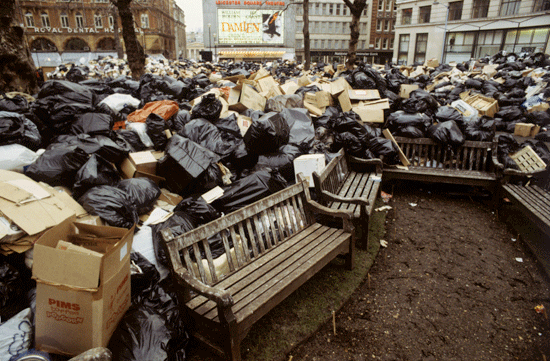
Most Americans don't know about Britain's "Winter of Discontent" in the late 1970s, when the government put a freeze on wages. There were continuous strikes in nearly every sector... grave diggers, trash collectors... even hospital workers. Things got so bad at one point that many hospitals were reduced to accepting emergency patients only.

In 1975, inflation in Britain skyrocketed 26.9%... in a single year!

The government also imposed what was known as the "Three Day Week" in 1974. In short, businesses were limited to using electricity for only three specified consecutive days' each week and they were prohibited from working longer hours on those days. Television companies were required to cease broadcasting at 10:30pm... to save electricity.

The extreme problems in the economy led to Britain being nicknamed, "the sick man of Europe."

Just how bad were things, exactly?

Well, here's a photo of the garbage that piled up because they didn't have enough money to pay trash collectors a fair wage...


And here's what John Blackburn, from Wetherby, recently told the BBC television channel about his experience during this period...

John Blackburn, from Wetherby said:
"I was a control engineer at Huddersfield Power Station at the time and part of my duty was to switch off the supply to various substations around the town, according to an official rota. On many an evening shift I would have to switch off the power to my own home before going back for a candle-lit supper!"


Imagine... Britain was a global superpower for 150 years. But when they started intentionally devaluing their currency, things went straight down hill.

Maybe you don't think something similar can happen here... but I'm telling you... it's already underway!

In fact, the exchange value of the U.S. dollar has fallen about 13% since June 2010. And its rate of decline is accelerating.

What happened to the British currency is now happening to the U.S. dollar.

As Barron's recently reported:
"When the monetary history...is written decades from now...2010 could be a watershed marking the beginning of the end of the dollar-based, Western-centric monetary system."
As the U.S. dollar continues to lose its position as the world's currency, gas, oil, and other commodities will continue to skyrocket. Almost EVERYTHING we consume will immediately get more expensive. All the clothing, furniture, and household goods we import from China.

All the food we get from Central and South America... all the electronics, televisions, computers, and cars we get from Asia and Europe. In fact, it's happening, right now before our eyes.

Everything is getting more expensive...

In fact, each week, The Wall Street Journal has a section called �Cash Prices.' It lists dozens of commodities, everything from wool, zinc, tin and pork... to gold, silver, platinum, and lead.

I recently checked these listings in the paper's March 1st, 2011 edition. And the numbers were mind-boggling...

In short, of the 88 prices quoted ... 85 items are more expensive today than they were just a year ago... many significantly so.

Oil is up more than 50% from a year ago. Silver is up more than 100%–so is cotton, and coffee. Tin is up 90%. Oats are up more than 70%. So is wheat. Butter is up more than 40%. So is sugar.

Again, of the 88 prices quoted, the only three physical commodities that are cheaper today than they were a year ago... natural gas, eggs, and chickens.

Everything is more expensive! In some cases... MUCH more expensive.

And yet the government says there is no inflation? How is that possible?

It's unbelievable to me that they think the American public is going to fall for this.

U.S. businesses have certainly caught on...

As Wesley Card, the head of a clothing company that includes brands like Dockers and Anne Klein, recently said: "It's really a no-choice situation. Prices have to come up."

And when you look back further than a year, the numbers are even more startling...

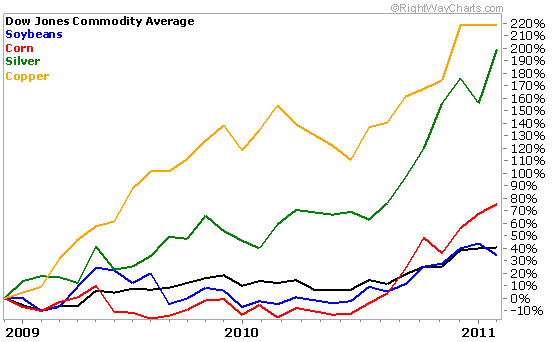
The chart below shows how much a few key commodities have skyrocketed in price, just since the beginning of 2009...


And the point here is simple: As we print more money, the price of the world's most essential commodities have soared. This is NOT a coincidence.

Around the world, as we print, prices soar... citizens protest... governments get overthrown. And it's only going to get worse...

Because we can NOT stop printing because we can't actually afford our existing debts. No one wants you to know this. No one.

That's why, despite the obvious inflation going on all around the world, the Fed continues to say there's no inflation at all.

And that's the scary part, to me. Just like in a Banana Republic, the government is radically devaluing the dollar and totally lying to everyone about what is really happening.

Whether you realize it or not, there is already a "run" on the dollar. Many of our creditors, like the Chinese, are getting out of the dollar as fast as they can via strategic commodities, like copper. That's partly why commodity prices are soaring.

Unfortunately, skyrocketing commodity prices are just the beginning.

There are other disastrous consequences to the U.S. dollar losing status as the world's currency...

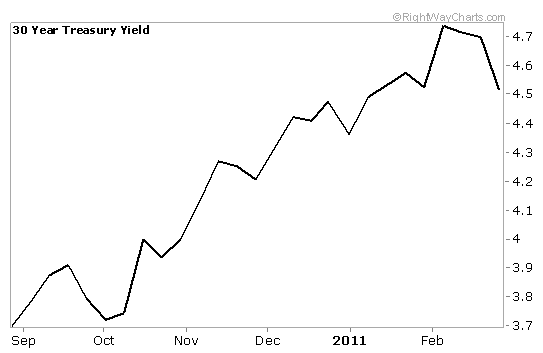
For example, there would be much less demand for U.S. dollars around the globe, so interest rates will skyrocket. Already, just look how quickly rates have moved up in recent months...


Instead of getting a mortgage at today's low rates of 5%, it may soon cost you 8% or even 10% or 15%.

Imagine what that would do to housing prices!

Stock prices will likely plummet by at least 40% in a matter of weeks as a result of this event in the currency markets.

It will cost every American business A LOT more money for supplies and materials. No one will be able to get a loan... and no bank will want to make loans.

In short, when the U.S. dollar loses its spot as the world's 'reserve currency,' it will cause a brutal downturn in the economy, which I expect will be about 10-times worse than the mortgage crisis of 2008.

As Barron's recently reported:

"The demand for dollars from the rest of the world has been of inestimable benefit to the U.S. economy. It quite simply allows Americans to consume more than they produce and save less than they invest; in other words, to live beyond our means."

You see, what will also happen as a result of this currency crisis, and the end of the U.S. dollar as the world's reserve currency, will be massive inflation, the likes of which we have never seen before.

When everyone is trying to get rid of their dollars, the government is printing more and more to pay debts, and no one wants to own them, the crisis will reach epic proportions.

Just look, for example, at what happened to one European country that faced this type of crisis in the 1990s...

This is what happens during a major hyperinflation in the real world.

The World's Most
Expensive Loaf of Bread

In the early 1990s, the national government of one European nation had spent nearly all its savings. So what did they do next? Simple... they began to steal the savings of private citizens by limiting people's access to their money in government-controlled banks.

And of course, to finance the daily operations of maintaining their basic infrastructure, they started printing money, big time. Even so, the country's basic infrastructure began to fall apart. There were potholes in the street, broken water pipes... elevators that never got repaired... and entire construction projects that simply shut down, before being completed.

The unemployment rate was more than 30%... and the government just kept printing money.

As San Jose State University Economics Professor Dr. Thayer Watkins, an expert on countries that try to inflate their way out of big debts, wrote on this particular disaster:

"The government tried to counter the inflation by imposing price controls. But when inflation continued, the government price controls made the price producers were getting so ridiculously low that they simply stopped producing. bakers stopped making bread... slaughterhouses refused to sell meat to the stores... other stores closed down"

So what did the government do next to try to curb inflation?

Well, one bright idea they had was to force stores to fill out government documents every time they increased prices. They thought that this would slow down price increases, because the paperwork would take so much time!

But like many government plans, this one had terrible, unintended consequences.

Since stores had to dedicate an employee to do nothing but register this paperwork, and since the process took so long, stores began to raise prices on basic goods at even higher rates, so that they didn't have to come back and file more paperwork!

Incredible, isn't it?

So next the government created a new currency... which basically removed six zeroes from the old one. So 100,000,000 old units were soon worth 100 new units. Of course, this didn't work either... it never does.

Between October of 1993 and January 1995, prices increase by, get this: 5 quadrillion percent. That's...

5,000,000,000,000,000%

In other words, a loaf of bread that cost $1 in 1993, suddenly cost

$50,000,000,000,001

Yes, that's $50 TRILLION.

I know, it's laughable... but I can guarantee that the people of this once proud European country weren't laughing one bit, especially those living on a fixed income.

[John's comment: "1993 to 1995"? I hadn't heard of this hyperinflation. Maybe Stansberry got his dates mixed up? He's pulling our leg? What's he talking about? . . . I did a Google search on inflation five quadrillion percent.

Oh! A paper by Dr. Watkins popped right up! --Yugoslavia. "The worst episode of hyperinflation in world history," says Dr. Watkins.

So now I can add Yugoslavia to my list of country's of whose hyperinflation I'm aware: Germany, Argentina, Chile, Vietnam, and so many others.

And we in the U.S. think we're going to escape?]

Of course, at this point, the country completely fell apart. As Dr. Thayer Watkins wrote:

"The social structure began to collapse. Thieves robbed hospitals and clinics of scarce pharmaceuticals and then sold them in front of the same places they robbed. The railway workers went on strike and closed down the country's rail system."

At this point, businesses and citizens across the country basically refused to take the local currency.

Instead, everyone started dealing in German Marks. Keep in mind, the daily rate of inflation was nearly 100%.

Can you imagine the panic in a society when the price of just about everything doubles... every single day? It was absolute pandemonium, and the economy basically came to a grinding halt. It was like living in a war zone. Truckers stopped delivering goods. Stores, restaurants, and gas stations all shut down.

In another ridiculous government move, the government actually made it illegal to NOT accept a personal check.

Imagine... you could write a check... and in the several days that it typically takes for a check to clear, inflation would wipe out almost all of the cost of covering your check.

Of course, as is typical, the government took none of the blame. As Dr. Thayer Watkins reported, the government's official position was that the hyperinflation occurred "because of the unjustly implemented sanctions against the people and state."

Again... I know what you are thinking... "just because it happened in Europe doesn't it mean it can happen here, right"?

Well guess what...

The same thing that happened in this European country – Yugoslavia – also just happened in Iceland and Greece, but on a less dramatic scale. . . .
And then there is Martin Weiss who asks--and answers in the assertive: Will the U.S. default? Is it really possible?

It's not only possible, it is already happening. They're just hiding it. Kind of.

Take a look.
*******


Okay. So we've got all these screaming "the sky is falling" disaster pundits. What is a nice, sane, reasonable person supposed to do?

I'd say, first of all, you want to get educated about this stuff.

Read Weiss' article. He makes some solid suggestions.

Read the rest of Stansberry's lengthy article. He concludes with several practical suggestions, including an appeal to subscribe to one of his newsletters.

Maybe you would like to read The Hyperinflation Survival Guide published at the behest of Harry E Figgie, Jr, the CEO of Figgie International, Inc., back in the late '80s. --I wrote about it back in November.

Come to think about it, maybe you'd even like to read some of my past posts about hyperinflation here on my John's Corner blog.

Funny how one's own "ancient history" can come back to life!

I don't remember how I found this last week. But I was stunned. I didn't know (or, I guess I should say, I didn't remember!) that such an interview even existed, much less that someone might have a record of it.

I had little doubt I was the only male secretary, or only one of very few male secretaries at MSU. But I had no idea until I saw the title of the recording that I was the only one of 1400 secretaries.

I wonder what I said in that interview?

Brings back memories of an interesting time in my life!

Tuesday, November 30, 2010

"That we may never forget . . ."

As the son of a Holocaust survivor, I receive from my dad little reminders every now and then of things like the following story. I think they are worth remembering no matter what your religious persuasion.

Who are the heroes of any age?

Irena Sendlerowa would make a good one.


Sendlerowa, more commonly known as Irena Sendler, died in May 2008 at the age of 98.

Why should we remember her? Here's her story, in brief:

During the Nazi occupation of Poland during World War II, Irena helped smuggle Jews out of the Warsaw Ghetto. She used various means. She smuggled some babies in the bottom of a tool box she carried. She placed some older children in a burlap sack that she had in the back of a truck she borrowed. A couple of times she took a dog with her to bark when the Nazi soldiers let her in and out of the ghetto.

The soldiers of course would want nothing to do with the dog, and, hopefully, the barking would also cover any inadvertent noises the children might make.

Over the course of a little more than three months in the summer of 1942, she managed to smuggle out and save close to a thousand children and adults.

Eventually Irena was caught, and the Nazis tortured her and fractured one of her legs and a foot.

Irena kept a record of the names of many of the children she smuggled out and kept them in glass jars, buried under an apple tree in her friend's back yard. After the war, she and the others from the group with whom she worked (there were 24 women and a man) tried to reunite the families of the almost 2500 people they had saved. Sadly, few were able to be reunited because so many family members had died at Treblinka.

Today she is remembered through a play called Life in a Jar.

*******

In the original email that alerted me to Irena's life, the author attached this cartoon by Wiley Miller and commented,
It is now more than 60 years after the Second World War in Europe ended. This e-mail is being sent as a memorial chain, in memory of the six million Jews, 20 million Russians, 10 million Christians and 1,900 Catholic priests who were murdered. Now, more than ever, with Iran and others claiming the Holocaust to be 'a myth,' it's imperative to make sure the world never forgets, because there are others who would like to do it again.

This e-mail is intended to reach 40 million people worldwide!

Join us and be a link in the memorial chain and help us distribute it around the world.

Please send this e-mail to people you know and ask them to continue the memorial chain.
It is with that intention in mind that I did my own research, discovered many errors in the original email (but a fair enough conglomeration of facts) and determined to make this post.

Sunday, August 01, 2010

Taking a survey about world leaders during WWII gets me thinking . . .

An acquaintance of mine wrote on Friday:
I have a theory about Americans' opinions about dictators in other countries, so I'll be using a series of online surveys to see if my hunch is correct. If you think you or your children might find my first survey interesting, please take a look at it. I'm asking few demographic questions so as to not cause any privacy concerns. Thanks.
I took it. I think it may have required about 10 minutes of my time, all told.

The majority of the questions were of the form, "Who was worse, _________ or ________?"

For most of the pairs I had no difficulties answering. But there were a number that caused me to scratch my head.

For example, "Who was worse: Hirohito or Hitler?"

I got thinking:
  • How much of my opinion is based on familiarity? (I know of both men; I am at least somewhat familiar with both men; but am I biased toward viewing Hitler as "worse" because his atrocities impacted "my people" while Hirohito's atrocities impacted "others" [particularly the Chinese and Koreans--of which atrocities I am aware but with which I am rather less familiar], and, therefore, am I more likely to judge Hitler more harshly than I will Hirohito?)
And then this thought:
  • How much of my (or anyone's) perception is a result of the particular leader's mere opportunity to do evil (he happened to rule a large and/or already powerful country) and how much was the result of some kind of megalomaniacal internal commitment to wicked behavior? . . .
     
  • And so forth.
Take the survey yourself and tell me what you think.

By the way, the author of the survey is a woman in her 20s. I asked her if she would provide a little explanation of what she is hoping to do with the survey, what she hopes to achieve . . . as well as explain how participants might hear of her survey's results. Here is her response.

Friday, April 02, 2010

I thought he was "green." So what's with the sudden move to open oil fields?

Perhaps you were as surprised as I was when President Obama announced his intentions to open huge new oil fields off the coast of the United States.

You can be sure of this, writes Keith Fitz-Gerald of Money Morning, it "has nothing to do with oil. It's all about the U.S. dollar."

Fitz-Gerald reminds us of a little British history from the early 1900s--when Britain was the world's most powerful country--to 1939--at which point "England had spent itself into oblivion and the pound sterling was being abandoned en masse by the international banking community - not to mention by the Crown's own subjects. To prevent a complete breakdown in global markets, the government made it an act of treason to use anything but the pound sterling to settle debts, while simultaneously implementing strict exchange-rate controls designed to prevent an all-out currency collapse"--to the present:
By the start of the 1970s, Britain was all but bankrupt and unable to sell long-term government bonds. . . .

So what saved Great Britain from oblivion? Many historians attribute this rebirth to the leadership of the dynamic Margaret Thatcher, and the proliferation of "Thatcherism." But the truth is that the catalyst for the United Kingdom's turnabout was the North Sea oil fields, which began pumping in earnest in the latter part of the 1970s - producing a trade surplus that helped engender new support for the pound in international markets.
By the way, in case you didn't see my post of February 21, or haven't been following the story since that time:

  • Government bond auctions have continued weak and weaker and, as a result, interest rates continue to rise. Not yet front-page news, but don't be surprised when it gets there.
     
  • Then there's the story of the national debt.

    Some commentators keep pointing out that the U.S. debt is relatively small compared to several other countries' debts as a percentage of GDP. And that is true.

    However, we have to look not only at total quantity of debt, but when the debt is due. And a large portion of the U.S.' debt is due very soon. As Porter Stansberry points out, the federal government has about $7 trillion of debt it needs to sell in the next 30 months. It's nice that the government is so eager to "supply" all that debt. The question is, is there enough demand from the market in order to swallow it all? At what price? (After all, when there is too much supply and too little demand, prices inevitably fall . . . which, in the bond markets, means interest rates rise.)

    I think it's time to say goodbye to low interest rates!
     
  • And then, finally, what about exchange controls? (Did you note Keith Fitz-Gerald's comment about Great Britain in the early '70s?)

    Did you see this item in your local paper? Yep. The United States government is tightening the noose on freedom of commerce. As Tyler Durden suggests, the $17.5 billion Hiring Incentives to Restore Employment Act (H.R. 2487) ought really to have been called the Capital Controls Act. Durden concludes,
    [V]ery soon the only option US citizens have when it comes to investing their money, will be in government mandated retirement annuities, which will likely be the next step in the capital control escalation, which will culminate with every single free dollar required to be reinvested into the US, likely in the form of purchasing US Treasury emissions such as Treasuries, TIPS and other worthless pieces of paper.

    Congratulations bankrupt America - you are now one step closer to a thoroughly non-free market.

Monday, February 08, 2010

The financial future of the United States

Last Saturday evening, Sarita and I went out to dinner with some old friends. He works at a major aerospace company. Whenever we talk with this couple, I know I have to be careful about touching on subjects that could be touchy from a security/secrets perspective.

At some point in the conversation, we got talking about the state of American technology and infrastructure. He mentioned that his group is doing very little truly transformative, new development but is, instead, always having to write code to work around equipment that is breaking down.

????!!!!????

I didn't understand. It didn't make sense to me.

"Wait a second. You're saying the equipment--computer processors--are breaking down? Why wouldn't your clients either get new equipment or fix what they already have? I mean, computing power is getting less and less expensive. . . ."

"But suppose we can't get to the equipment . . . ," he suggested.

????

"Suppose, for example, that we're talking about, say, a communications satellite in geosynchronous orbit. . . ."

"Yes . . . "

"Well, you can't get to it."

"Why not?"

"It's out about 26,000 miles."

"So? . . . I mean, the Earth is only--what?--about 18,000 miles around the equator. So it's not that far. . . ."

So we got talking about the space station and the Hubble Telescope--which are only a couple hundred miles above the Earth's surface--and how difficult and expensive it is for us to get to them to make fixes and adjustments.

Now push that distance out by a factor of 130 times.

The conversation drifted pretty quickly, then, to other subjects, including, for some reason, the interstate highway system: Could the United States possibly do, today, what it did in the mid-50s and through the very early '70s?

We all agreed that such exploits would be virtually impossible.

We could not build another interstate highway system. We could not send a mission to the Moon beginning from scratch (the way the U.S. did back in the '60s). . . .

As Sarita and I were driving home, we drove along a small portion of an interstate highway and the road was pretty broken up.

As we drove across a bumpy section of soaring interstate bridge, I got thinking about the crumbling infrastructure of the United States--how so many hundreds of bridges in the U.S. are in serious need of maintenance, repair, or replacement.

I realized the U.S. can't afford to maintain, repair or replace these roads or bridges, partially because it has never fully paid off the original costs of these bridges . . . since it borrowed money to buy the roads and bridges in teh first place.

But/and now it's 40 or 50 years later, and the U.S. government is like the family that bought a car beyond its means, hoping and praying it would be able not only to pay it off before they figured they would need a new car in five or seven or 10 years, but, perhaps, they would even be able to lay aside some money to have a bit of extra cash on hand to pay for the next vehicle.

Too bad for the family: Having signed up for a $17,000 loan when they first bought the vehicle 17 years ago, they have never really paid it off. Oh, yes, the original debt instrument is no more. But in order to finish their payments, they "simply" bought more of their then-current food, clothing, furniture, toys, etc., etc., on credit (using their credit cards) and used the cash that had thus been "freed up" to pay off the vehicle.

Today, they are still driving the car they bought 17 years ago; it is in truly horrible condition. They have have $35,000 in credit card debt, a $247,000 home mortgage, and . . . well . . . the screws are tightening.

That's the U.S. Most especially at the federal government level.

The U.S. federal government hasn't paid off a lick of debt in 80 years.

And its acknowledged debt obligations amount to almost $13 trillion. Add in all the unfunded Social Security promises it has made (in case you are unaware: the government has saved absolutely nothing for Social Security; it has absolutely no investments set aside to make its promised payments), and the unfunded Medicare and Medicaid promises, and the retirement payment promises it has made to federal employees (who, on average, as wage-earners, earn twice what people in the private sector make), and the . . . well, let's not go into all the details . . . --But if we add in all the unfunded promises the federal government has made--promises to pay that no private company would be permitted to make if it hadn't set aside resources to pay them: the federal government is well over $110 trillion underfunded and/or in debt as we speak.

And who is going to pay these bills?

You and me? People over 40? Not likely!

It's our children, grandchildren, and great grandchildren who will, somehow, have to shoulder the burden. Oh, and some Boomers and X-ers as well, I imagine, as we, who have failed to make preparations for ourselves, will find the government cannot fulfill its promises in any form we might expect based on the government largesse of the '60s, '70s, '80s, and '90s.

A Parable for Our Day

I happened to locate an article yesterday that placed what I had already begun to feel into stark, concrete, historical terms. It's sub-titled Your Future of Blackouts and Shortages as the U.S. Becomes a Third World Country. James Dale Davidson, the author, lives in Buenos Aires, Argentina, and, he says, "There is perhaps no better place on earth to contemplate economic decline than in" Buenos Aires.

In essence, he says, beginning in the late 19th century, and up until 1929, Argentina was a very wealthy country. One of its great advantages: It was in close relationship to Great Britain.

Following WWI, however, with the decline of the British Empire, it didn't fare so well. Still, many analysts believe that, even in 1929, Argentina was one of the wealthiest countries in the world per capita. It was certainly ahead of Germany, France and, of course, Japan (since Japan was still a backward "developing" economy at the time).

In the meantime, however, Argentina has fallen hard. It is now far behind Europe, North America and Japan. The United States ought to look to Argentina as an object lesson for what will happen if we follow the siren song of government salvation.

Human nature being what it is, however, I'm afraid we are going to follow Argentina's path to destruction.
Like the US today, Argentina entered the Great Depression in 1929 heavily dependent on foreign capital, with highly unequal income dispersion, wide political resentments and lots of what would become bad debts in the banking system.

The path Argentina took out of depression led from bank bailouts to runaway budget deficits, hyperinflation and decades of negative compound growth.

An open, free economy was replaced by a closed system, hobbled by intervention and inward-looking strategies after the Great Depression.
Argentine economist Mauricio Rojas writes in his book, The Sorrows of Carmencita (p. 89), “The [Argentine] government couldn’t pay its bills, so it tried to inflate them away. The rise in prices between 1976 and April 1991 was an incomprehensible 2.1 billion times. During approximately the same period, per capita income sank by over 25% and the poverty rate among Argentine households soared from 5% to 27%.”

Argentine pesos worth a billion dollars in 1976 were worth only 47 cents 15 years later. And this was the result of ongoing government deficits averaging only 14% of GDP. Sound familiar?

Of course, it was not merely government borrowing that got Argentina into trouble. It was also government policies.

To illustrate his thesis, Davidson summarizes the sad story of Unión Telefónica del Río de la Plata Ltd., the British-owned Argentine telephone company that operated efficiently and profitably far into the 20th century . . . until the Argentine government under Perón bought it, renamed it Empresa Nacional de Telecomunicaciones (ENTel), and drove it into the ground. (By 1990, Davidson says, ENTel's service was "arguably the worst in the world, even worse than the poorest African countries. Argentines had to wait as long as 15 years to obtain a phone line, and then installation cost as much as $1,500.")

Davidson also describes the Huemul Project--a government program that was supposed to produce nuclear fusion. Energy produced by the process, Perón believed, would be able to be delivered in milk-bottle sized containers for use in airplanes and other vehicles. "Success was proclaimed; but no proof was given. When independent scientists investigated Perón’s Huemul Project to provide nuclear fusion in milk bottles, they revealed the project was a fraud."

[Will the United States endure similar frauds under the ever-louder siren call of research projects "needing" to be funded by the government in order to meet the legislated deadlines of alternative energy? Davidson asks.]

As decision-making power here in the United States becomes ever more centralized, I think Davidson is correct: We can expect greater and greater inefficiency, greater corruption, more and more serious repercussions from every decision that is made.
  • The "punitive cap-and-trade carbon taxes" being urged by certain big-government environmentalists, "will make Al Gore richer," Davidson suggests (see this article and this one, too, for some perspective on Gore's expected windfall); but will it make you and me poorer? (Hate to say it, but I think most likely!)
     
  • "When Perón took office, Argentina had the world’s second largest gold reserves. But these were soon squandered nationalizing industries and funding politicized investments, like the Huemal Project." (Kind of off-subject, here, but I think it's interesting: I just read that in 1940, when paper dollars were actually redeemable for silver (the face of a silver certificate said, "This certifies that there is on deposit in the Treasury of the United States of America one dollar in silver payable to the bearer on demand."), the United States government held 6 billion ounces of silver--to fulfill its promise. Today, with the "dollar" meaning, really, nothing more than a sheet of paper with printing on it that declares "This note is legal tender for all debts, public and private," the government holds no silver. None. Nada. . . . As for gold, it holds just over a quarter of a billion ounces. . . . A lot of people will say: "Who cares? No one--well, no one who counts--thinks money needs to be tied to precious metals. There are other ways to value currencies" . . . and they will mention land, labor, energy, and other things of value [how about, "a force-backed claim on . . . the productive power and wealth-producing capacity of the sovereign economy on the whole"--i.e., a government's ability to extract wealth from its subjects?] that might be pledged as the foundation for the currency's intrinsic worth. And maybe they are correct. Though it sure feels crazy that an entity like the Federal Reserve can create "money" out of nothing whenever the U.S. government asks. . . .

    But while we're on the subject, let me note that, while a quarter billion ounces of gold sounds like a lot, it's really not. At today's prices [just over $1,000 per ounce], that amounts to only slightly more than a quarter of a trillion dollars: "nothing more than pocket change on the Federal balance sheet," the equivalent of little more than "a rounding error . . . and irrelevant to overall governmental finances," according to Bill Zielinski.)
     
  • "As the US follows the same policy path as Argentina," Davidson suggests, "it will obtain similar results. Perverse policies will destroy prosperity and inspire thinking people to get out, and/or get their money out." ("This is already happening," says Davidson. "In 2008, more than two million Americans emigrated, marking the first time that net legal and illegal migration . . . reduced the population of the US.")
     
  • As more people seek escape, Davidson suggests, the federal government will do what Perón's government did: impose exchange controls. Moreover, "Soon after, the government will demand that people who had the foresight to take their money out bring it back."
     
  • "Although the U.S. government will resort to draconian measures to tax the 'rich,' . . . destructive economic policies will diminish tax revenues even as government spending runs amok."

    "Diminish tax revenue"? Davidson notes that,
    Among other consequences of runaway budget deficits and hyperinflation was the virtual disappearance of the income tax in Argentina. It shrank to just 1% of GDP as the value of the previous year’s income became pocket change by the time taxes were due.
     
  • Next consequence? Wage and price controls.
     
  • . . . And so on and so forth.
In sum: As the government's true bankruptcy becomes more and more obvious, the U.S. will not be a pleasant place in which to live. And, I might add, it will be especially unpleasant for those of us who grew up here because so few of us have ever lived with any real deprivation. We are not used to the kind of basic living arrangements that so many people around the world experience. We "expect" better. We "demand" better. The government--at least many of us seem to believe--"owes" us better. Y'know, it "owes" us things like free health care.
*******


For more on the subject of the economic future of the United States, I recommend the following articles I discovered in the midst of researching and writing the above:
  • What you must know about bankruptcy of the United States--an interesting and, I dare say, informative analogy between the federal government today and General Motors three years ago, before it went bust.
     
  • For a brief, crisp summary of Argentina's demise, see Stephen Cox's review of Rojas' The Sorrows of Carmencita: Once a Great Nation.
     
  • 20 Reasons Why The U.S. Economy Is Dying And Is Simply Not Going To Recover--a concise, and graphically-rich summary of significant economic data.
     
  • Another alarming article by James Dale Davidson, this one from February 2009, subtitled Why the U.S. Banking System is Toast. Davidson offers analogies to and perspectives from the bankruptcy of Iceland in October 2008 . . . and the trillion percent hyperinflation in Brazil during the '80s and '90s . . . to Japan's economic downfall in '89 (from which it has yet to recover) . . . to the Great Depression in the U.S. --To save a bit of time, begin reading from the paragraph that starts "A decade and a half ago there were few subprime mortgages."
I'll stop here. Sorry to have gone on so long.

[NOTE: If you are reading this article on Facebook and can't use links or don't see photos, please realize it originally appeared and is still available on my personal blog.]

Wednesday, November 11, 2009

The fall of the Berlin wall--November 9, 1989

My dad sent me a link to a series of New York Times articles about the fall of the Berlin Wall.

I happened to go first to this 4:43 video: The Man Who Opened the Gate. Rather chilling, first, to realize the momentous nature of the occasion . . . and the implications of one man's actions.

Be stunned yourself at this visual and auditory slice of history centered on the actions of an almost-forgotten East German border guard named Harald Jaeger.

Reblog this post [with Zemanta]

Monday, February 02, 2009

Love it! --The history of the internet

A serious--and easy to understand--7:08 (with an additional 1:02 of credits) animated teaching video about how we came to have the internet we know today.


History of the Internet from PICOL on Vimeo.

The entire presentation, and especially the voice-over, reminds me very much of the 5:22 "How to Not Mess Up the Great Commission Too Much" video I posted five months ago:

Thursday, November 20, 2008

Cool interactive history of the Middle East!

A wonderful Flash movie. (Click on the image to go to the site where you can watch it!)

I expect you'll be amazed, as I was, at how various empires extended their reach. . . .

Thursday, July 24, 2008

Wisdom for the ages

I think the following aphorisms are worth some thought:

* "Success usually comes to those who are too busy to be looking for it." --Attributed to Henry David Thoreau. (I agree!)

* "The secret of a man who is universally interesting is that he is universally interested." --Attributed to William Dean Howells. (A wise man, I think! . . . Or, at least, a wise observation.)

* "History doesn't repeat itself, but it does rhyme." --Attributed to Mark Twain. (I'll buy that!)