Showing posts with label inflation. Show all posts

Friday, October 28, 2011

Can we learn from the past for the benefit of the present and future?

I'm not sure why I keep writing about this kind of stuff. Maybe because I think it could be of help to someone.

I received an email this morning that sent me to a video/advertisement. I hate video advertisements! They take way too long to watch. So what I usually do is click on the "Close Window" tab and they then offer to let me "Stay on the current page" and read the transcript.

Yeah. So that's what I did.

And I've copied just a few of the more salient points for your benefit, here. (There's lots more. Lots of historical detail--about inflations from the Roman era to the present; about people's experiences from those times; about laws on the books or being projected (even by government officials; about current trends in the United States . . .)

From Addison Wiggin of Agora Financial:
Many years ago, the United States lived well within its means...
Thomas Jefferson walked to and from his own inauguration ceremony — right down Pennsylvania Ave — and spoke to anyone who came up to him. [13]

But now when the U.S. president travels, he does so in imperial style... 

When President Bush vacationed in Crawford, Texas, the flight on Air Force One alone cost nearly a quarter million dollars. And that didn't include the costs of the cargo planes that shuttled the president's limousines and helicopters... or the salaries of the hundreds of workers who laid the groundwork and organized the trip. [14] [15]

During President Obama's recent trip to India, it was rumored that he brought an entourage of 3,000... that he took with him 40 aircraft and six armored cars (one of which was equipped to even launch a nuclear missile... can you imagine what that car cost?)

Obama and his crew rented out 870 rooms in the five-star Taj Mahal. Political sites claimed that the trip cost the United States over $200 million per day. [16]

But as I'm sure you're aware, the executive branch isn’t the only one spending like crazy. Like a disease, this spree has spread to every branch of the government…

According to the most conservative numbers from the Bureau of Labor Statistics (BLS), the average federal worker is paid 20% more in salary than their private-sector equivalent. Add in the cost of benefits and the total federal employee’s salary boost is 50% over the private sector worker’s. [17]

One report recently revealed that half of the publicly funded Californian lifeguards are making more than $150,000. [18]

Lifeguards making $150,000? Out of taxpayer money? That’s out of control... wouldn’t you agree?

I've even read recent government audits that found...
The National Institute of Health will spend $2.6 million in U.S. tax dollars studying whether or not alcohol increases a Chinese prostitute's chance at getting AIDS... [19]

The National Science Foundation spent $500,000 studying how sick shrimp recover from treadmill exercise... [20]

The New York's Psychiatric Institute spent $400,000 of government grants studying why gay Argentinean men engage in risky sexual behavior while drunk... [21]

The government even spent $80,000 studying why the same NCAA basketball teams always dominate March Madness... [22]
This wasteful spending sounds made up, I know.

But it's not. You can look it all up for yourself after this presentation... and you'll find that it's all 100% true.

Of course, these spending sprees and lavish salaries wouldn't be a problem if our government used its savings to pay for them.

But that’s the rub: The U.S. government has no savings.

Instead, we’ve relied on the savings of foreign nations... mainly places like China, Japan, India, and the Middle East... to pay for these things.

Until now, these "emerging" countries have been happy to lend us money. They're happy to take part in the “great American economic miracle.” . . .
But what's around the corner? Wiggins asks.
[T]he government has spent so much money... we’ve racked up so many bills... we’ve dug a hole sooo deep...
There’s no possible way we could ever pay our lenders back.

Let me ask you: When you can't pay your bills, what happens?

It's only a matter of time before our credit card is finally shut off for good.

The rating agencies Standard & Poor's and Moody's, as well as the International Monetary Fund (IMF), have all issued warnings that they believe the day the U.S. government's credit card gets shut off is fast approaching. [24] [25] [26] [27]

Even David Walker, the former top accountant of the federal government, has gone on record warning that the U.S. government's credit could be cut off...

"You cannot spend trillions of dollars more than you take in… without someday having a day of reckoning," says Walker. [28] . . . .

In response to the Great Recession of 2008, the government used its “credit card” to borrow even more money to pay for all the stimulus and bailout programs you hear about in the news... putting us even DEEPER in the hole!
"Bank failures? No problem." Ka-ching!

"Automakers going under? No problem." Ka-ching!

"Extended unemployment benefits? No problem." Ka-ching!
The U.S. government’s financial hole has been getting deeper by the trillions of dollars every year since 2008.

Let's look at one specific item the government’s been charging on its credit card: mortgage loans.

You may not know this, but in the past few years, the federal government has used its credit card to buy up 90% of all mortgage loans. [29]

The government’s goal is to keep mortgage interest rates well below free market rates. They believe this stimulates the housing market.

But what will happen to mortgage loans and home prices when the government can no longer buy mortgages with its own credit card?

Look around the world and you’ll find that mortgage rates are...
  • 30% higher in Canada…
     
  • 42% higher in the U.K....
     
  • 147% higher in Australia...
     
  • 344% higher in India...
     
  • 404% higher in Brazil... [30]
Once your government’s credit card is cut off — and they’re unable to fund the entire mortgage industry — mortgage rates will skyrocket.

Imagine what would happen to the price of your home if mortgage rates doubled...

The housing market would crash yet again.

All that needs to happen to crush the housing market is for our foreign lenders to say, “America, you’ve spent too much... we know you will never be able to pay us back... so we’re cutting up your credit card.”

The reality is this...

The government's outstanding "credit card" bill is now more than the entire economic output of China, Japan and Germany — the next three largest economies in the world — combined! [31]

There’s not a snowball’s chance in hell that we will ever be able to pay this money back to our lenders. I say that with 100% confidence.

Consider this fact from the National Inflation Association (NIA):
America’s greatest business success story of the past decade has been Apple Inc. — maker of the iPod, the iPhone and the new iPad.

The U.S would need to see the creation of 700 companies like Apple in the next year just to generate enough tax revenue to balance [this year’s] budget deficit... that's impossible. [32]
Amazing, isn't it?

Think we’ll create 700 new companies like Apple this year?

It took Steve Jobs, the founder of Apple, a lifetime to create the wealth he built in that company. It's not likely we can just wave a wand and create 700 more companies like that overnight.

But it's not really important what we think, is it?

It's only important what our lenders think. What happens if our lenders — mainly foreign nations — lose confidence in getting any of their money back? Or even getting a portion of it back?

After they finish being mad as hell, they'll stop lending to us. They'll cut off the credit card. They’ll look for better places around the world to park their own money.

Without that open-ended credit card… without being able to borrow more and more money… without our politicians being able to promise anything they want to get elected… the United States would look like a completely different place.

You know the feeling... standing at the register wondering if your credit card will go through. Wondering if you'll have to select a few items to put back on the shelves... all the while holding up the line.

The U.S. government is in the very same predicament... but the stakes are much higher.

All it would take for chaos to erupt is our creditors saying, “Enough is enough… we’re not lending you any more money.”

You may think this will never happen.

But the reality is that the cutoff process is already under way. Look around you. The consequences are easy to spot.

Consider this...

Throughout the property boom of the early 2000s, our state and local governments bet big that housing prices would continue going up. For them, higher home prices meant increased revenue from property taxes.

Based on those increased revenue projections, state and local governments expanded. They spent beyond their means.

When home prices crashed and foreclosures skyrocketed, the property tax revenue they so desperately needed to come in… never showed up. And they couldn’t “unspend” the money they had spent.

That’s why certain cities and states are now in deep financial trouble.

It’s also why the federal government used its credit card to send “stimulus” money directly to the state governments. The hope was to use Uncle Sam’s credit card to bail out the states and local governments.

With “stimulus” money, the states could continue to pay for more teachers... law enforcement officers... firemen... and other workers.

In total, 80% of the total stimulus money the feds borrowed went directly to the state governments. [33]

But now that “stimulus” money has run out. Now no one wants to lend these states money… because they know local governments can’t pay the money back.

And just this month, in a very similar "denial of credit," the United States Treasury itself cut off funding for state and city governments entirely. (The feds can’t afford to extend any more money. As we've shown you, their credit is already in danger!) [34]

So.... what we get is a real-life, in-your-face view of what America looks like without its credit card. Here’s a terrifying example…

* AMERICAN HELLHOLES — Camden, N.J., used to be the home to the entire Campbell's Soup factory. It was home to the world's first color television. They invented the "drive-in" movie theater. With almost full employment, innovation and massive manufacturing output, the mayor once proclaimed the place "the city of contented industries."

But just like what we’re seeing play out right now, they eventually got in over their heads…

The city's workers demanded more. They began to produce less. The politicians in Camden spent and promised too much.

And now lenders have shut off their credit card — giving them no choice but to cut services.

City leaders have been forced to lay off a quarter of the city workers — including nearly half of the police force and one-third of the firefighters. [35]

"The fear quotient has been raised," said Rev. Heyward Wiggins, pastor of the local church. His fellowship once held choir practice on Thursday and Friday evenings. Now he says he's cancelled those. Members are simply too afraid of being out after dark. [36]

Fellow Camden resident George Watson fears for his life... and home. He told the local news that "[Criminals will] be coming into the houses... they know you can’t call the cops. There won’t be any cops to call."

What’s happening in New Jersey is also happening in California...

After Oakland's police chief was forced to lay off his staff, he informed citizens that the police could no longer respond to various crime calls. Here are just a few things the police won’t show up for anymore…
  • Burglary…
     
  • Theft…
     
  • Failure to register as a sex offender…
     
  • Passing fake checks…
     
  • Embezzlement…
     
  • Extortion…
     
  • Vandalism
     
  • And the list goes on… [37]
Can you imagine being the victim of a robbery… and knowing the police won’t be there to answer your 911 call?

Then there’s this…

* POOR MAN'S PAVEMENT — In Spiritwood, N.D., they've run out of money for road paving. So they've begun the process of ripping up roads that need repair... and turning them back into gravel.

Sounds unbelievable, I know. But here's what The Wall Street Journal reported:
Paved roads, historical emblems of American achievement, are being torn up across rural America and replaced with gravel or other rough surfaces as counties struggle with tight budgets and dwindling state and federal revenue. State money for local roads was cut in many places amid budget shortfalls...

In Michigan, at least 38 of the 83 counties have converted some asphalt roads to gravel in recent years. Last year, South Dakota turned at least 100 miles of asphalt road surfaces to gravel. Counties in Alabama and Pennsylvania have begun downgrading asphalt roads to cheaper chip-and-seal road, also known as "poor man's pavement." Some counties in Ohio are simply letting roads erode to gravel.
[38]
Residents have complained of cracked windshields. They now cough up the dirt stirred up by traffic driving on gravel roads. And they worry about how the lack of roads will affect their businesses.

"When [counties] had lots of money," stated the local county highway superintendent, "they paved a lot of the roads and tried to make life easier for the people who lived out here. Now it's catching up to them."

Just think about that for a second...

Without access to Uncle Sam's credit card, some cities and states in America are already going back to gravel roads... back to the start of the 20th century. . . .

******* 
. . . Did you hear the nasty rumors flying around last year about the government seizing control of private 401(k)s? [57]

Financial researcher Jeff Schneider writes:
Americans have $4 trillion saved in 401(k) plans and another $8 trillion in IRAs and pension plans...

If the U.S. government forces investors to invest 50% of their IRAs in government bonds, that would raise $6 trillion. [58]
As you see, the idea was that politicians would take control of your retirement accounts... and then forcefully loan your money to the government.

All in hopes to continue our consumption-driven way of life.

Whether or not this will happen is anyone’s guess. But here’s something that HAS been confirmed...

As I record this presentation for you. Treasury Secretary Geithner has announced that he will start tapping into federal pensions to borrow money for the government. [59]

When times get tight, governments have a history of seizing control of retirement accounts and savings accounts and controlling money flow in and out of the country.

Most people don’t remember this, but in 1982, the Mexican economy was suffering through its worst recession in over 60 years.

Unemployment was running at 40%. Massive money printing resulted in the prices of goods and services going up by 100% in just five months.

“Everything is so high,” said Trinidad Angeles, a widow living in Mexico during this time, “I can’t afford anything anymore. Even the price of water has doubled.”

When Mexicans began trying to trade in worthless pesos for other currencies, the Mexican government promptly outlawed the trading.

Here’s the report from a local paper, the Sept. 11, 1982, edition of The Evening Independent:
In a surprise move Friday, the Commerce Department announced Mexicans will not be allowed to take pesos from the country...

The controls, expected to curtail trading in the peso on the international market, are an attempt to maintain the artificially high value of the currency set by the government last week.

The announcement… also included a long list of silver and gold items, jewelry and gems that cannot be taken from Mexico without government authorization. [60]
The same thing that happened in Mexico during a currency crisis also happened in Malaysia, Venezuela, Russia... and other countries.

For you, of course, it doesn’t matter what happened in other places. What matters most is the answer to this question: Will it happen here?

No one can say for sure. But I suggest you don’t wait around for a “surprise”...
Wiggin goes on to offer at least some outlines of what he is doing in response to these looming and breaking crises. And, of course, he offers to sell you some newsletters.

I can't comment on the quality of the newsletters. I do think he may have some insights--even in his advertisement/presentation--that could be of benefit.

I hope you find it so, anyway.

Wednesday, August 31, 2011

Low-cost, stupendous options for college education

I subscribed on Sunday to an email service called Sovereign Man Notes from the Field. I was astonished, yesterday, to receive the following note:
It's no secret that the cost of university education, especially in the United States, is staggering. Tuition at private schools in the US averages $30,000 annually, and students often graduate over $50,000 in debt.

This leads to a fancy form of indentured servitude; students with this kind of debt load are forced to take the first paid work they can find, and they'll work for the next 14-years of their life just to start back at zero. For parents footing the bill, the prospect of huge tuition fees can keep people up at night for years fretting about the payments.

Graduate schooling can be even more painful. Top MBA programs can charge $50,000 per year or more, and for those who still cling to the idea of working their way up the corporate ladder, this has become a necessary step.

Especially now in the midst of a severe recession, it has become a new trend for people to head back to school, firm up their credentials, and wait out the economic downturn.

I have a better solution for you to consider: head overseas.

Going to a school overseas ticks a lot of boxes-- for one, it's a hell of a lot cheaper, and you don't emerge deep in debt like you would back home.

Second, the quality of the education is as good if not better than what you would otherwise receive.

Third, and most importantly, it's just more interesting. The experience abroad will be much more fulfilling, and it will distinguish you from the pool of other candidates who all have generic resumes.

Let's say you're an Ivy League type. Why pay Harvard $52,000 per year when you can go to the University of Cambridge in England for around $19,000 per year? Cambridge is consistently rated as one of the top universities in the world: same quality education, a fraction of the price.

If that sounds like too much, consider a place like Hong Kong University. Tuition at Asia's top school is around $15,000 per year, and there are plenty of scholarships and financial aid packages available. Not to mention you'd be networking with future movers and shakers in the region.

Still too much? Look at Erasmus University in the Netherlands, whose Rotterdam School of Management is one of the top business schools in Europe. Tuition in the all-English program is around $11,500 per year, 73% less than Notre Dame's Mendoza School, and 26% less than Michigan's Ross School of Business.

Still too much? Try Qatar University, where there are numerous English-language programs in disciplines such as business and engineering. Tuition for foreign undergraduates is just $4,000 annually, and you'd be spending formative years in one of the world's most thriving, opportunity-rich economies.

Still too much? Try Albert Einstein's Alma Mater, the Swiss Federal Institute of Technology (ETH) in Zurich. If you make the cut, ETH's tuition fee is a whopping $750 per semester for both undergraduate and graduate programs, and the school is typically ranked among Europe's top 5 universities.

Here's the bottom line-- if you're facing an uphill battle for prospects and opportunities, get creative; don't simply follow the same path that everyone else is taking. The world is a big place-- stop limiting yourself by geography and start looking overseas for solutions.
I wish someone had suggested some of these options to me when I was in high school! Not so much for the cost savings. (I did just fine. Despite having to pay 100% of my tuition, room, board and all expenses for the last three years of college, I graduated with less than $150 of debt.)

No. I just imagine how great it would be to have the kind of international perspective that anyone with such an education might enjoy!

I'll tell you: I look forward to reading more from Mr. Black, the guy who writes this newsletter.

Sign up here. He'll definitely give you a different perspective on the world!

(Check out, for example, his The price of a Big Mac meal is now $17.19 in Zurich.

In a much longer piece, he notes,
One of the things that people pick up on very quickly as they travel are how different price levels are around the world. I’ve been to roughly 100 countries, and I still find it amazing how much variance there is among things like food, property, and entertainment prices.

There are certain places– Cambodia, Ecuador, Tanzania– that are so jaw-droppingly cheap that it almost seems unreal. And you wonder how these people could possibly ever survive if they came to your country.

Well, the United States has just joined this proud cadre banana republics… at least if you’re from Switzerland.
I have to agree with that last statement. It was Sarita's and my experience, too, in Norway earlier this summer, where a trip to a public restroom would set you back a good NOK20 or NOK25 (USD3.72-USD4.65), minimum. Yep. Just to go to the bathroom. Indeed, there was hardly anything in Norway that cost less than NOK20. I came to the conclusion that NOK20 was, pretty much, their mental equivalent of a quarter.

Anyway.)

Enjoy the eye-opening experience!

Monday, May 23, 2011

"Kicking the can"

I thought I would post some of the most recent inputs I've been receiving about our government's failure to address the financial crisis.

From Dr. Gary North (5/17/2011):
The worst crisis from the government's point of view is the national debt crisis. It leads to calls for reduced government spending. For this crisis, the government has this well-orchestrated response:
  1. An admission that it is real, but not imminent
     
  2. A promise to deal with it later
     
  3. A call to spend more now to spend less later
     
  4. Kabuki theater [According to Wikipedia: "classical Japanese dance-drama . . . known for the stylization of its drama and for the elaborate make-up worn by some of its performers. . . . (The word) kabuki can be interpreted as "avant-garde" or "bizarre" theatre. The expression kabukimono (歌舞伎者) referred originally to those who were bizarrely dressed and swaggered on a street."]
This week, the issue of the U.S. government's debt ceiling comes up for discussion in Congress. The Secretary of the Treasury has offered a dire forecast. There will be a double-dip recession unless Congress votes to raise the debt ceiling once again. Congress does this every year, but this year there is pressure from new House members not to raise the ceiling. Meanwhile, the government is in the middle of a $1.65 trillion on-budget deficit. Like a tornado, the deficit will hit the political will of Congress. There is no basement storm shelter. There is no safe room.

Congress's will to resist will be flattened, as it is every year. Usually, this vote has been pro forma. The media may mention it, but not as a prime-time story. It is always assumed that Congress will rubber stamp the proposed increase, in order to avoid a partial shutdown of the government -- maybe 10% of operations. For Congress, this is regarded as a level-5 tornado, not a squall.

The debt limit will be reached this week. Geithner says that he can juggle accounts until August, but at that point, the government will have to default -- the big D.

Speaker of the House Boehner has said that there will be a hike in the debt ceiling, but it will be a very special kind of increase. He said on the CBS Sunday morning news show, Face the Nation, that "we're going to do it in a way that addresses America's long-term fiscal challenges." . . .

In a previously recorded segment of the show, President Obama invoked what has become a familiar refrain: the recurrence of the 2008 crisis. If investors ever "thought the full faith and credit of the U.S. was not being backed up, if they thought we might renege on our IOUs, it could unravel the entire financial system. We could have a worse recession than we've already had."

Of course, neither Boehner nor Obama mentioned the possibility of cutting Federal spending in order to balance the budget this year and thereby avoid having to raise the debt ceiling ever again. Such a strategy is too radical. The proposed official solution is to raise the ceiling again, and to promise that this will not always be necessary, because economic growth will raise tax revenues One of These Days, Real Soon Now. The budget will be balanced. The recession will not arrive. They promise.

This year is different. The discussion is front-page, prime-time news. This is because a handful of first-term Congressional Republicans in the House are making noises about cutting spending in order to reduce the size of the increase. They don't have the votes, as we will see. These Congressmen say publicly that they see what is economically necessary, but economics has little influence in Congress. The majority of the members think they can kick the can down the road for another year. In 2012, they will all campaign on responsible spending. The operational definition of "responsible spending" never changes: "kick the can again."

DEFAULT IS COMING

In his interview in front of an audience, President Obama warned about the consequences of a default by the U.S. government. It could unravel the worldwide economic recovery. You can see the video here.

He is correct. If the Federal government ever stops paying interest on its debt, the repercussions in the financial markets would be severe. It would be worse than the crisis in the fall of 2008.

The problem we face is this: with every increase in the Federal debt ceiling, the likelihood of default increases. The politicians' solution to the threat of default is to delay the default.

The government is trapped. It really does face the prospects of default if the debt ceiling is not raised. The alternative is to cut spending drastically before August. But that would be a form of default. Certain groups that have been promised largesse from the Federal government would find that the promises were not binding.

The problem is now selective default. The Congress and the White House always agree to defer any form of default. This is why we can be sure that selective default is inevitable. The deficit numbers do not allow the government to escape the increase in the debt ceiling.

We know from decades of experience that selective defaults are not politically acceptable. So, the deficit keeps growing. The debt ceiling keeps getting raised. This is done in the name of default-avoidance.

The battle over the debt ceiling is a sham. If Congress cannot legislate spending cuts that will balance the budget, then there is no possibility that it will put a cap on total expenditures by means of a debt ceiling. There was no significant reduction in the deficit earlier this year. The deficit in fact rose compared to last year's forecast.

This is why the debate over the deficit is American kabuki theater. It is a way to score debate points for next year's elections. Candidates will be looking for published statements of incumbents' opinion on the debt ceiling. Everyone in Congress wants to position himself or herself as taking the responsible path to national prosperity.

The problem they face is this: to cut the deficit specifically is to alienate voting blocs that are dependent on transfer payments from the Federal government. They refuse to make specific cuts for this reason.

Each political party is more afraid of the alienation of specific voting blocs than it is with the general threat of the debt ceiling as a political issue. So, they do not specify what must be cut. Therefore, nothing will be cut.

An interviewer who wants to sink a candidate asks him to identify what programs he recommends cutting. The candidate mumbles.

Boehner said that everything should be on the table except raising taxes. This plays well to conservative voters. But where is this table? Whenever the debate over the annual budget gets laid on the table, the specific cuts are not made.

Boehner says we must now look at "the big picture." Indeed, we should. But Congress never does. Congressmen look at the small picture: the swing voters in their districts. These voters can usually make or break a re-election campaign. So, the Congressman seeks to retain the swing voters who elected him two years earlier while not losing his core constituency. He does not want voters to defect to his rival. So, he dares not propose specific cuts. Specific cuts alienate specific swing voters.

He said that Congress must not kick the can. But he announced that it must kick the can on the debt ceiling this time. When a politician says that Congress must not kick the can, but then says it must kick the can this time, so that it won't have to kick it next time, he is saying that Congress will kick the can.
And this from Porter Stansberry (I hate his (and so many other internet marketers') videos; they take way too long to "watch"/listen to them. So if you wait till the video starts, then hit the "Close Window" X button, you will be given the opportunity to stay on the page. Click "Cancel" and you will be able to read a full typescript of the video.) Here's just a small portion of Stansberry's longer presentation:
as late as the 1970s, America was the world's largest creditor. But by the mid-1980s we'd become a debtor to the world. And since the late 1990s we've been the world's LARGEST debtor.

Today, our government owes more money to more people than anyone else in the world.

And that was before the financial crisis!

With all of these bad debts piling up, we've had to begin repaying our debts by printing trillions of new dollars. And now, finally, the impact of this is being felt in a big way.

As our creditors continue to figure out what's happening, we're going to have very, very big problems.

I believe our creditors (which includes foreign countries and other investors here and abroad) will either completely stop accepting dollars in repayment... or greatly discount the value of these new dollars. I'm sure you think that sounds crazy, but as I'll show you, it is already happening.

This will make our consumption-led way of life impossible to afford.

And I'm confident it will lead to an end of the U.S. dollar standard.

Keep in mind, the U.S. dollar has been the world's reserve currency for decades now... so most Americans don't have a clue about what the repercussions are of losing this status.

And maybe you think it could never happen... but the truth is, this is exactly what happens when countries get too far in debt or when they consume too much or produce too little.

In fact, the exact same thing happened to Great Britain in the 1970s.

Most people don't know this, but British Sterling was the reserve currency for most of the world for nearly 200 years... for most of the 18th and 19th centuries.

It continued to play this role until after World War II, when America was forced to prop up Britain's economy with foreign aid – remember the famous Marshall Plan, when we gave billions to help European countries rebuild?

Unfortunately though, Britain pursued a socialist national agenda. The government took over all of the major industries. Like Barack Obama, Britain's leaders wanted to "spread the wealth around." Pretty soon the country was flat broke.

The final straw for Britain came in 1967, when things got so bad the Labour Party (the socialists) decided to "devalue" the British currency by 14%, overnight. They believed this would make it easier for people to afford their debts.

In reality, what it did was make anyone holding British sterling 14% poorer, overnight, and it made everything in Britain, much, much more expensive in the coming years.

And for the country as a whole, it ushered in one of the worst decades in modern British history.

Most Americans don't know about Britain's "Winter of Discontent" in the late 1970s, when the government put a freeze on wages. There were continuous strikes in nearly every sector... grave diggers, trash collectors... even hospital workers. Things got so bad at one point that many hospitals were reduced to accepting emergency patients only.

In 1975, inflation in Britain skyrocketed 26.9%... in a single year!

The government also imposed what was known as the "Three Day Week" in 1974. In short, businesses were limited to using electricity for only three specified consecutive days' each week and they were prohibited from working longer hours on those days. Television companies were required to cease broadcasting at 10:30pm... to save electricity.

The extreme problems in the economy led to Britain being nicknamed, "the sick man of Europe."

Just how bad were things, exactly?

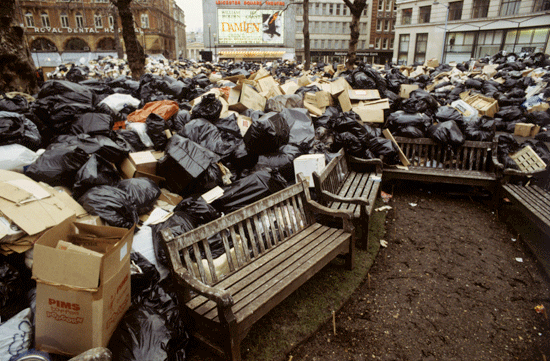
Well, here's a photo of the garbage that piled up because they didn't have enough money to pay trash collectors a fair wage...


And here's what John Blackburn, from Wetherby, recently told the BBC television channel about his experience during this period...

John Blackburn, from Wetherby said:
"I was a control engineer at Huddersfield Power Station at the time and part of my duty was to switch off the supply to various substations around the town, according to an official rota. On many an evening shift I would have to switch off the power to my own home before going back for a candle-lit supper!"


Imagine... Britain was a global superpower for 150 years. But when they started intentionally devaluing their currency, things went straight down hill.

Maybe you don't think something similar can happen here... but I'm telling you... it's already underway!

In fact, the exchange value of the U.S. dollar has fallen about 13% since June 2010. And its rate of decline is accelerating.

What happened to the British currency is now happening to the U.S. dollar.

As Barron's recently reported:
"When the monetary history...is written decades from now...2010 could be a watershed marking the beginning of the end of the dollar-based, Western-centric monetary system."
As the U.S. dollar continues to lose its position as the world's currency, gas, oil, and other commodities will continue to skyrocket. Almost EVERYTHING we consume will immediately get more expensive. All the clothing, furniture, and household goods we import from China.

All the food we get from Central and South America... all the electronics, televisions, computers, and cars we get from Asia and Europe. In fact, it's happening, right now before our eyes.

Everything is getting more expensive...

In fact, each week, The Wall Street Journal has a section called �Cash Prices.' It lists dozens of commodities, everything from wool, zinc, tin and pork... to gold, silver, platinum, and lead.

I recently checked these listings in the paper's March 1st, 2011 edition. And the numbers were mind-boggling...

In short, of the 88 prices quoted ... 85 items are more expensive today than they were just a year ago... many significantly so.

Oil is up more than 50% from a year ago. Silver is up more than 100%–so is cotton, and coffee. Tin is up 90%. Oats are up more than 70%. So is wheat. Butter is up more than 40%. So is sugar.

Again, of the 88 prices quoted, the only three physical commodities that are cheaper today than they were a year ago... natural gas, eggs, and chickens.

Everything is more expensive! In some cases... MUCH more expensive.

And yet the government says there is no inflation? How is that possible?

It's unbelievable to me that they think the American public is going to fall for this.

U.S. businesses have certainly caught on...

As Wesley Card, the head of a clothing company that includes brands like Dockers and Anne Klein, recently said: "It's really a no-choice situation. Prices have to come up."

And when you look back further than a year, the numbers are even more startling...

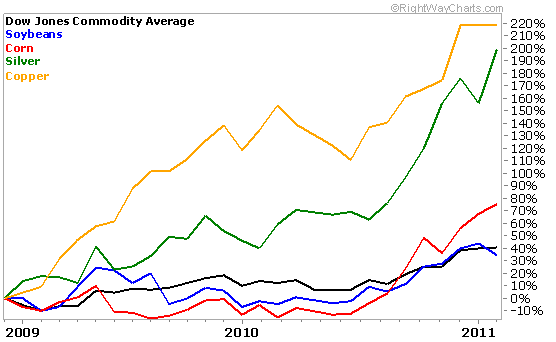
The chart below shows how much a few key commodities have skyrocketed in price, just since the beginning of 2009...


And the point here is simple: As we print more money, the price of the world's most essential commodities have soared. This is NOT a coincidence.

Around the world, as we print, prices soar... citizens protest... governments get overthrown. And it's only going to get worse...

Because we can NOT stop printing because we can't actually afford our existing debts. No one wants you to know this. No one.

That's why, despite the obvious inflation going on all around the world, the Fed continues to say there's no inflation at all.

And that's the scary part, to me. Just like in a Banana Republic, the government is radically devaluing the dollar and totally lying to everyone about what is really happening.

Whether you realize it or not, there is already a "run" on the dollar. Many of our creditors, like the Chinese, are getting out of the dollar as fast as they can via strategic commodities, like copper. That's partly why commodity prices are soaring.

Unfortunately, skyrocketing commodity prices are just the beginning.

There are other disastrous consequences to the U.S. dollar losing status as the world's currency...

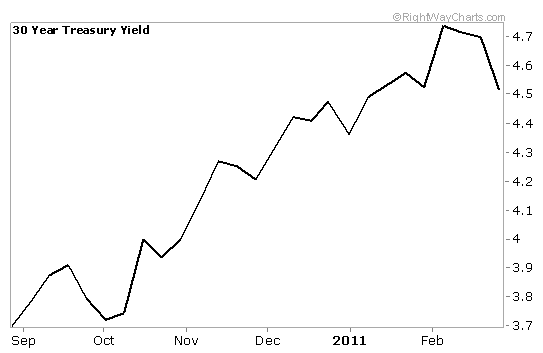
For example, there would be much less demand for U.S. dollars around the globe, so interest rates will skyrocket. Already, just look how quickly rates have moved up in recent months...


Instead of getting a mortgage at today's low rates of 5%, it may soon cost you 8% or even 10% or 15%.

Imagine what that would do to housing prices!

Stock prices will likely plummet by at least 40% in a matter of weeks as a result of this event in the currency markets.

It will cost every American business A LOT more money for supplies and materials. No one will be able to get a loan... and no bank will want to make loans.

In short, when the U.S. dollar loses its spot as the world's 'reserve currency,' it will cause a brutal downturn in the economy, which I expect will be about 10-times worse than the mortgage crisis of 2008.

As Barron's recently reported:

"The demand for dollars from the rest of the world has been of inestimable benefit to the U.S. economy. It quite simply allows Americans to consume more than they produce and save less than they invest; in other words, to live beyond our means."

You see, what will also happen as a result of this currency crisis, and the end of the U.S. dollar as the world's reserve currency, will be massive inflation, the likes of which we have never seen before.

When everyone is trying to get rid of their dollars, the government is printing more and more to pay debts, and no one wants to own them, the crisis will reach epic proportions.

Just look, for example, at what happened to one European country that faced this type of crisis in the 1990s...

This is what happens during a major hyperinflation in the real world.

The World's Most
Expensive Loaf of Bread

In the early 1990s, the national government of one European nation had spent nearly all its savings. So what did they do next? Simple... they began to steal the savings of private citizens by limiting people's access to their money in government-controlled banks.

And of course, to finance the daily operations of maintaining their basic infrastructure, they started printing money, big time. Even so, the country's basic infrastructure began to fall apart. There were potholes in the street, broken water pipes... elevators that never got repaired... and entire construction projects that simply shut down, before being completed.

The unemployment rate was more than 30%... and the government just kept printing money.

As San Jose State University Economics Professor Dr. Thayer Watkins, an expert on countries that try to inflate their way out of big debts, wrote on this particular disaster:

"The government tried to counter the inflation by imposing price controls. But when inflation continued, the government price controls made the price producers were getting so ridiculously low that they simply stopped producing. bakers stopped making bread... slaughterhouses refused to sell meat to the stores... other stores closed down"

So what did the government do next to try to curb inflation?

Well, one bright idea they had was to force stores to fill out government documents every time they increased prices. They thought that this would slow down price increases, because the paperwork would take so much time!

But like many government plans, this one had terrible, unintended consequences.

Since stores had to dedicate an employee to do nothing but register this paperwork, and since the process took so long, stores began to raise prices on basic goods at even higher rates, so that they didn't have to come back and file more paperwork!

Incredible, isn't it?

So next the government created a new currency... which basically removed six zeroes from the old one. So 100,000,000 old units were soon worth 100 new units. Of course, this didn't work either... it never does.

Between October of 1993 and January 1995, prices increase by, get this: 5 quadrillion percent. That's...

5,000,000,000,000,000%

In other words, a loaf of bread that cost $1 in 1993, suddenly cost

$50,000,000,000,001

Yes, that's $50 TRILLION.

I know, it's laughable... but I can guarantee that the people of this once proud European country weren't laughing one bit, especially those living on a fixed income.

[John's comment: "1993 to 1995"? I hadn't heard of this hyperinflation. Maybe Stansberry got his dates mixed up? He's pulling our leg? What's he talking about? . . . I did a Google search on inflation five quadrillion percent.

Oh! A paper by Dr. Watkins popped right up! --Yugoslavia. "The worst episode of hyperinflation in world history," says Dr. Watkins.

So now I can add Yugoslavia to my list of country's of whose hyperinflation I'm aware: Germany, Argentina, Chile, Vietnam, and so many others.

And we in the U.S. think we're going to escape?]

Of course, at this point, the country completely fell apart. As Dr. Thayer Watkins wrote:

"The social structure began to collapse. Thieves robbed hospitals and clinics of scarce pharmaceuticals and then sold them in front of the same places they robbed. The railway workers went on strike and closed down the country's rail system."

At this point, businesses and citizens across the country basically refused to take the local currency.

Instead, everyone started dealing in German Marks. Keep in mind, the daily rate of inflation was nearly 100%.

Can you imagine the panic in a society when the price of just about everything doubles... every single day? It was absolute pandemonium, and the economy basically came to a grinding halt. It was like living in a war zone. Truckers stopped delivering goods. Stores, restaurants, and gas stations all shut down.

In another ridiculous government move, the government actually made it illegal to NOT accept a personal check.

Imagine... you could write a check... and in the several days that it typically takes for a check to clear, inflation would wipe out almost all of the cost of covering your check.

Of course, as is typical, the government took none of the blame. As Dr. Thayer Watkins reported, the government's official position was that the hyperinflation occurred "because of the unjustly implemented sanctions against the people and state."

Again... I know what you are thinking... "just because it happened in Europe doesn't it mean it can happen here, right"?

Well guess what...

The same thing that happened in this European country – Yugoslavia – also just happened in Iceland and Greece, but on a less dramatic scale. . . .
And then there is Martin Weiss who asks--and answers in the assertive: Will the U.S. default? Is it really possible?

It's not only possible, it is already happening. They're just hiding it. Kind of.

Take a look.
*******


Okay. So we've got all these screaming "the sky is falling" disaster pundits. What is a nice, sane, reasonable person supposed to do?

I'd say, first of all, you want to get educated about this stuff.

Read Weiss' article. He makes some solid suggestions.

Read the rest of Stansberry's lengthy article. He concludes with several practical suggestions, including an appeal to subscribe to one of his newsletters.

Maybe you would like to read The Hyperinflation Survival Guide published at the behest of Harry E Figgie, Jr, the CEO of Figgie International, Inc., back in the late '80s. --I wrote about it back in November.

Come to think about it, maybe you'd even like to read some of my past posts about hyperinflation here on my John's Corner blog.

Wednesday, February 09, 2011

Inflation . . . and foreign currencies

Several weeks ago while preparing for our Southeast Asian trip, and then again, two weeks ago, while in Vietnam, I got a good sense of what major inflation looks and feels like.

If you ever plan to buy something while you're in a foreign country, it's always nice to have some idea of whether the price is at least "in the ballpark." So before we took off, I did some research about exchange rates.

You want a "general idea" of what you should be looking for.

At the time, then, I found that, for Singapore, I could make the following General/Mental Conversion:

Singapore:
1 Singapore Dollar = US$0.75 (actual/exact US$ equivalent was 0.77)
13 SGD = $10 ($10.05)
100 SGD = $75 ($77.31)

Thailand:
10 Baht = 33 cents
30 Baht = $1 ($0.99)
100 Baht = $3 ($3.29)
2000 Baht = $65 ($65.78)

Cambodia:
1,000 Riel = 1 quarter; 25 cents
4,000 Riel = $1 ($0.99)

Hong Kong:
1 Hong Kong Dollar = an eighth of a dollar; $0.125 ($0.129)
8 HKD = $1 ($1.03)
10 HKD = $1.30 ($1.29)
77.7 HKD = $10

Vietnam, however, blew me away. I've never had to deal with these kinds of numbers before, not while traveling:

20,000 Dong = $1 ($1.02; $1 = 19,400 VND)
1,000,000 VND = $50 ($51.06)

When your primary currency unit is worth about 1/20,000th of another country's primary currency unit, you can pretty well assume there has been some massive inflation! And having just done a bit of research, I confirmed the fact. According to the Vietnamese Embassy, "the inflation rate [in Vietnam] rose up to a record 774.7% [for at least a short time] in 1986." But according to Index Mundi's Vietnam Inflation rate (consumer prices), throughout the '80s Vietnam experienced high double- and triple-digit inflation:

Year
Inflation, average
consumer prices
End-of-Year
= 1VND on 1/1/80
Year
Inflation, average
consumer prices
End-of-Year
= 1VND on 1/1/80
Year
Inflation, average
consumer prices
End-of-Year
= 1VND on 1/1/80
Year
Inflation, average
consumer prices
End-of-Year
= 1VND on 1/1/80
1980
25%
1.25
1990
36%
6,298
2000
-1.768%
26,245
2010
8%
54,197
1981
70%
2.13
1991
82%
11,462
2001
-0.31%
26,163
1982
95%
4.14
1992
38%
15,818
2002
4%
27,210
1983
49%
6.17
1993
8%
17,084
2003
3%
28,026
1984
65%
10.19
1994
9%
18,621
2004
8%
30,268
1985
92%
19.56
1995
17%
21,787
2005
8%
32,690
1986
454%
108.36
1996
6%
23,094
2006
8%
35,305
1987
360%
498.46
1997
3%
23,787
2007
8%
38,129
1988
374%
2,363
1998
8%
25,690
2008
23%
46,899
1989
96%
4,631
1999
4%
26,717
2009
7%
50,182

Meanwhile, of course, the U.S. dollar has undergone some significant inflation of its own. I won't reproduce a chart and do the multiplication as I did, above. But you can find the "official" consumer price index on the Federal Reserve of Minneapolis' website (look over to the right). 

During the same period, from 1980 till today, the value of US$1 has been inflated to $2.68. 

Divide VND54,197 by US$2.68 and you should find how much "real" inflation (compared to US inflation) has occured in Vietnam. If the Vietnamese dong had been at parity with the US dollar back in 1980 (so that US$1 = VND1 in 1980), then USD1 should buy VND20,223 worth of goods today--very nearly what US$1 does purchase today (more or less, VND19,400 worth of goods or services).

While I'm on the topic, I should note that dealing with all those zeros can get confusing . . . and difficult!

When we first got into Vietnam, I realized that US dollars would likely be accepted at most places I went, but I wasn't carrying near enough dollars for my needs. (We intended to stay at a hotel one night, and we were looking for Christmas presents [for 2011] for Sonlight employees.) So I needed some dong. But not too much. (What good would they be to me--especially if Vietnam continues to inflate its currency faster than the US inflates its currency?)

Well, I figured I would need at least about US$300 to cover taxi fares for a couple of days, plus, if I wanted to pay in dong, the approximately $50 we were going to owe for our hotel room.

Quick! How much money--in dong--do you want to take out of your bank account back in the US via the ATM in Vietnam? You want enough but not too much. And, of course, if you take out too little, you are likely going to be able to find another ATM to get a bit more.

The ATM offered several standard withdrawal numbers, including a maximum listed withdrawal of VND2,000,000 . . . plus, of course, the option to enter your own value in increments of VND50,000 or 100,000. . . . And every withdrawal would incur a VND20,000 service charge on top.

I decided to go for VND5,000,000.


Didn't work.

Oh, no! Was my card being blocked by my bank back in the US? Did I enter a digit wrong?

Tried again. No success.

Is my total too high? The machine doesn't have enough dong?

I tried VND3,000,000.

No success.

Use the standard maximum?

VND2,000,000.

Success!

Hmmm. But that's only about US$100. It won't get me very far with my taxi driver.

Maybe I should try it again.

Success!

So I finally withdrew VND5,500,000--dispensed in VND100,000 notes. 

I feel so foolish for not having taken any photos of the beautiful (but largely worthless) currency!

********

A few additional stories about money from our trip.

One about standing at an ATM. I think it was in Cambodia, though it might have been in Vietnam.

The taxi brought me to a two-ATM location. 

When I walked up, both machines were being used, and a man was standing to the side at the left one--not behind the person, but kind of in front of and to the left side of the person at the machine.

It appeared obvious to me that he was waiting. But he wasn't "in line."

When "his" machine came free, I motioned for him to do his business. Which he happily did.

Meanwhile, the machine on the right remained occupied.

When that guy finally began to move out of the way, stepping slightly to the right and turning away, I moved toward the spot. But a woman came from behind me on my right and stepped up to the machine!

!!!!

Then she turned slightly to the right to give herself room to rummage in her purse to find her card.

I figured two could play the game of "jumping" in line.

I quickly leapt to her side--now, actually, behind her, on her left--reached across and slid my card into the machine.

She muttered something indecipherable under her breath--I don't have any idea whether it was something to the effect of "Well played!" or, "*&^@%#! foreigner!"--and stepped away.

*******

When on cruises, you meet all kinds of people.

I found myself in conversation with a man from Holland. Somehow, we got into a conversation about money. Maybe it was because I asked him about his family, and he told me his son is working in Indonesia, and his daughter is looking for work in Australia: "There is no future for them in Holland," he said. "Taxes run between 80 and 90 percent. And the Euro has no future."

Then he told me: "Joining the Eurozone was one of the biggest mistakes Holland ever made."

"Why?"

"The guilder was a stable currency.

"Just before the conversion was made in January 2002, 1 guilder [the former Dutch unit of currency] purchased a cup of coffee. When the conversion was made, we received 44 cents Euro for every guilder. So our wealth was immediately reduced by a factor of more than two--we had less than half what we did the day before.

"At the time the conversion was made, a cup of coffee cost 1 Euro--effectively 2.2 times what it cost immediately before the conversion.

"Now, a cup of coffee costs EUR2.50."

Do the math: 2.2*2.5 = 5.5. That's pretty severe inflation--450%--for a period of nine years!

And what did the Dutch people gain for their troubles?

Similar stories could be told by West Germans, too, I'm sure, as they were first called upon to help the East Germans catch up after half a century of Communist rule, and now they are being called upon to bail out and support the "poor" French workers who want to retire with full pensions at 60 rather than 62 (!!!) . . . or the Italians and Portuguese, Greeks and Spanish. . . .

******

Okay. Enough financial stories for one day.