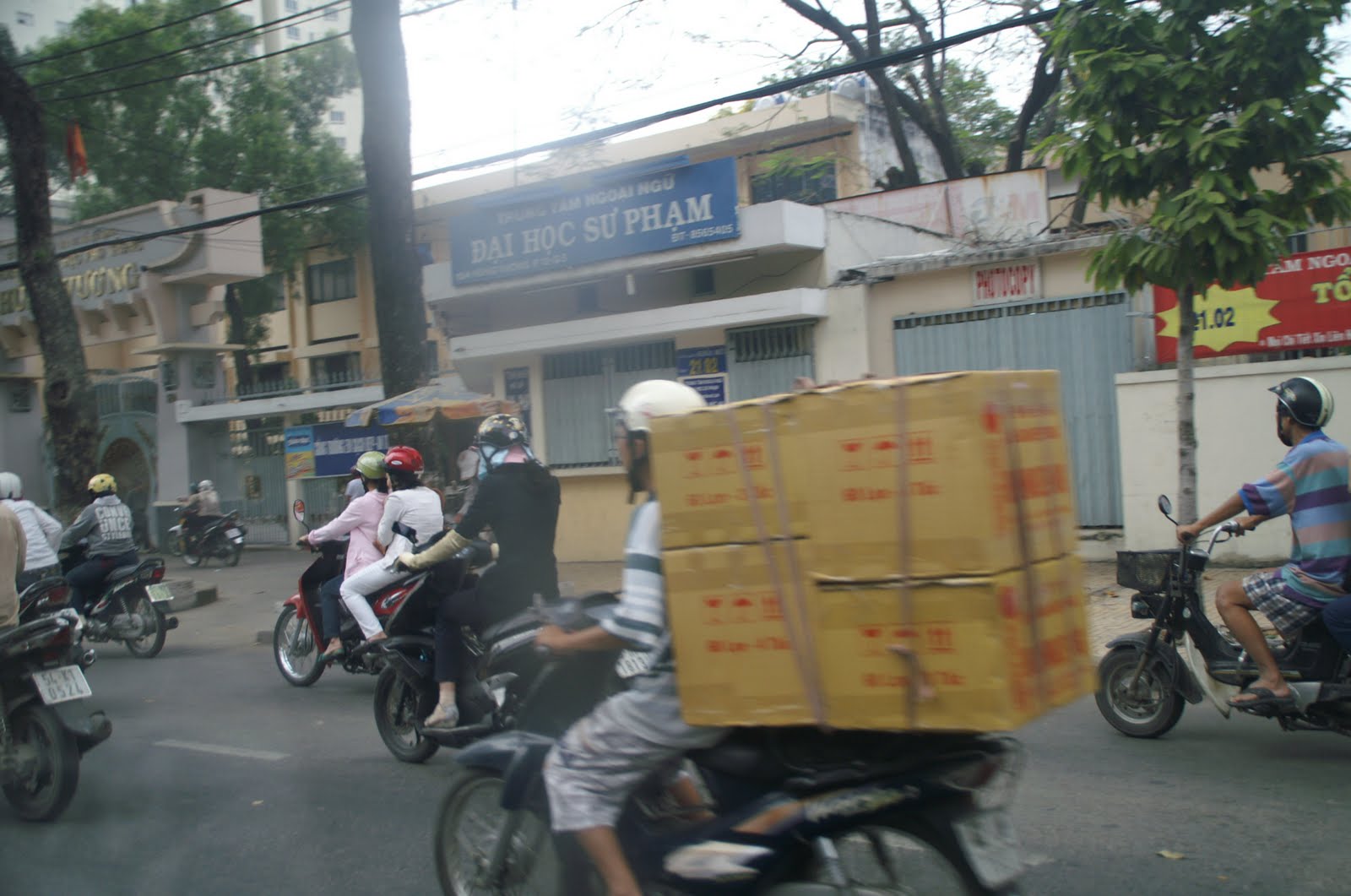
Several weeks ago while preparing for our Southeast Asian trip, and then again, two weeks ago, while in Vietnam, I got a good sense of what major inflation looks and feels like.
If you ever plan to buy something while you're in a foreign country, it's always nice to have some idea of whether the price is at least "in the ballpark." So before we took off, I did some research about exchange rates.
You want a "general idea" of what you should be looking for.
At the time, then, I found that, for Singapore, I could make the following General/Mental Conversion:
Singapore:
1 Singapore Dollar = US$0.75 (actual/exact US$ equivalent was 0.77)
13 SGD = $10 ($10.05)
100 SGD = $75 ($77.31)
Thailand:
10 Baht = 33 cents
30 Baht = $1 ($0.99)
100 Baht = $3 ($3.29)
2000 Baht = $65 ($65.78)
Cambodia:
1,000 Riel = 1 quarter; 25 cents
4,000 Riel = $1 ($0.99)
Hong Kong:
1 Hong Kong Dollar = an eighth of a dollar; $0.125 ($0.129)
8 HKD = $1 ($1.03)
10 HKD = $1.30 ($1.29)
77.7 HKD = $10
Vietnam, however, blew me away. I've never had to deal with these kinds of numbers before, not while traveling:
20,000 Dong = $1 ($1.02; $1 = 19,400 VND)
1,000,000 VND = $50 ($51.06)
When your primary currency unit is worth about 1/20,000th of another country's primary currency unit, you can pretty well assume there has been some massive inflation! And having just done a bit of research, I confirmed the fact. According to the Vietnamese Embassy, "the inflation rate [in Vietnam] rose up to a record 774.7% [for at least a short time] in 1986." But according to Index Mundi's Vietnam Inflation rate (consumer prices), throughout the '80s Vietnam experienced high double- and triple-digit inflation:
Year | Inflation, average consumer prices | End-of-Year = 1VND on 1/1/80 | Year | Inflation, average consumer prices | End-of-Year = 1VND on 1/1/80 | Year | Inflation, average consumer prices | End-of-Year = 1VND on 1/1/80 | Year | Inflation, average consumer prices | End-of-Year = 1VND on 1/1/80 |
|---|---|---|---|---|---|---|---|---|---|---|---|
1980 | 25% | 1.25 | 1990 | 36% | 6,298 | 2000 | -1.768% | 26,245 | 2010 | 8% | 54,197 |
1981 | 70% | 2.13 | 1991 | 82% | 11,462 | 2001 | -0.31% | 26,163 | |||
1982 | 95% | 4.14 | 1992 | 38% | 15,818 | 2002 | 4% | 27,210 | |||
1983 | 49% | 6.17 | 1993 | 8% | 17,084 | 2003 | 3% | 28,026 | |||
1984 | 65% | 10.19 | 1994 | 9% | 18,621 | 2004 | 8% | 30,268 | |||
1985 | 92% | 19.56 | 1995 | 17% | 21,787 | 2005 | 8% | 32,690 | |||
1986 | 454% | 108.36 | 1996 | 6% | 23,094 | 2006 | 8% | 35,305 | |||
1987 | 360% | 498.46 | 1997 | 3% | 23,787 | 2007 | 8% | 38,129 | |||
1988 | 374% | 2,363 | 1998 | 8% | 25,690 | 2008 | 23% | 46,899 | |||
1989 | 96% | 4,631 | 1999 | 4% | 26,717 | 2009 | 7% | 50,182 |
Meanwhile, of course, the U.S. dollar has undergone some significant inflation of its own. I won't reproduce a chart and do the multiplication as I did, above. But you can find the "official" consumer price index on the Federal Reserve of Minneapolis' website (look over to the right).
During the same period, from 1980 till today, the value of US$1 has been inflated to $2.68.
Divide VND54,197 by US$2.68 and you should find how much "real" inflation (compared to US inflation) has occured in Vietnam. If the Vietnamese dong had been at parity with the US dollar back in 1980 (so that US$1 = VND1 in 1980), then USD1 should buy VND20,223 worth of goods today--very nearly what US$1 does purchase today (more or less, VND19,400 worth of goods or services).
While I'm on the topic, I should note that dealing with all those zeros can get confusing . . . and difficult!
When we first got into Vietnam, I realized that US dollars would likely be accepted at most places I went, but I wasn't carrying near enough dollars for my needs. (We intended to stay at a hotel one night, and we were looking for Christmas presents [for 2011] for Sonlight employees.) So I needed some dong. But not too much. (What good would they be to me--especially if Vietnam continues to inflate its currency faster than the US inflates its currency?)
Well, I figured I would need at least about US$300 to cover taxi fares for a couple of days, plus, if I wanted to pay in dong, the approximately $50 we were going to owe for our hotel room.
Quick! How much money--in dong--do you want to take out of your bank account back in the US via the ATM in Vietnam? You want enough but not too much. And, of course, if you take out too little, you are likely going to be able to find another ATM to get a bit more.
The ATM offered several standard withdrawal numbers, including a maximum listed withdrawal of VND2,000,000 . . . plus, of course, the option to enter your own value in increments of VND50,000 or 100,000. . . . And every withdrawal would incur a VND20,000 service charge on top.
I decided to go for VND5,000,000.
Didn't work.
Oh, no! Was my card being blocked by my bank back in the US? Did I enter a digit wrong?
Tried again. No success.
Is my total too high? The machine doesn't have enough dong?
I tried VND3,000,000.
No success.
Use the standard maximum?
VND2,000,000.
Success!
Hmmm. But that's only about US$100. It won't get me very far with my taxi driver.
Maybe I should try it again.
Success!
So I finally withdrew VND5,500,000--dispensed in VND100,000 notes.
I feel so foolish for not having taken any photos of the beautiful (but largely worthless) currency!
********
A few additional stories about money from our trip.
One about standing at an ATM. I think it was in Cambodia, though it might have been in Vietnam.
The taxi brought me to a two-ATM location.
When I walked up, both machines were being used, and a man was standing to the side at the left one--not behind the person, but kind of in front of and to the left side of the person at the machine.
It appeared obvious to me that he was waiting. But he wasn't "in line."
When "his" machine came free, I motioned for him to do his business. Which he happily did.
Meanwhile, the machine on the right remained occupied.
When that guy finally began to move out of the way, stepping slightly to the right and turning away, I moved toward the spot. But a woman came from behind me on my right and stepped up to the machine!
!!!!
Then she turned slightly to the right to give herself room to rummage in her purse to find her card.
I figured two could play the game of "jumping" in line.
I quickly leapt to her side--now, actually, behind her, on her left--reached across and slid my card into the machine.
She muttered something indecipherable under her breath--I don't have any idea whether it was something to the effect of "Well played!" or, "*&^@%#! foreigner!"--and stepped away.
*******
When on cruises, you meet all kinds of people.
I found myself in conversation with a man from Holland. Somehow, we got into a conversation about money. Maybe it was because I asked him about his family, and he told me his son is working in Indonesia, and his daughter is looking for work in Australia: "There is no future for them in Holland," he said. "Taxes run between 80 and 90 percent. And the Euro has no future."
Then he told me: "Joining the Eurozone was one of the biggest mistakes Holland ever made."
"Why?"
"The guilder was a stable currency.
"Just before the conversion was made in January 2002, 1 guilder [the former Dutch unit of currency] purchased a cup of coffee. When the conversion was made, we received 44 cents Euro for every guilder. So our wealth was immediately reduced by a factor of more than two--we had less than half what we did the day before.
"At the time the conversion was made, a cup of coffee cost 1 Euro--effectively 2.2 times what it cost immediately before the conversion.
"Now, a cup of coffee costs EUR2.50."
Do the math: 2.2*2.5 = 5.5. That's pretty severe inflation--450%--for a period of nine years!
And what did the Dutch people gain for their troubles?
Similar stories could be told by West Germans, too, I'm sure, as they were first called upon to help the East Germans catch up after half a century of Communist rule, and now they are being called upon to bail out and support the "poor" French workers who want to retire with full pensions at 60 rather than 62 (!!!) . . . or the Italians and Portuguese, Greeks and Spanish. . . .
******
Okay. Enough financial stories for one day.