Thursday, November 19, 2009

Yipes! Scary! "This is your brain on GPS"

I was reading "The Last Word" in a recent The Week magazine.
IN JUNE, AL Byrd’s three-bedroom home, built by his father on the western outskirts of Atlanta, was mistakenly torn down by a demolition company. “I said, ‘Don’t you have an address?’” a distraught Byrd later recounted. “He said, ‘Yes, my GPS coordinates led me right to this address here.’” The incident joined a long list of satellite-guided blunders, including one last year in which a driver in Bedford Hills, N.Y., obeyed instructions from his GPS to turn right onto a set of train tracks, where he got stuck and had to abandon his car to a collision with a commuter train. Incredibly, the same thing happened to someone else at exactly the same intersection nine months later. In Britain, an insurance company survey found that 300,000 drivers have either crashed or nearly crashed because of GPS systems.
What's going on? It seems that GPS's conflict with the way our minds work. I know they conflict with the way my mind works!

Instead of permitting us to generate maps in our own minds, they provide directional "recipes" that actually contribute to the decline of spatial function in our brains.

Find the whole sordid story here.

Monday, November 16, 2009

Islam: A religion of violence?

The Sonlight forums have had a fairly lengthy discussion that arose when someone posted the following thesis statement and invitation for response:
From the Mouths of American Muslims: Praising the Ft. Hood Shooter . . . Here is evidence that true Islam is a religion of violence (by CNN!):


Your comments?
It took several hours to wade through the entire "conversation" and to think about what it all meant, but I finally came to a conclusion:
As you may recall, back in May and June of '07 I brought up Mark Steyn's book, America Alone. I was very concerned about the problem that [the original poster in this thread] has attempted to bring up here. And I will admit that, at the end of that set of conversations, I was still not settled at all in my mind. Indeed, I was still perplexed that, it seemed, so many of my forum-mates . . . were so "relaxed" about violent Islam.

If you go to , you will find the ice almost melted through. But, obviously, not quite.

Today I think it did melt. The conversation here finally did the trick.

I wrote back then,
Mark Steyn notes in America Alone that too few of us in the West are aware of the different sects of Islam--Wahhabi, Deobandi, Sunni, Shiite, Sufi. . . .

Steyn points out that Saudi Arabia, the great exporter of Islam worldwide at this point in history, exports Wahhabi Islam--the most "radical" and violent version.
What I realized today, here, is that we must, indeed, distinguish these various sects . . . Just as those of us who are "way" on the "inside" of Christianity recognize there are huge differences between Pentecostals and Baptists, Roman Catholics and Presbyterians, Episcopalians and Eastern Orthodox, Charismatics and United Methodists, Mennonites and Christian Reconstructionists, Old-Earthers and Young-Earthers, Theistic Evolutionists and Six-24-hour-day Creationists, a-millennialists, pre-millennialists and post-millennialists [and so on and so forth] . . . so we who are on the outside of Islam need to recognize the differences between Wahhabis (who are, indeed, the most "radical" and violent) and Sufis (from south Asia, who tend to be way "laid back") and Sunnis and Shias and all the rest. And, yes, even within each sect, and among the members of each sect, we need to recognize that there are going to be individual differences.

I had not thought of that before.

Just as we, if we are of an Old-Earth persuasion, hate to have someone from the "outside" tell us what we "have to" believe about creation, or if we are of a Brethren/Mennonite or even an historical Baptistic perspective on law and politics don't want someone telling us we "must" follow the teachings of Christian Reconstruction, or if we are paedo-baptists (i.e., people who believe in infant baptism) we take issue with those who tell us we are completely ignoring biblical teaching on the subject [and so on and so forth], so, too, we need to be careful about telling Muslims--or speaking of Muslims--as "having" to believe one way or another . . . "because the Q'uran teaches _______."

YES, some Christians are convinced the Bible teaches six-24-hour-day creation about 6,000 years ago. But others among us believe very differently. So, too: YES, some Christians are convinced the Bible teaches that all of civil society should be conformed to the civil law as outlined in the Old Testament. But others among us believe very differently.

So, too, with Muslims.

I see that, now.

And I thank [certain participants in this thread] for pushing the issue far enough . . . and [and certain] others pushing back hard enough . . . that I now see the analogy and think I can understand where I--and, I believe, our society as a whole--needs to go.

My conclusion: Mark Steyn was correct; he is correct: we need to learn far more about Islam . . . 1) so we understand where different people are likely to be coming from and, then, 2) to delve deeper to understand each individual person's perspectives.

*******

Immediately after the above post, I then added the following:
I saw this cartoon in The Week:


I thought it provides a nice hat-tip to what I was trying to say up-thread. Personally, I think there is reason to do some "profiling"; at the same time, there is reason for discernment and caution.

Hope you can enjoy the cartoon!
Oh. And one last comment.

Somehow, what the Muslim guys in the video at the top of this post say reminds me of footage I've seen from (and of) certain demonstrators who claim to be the mouthpieces of the Christian God. Don't they do the same for you?

For example:


If you are reading this post in Facebook, you should know that the original is on my personal blog.

Sunday, November 15, 2009

Physicists without common sense? Or some of the greatest cons in history?

Large Hadron Collider quadrupole superconductor electromagnets for directing proton beams to interact.Large Hadron Collider quadrupole superconductor electromagnets for directing proton beams to interact. Image via Wikipedia

Pretty astonished at this story about how a piece of bread, supposedly dropped by a bird, has shut down the Large Hadron Collider, the world's most powerful particle accelerator.

The article's source said,
machinery on the surface - the LHC accelerator circuit itself is buried deep beneath the Franco-Swiss border outside Geneva - had suffered a fault caused by "a bit of baguette on the busbars", thought perhaps to have been dropped by a bird.

As a result, temperatures in part of the LHC's circuit climbed to almost 8 Kelvin - significantly higher than the normal operating temperature of 1.9, and close to the temperature at which the LHC's niobium-titanium magnets are likely to "quench", or cease superconducting and become ordinary "warm" magnets - by no means up to the task imposed on them. Dr Tadeusz Kurtyka, a CERN engineer, told [The Register ("Biting the hand that feeds IT")] that this can happen unpredictably at temperatures above 9.6 K.
And so what? What would that mean, if the magnets were unable to fulfill their function?

Well, says the article in The Register . . .
At the moment there are no beams of hadrons barrelling around the huge magnetic doughnut at close to light speed, but when there are, each of the two beams has as much energy in it as an aircraft carrier underway. If the LHC suddenly lost its ability to keep the beam circling around its vacuum pipe, all that energy would have to go somewhere - with results on the same scale as being rammed by an aircraft carrier.
????!!!! "Being rammed by an aircraft carrier"? What would suffer the effects of being rammed by an aircraft carrier? And what kind of "ramming" are we talking about? A head-on collision? A side-long glance?

And at what speed would this "equivalent" aircraft carrier be going when it hit?

According to The Register which, in turn, was relying on information provided by Dr Mike Lamont, "LHC Machine Coordinator" at the CERN control center:
Had this week's feathered baguette-packing saboteur struck . . . with a brace of beams roaring round the LHC's magnetic motorway, the climbing temperatures would have been noted and the beams diverted - rather in the fashion that a runaway truck or train can be - into "dump caverns" lying a little off the main track of the LHC. In these large artificial caves, each beam would power into a "dump core", a massive 7m-long graphite block encased in steel, water cooled and then further wrapped in 750 tonnes of concrete and iron shielding. The dump core would become extremely hot and quite radioactive, but it has massive shielding and scores of metres of solid granite lie between the cavern and the surface. Nobody up top, except the control room staff, would even notice.

This whole process would be over in a trice, well before the birdy bread-bomber's shenanigans could warm the main track up to anywhere near quench temperature. Should the magnets then quench, no carrier-wreck catastrophe would result.

According to Lamont, provided the underlying fault didn't take too long to rectify, the LHC could be up and beaming again "within, say, three days" following such an incident.
Reassuring, wouldn't you say?

Meanwhile, back on the Popular Science blog where I first read about the "birdy bread-bomber," as The Register so humorously described the incident, readers question the entire affair.

Writes one: "I don't understand how a 'section of outdoor machinery' can be so sensitive to something being on it. Isn't this going to happen all the time?? Rain will fall on it, leaves will blow on it, birds will crap on it, etc. Shouldn't it be covered if it is so delicate?"

And another replies, reasonably: "Even if normal precautions are taken against leaves and other normal material found outdoors, a piece of bread may overcome them. First, the bread may be soft enough to mold itself to the grill if enough suction is being applied. Then the air will dry the bread effectively making it into a form fitted block. Less air flow means less cooling effectiveness down the line. Again, a cascade affect could become possible depending on how much other devices rel on that source for cooling - either as a primary source, or secondary or tertiary.

"Since a critical component in a machine does NOT have to be large, it may not require a lot of cooling. In these cases, a piece of bread would indeed be enough to cause a failure such that the entire operation has to be shut down to ensure nothing is damaged, or that a more serious problem is not culpable."

"While your analogy to a radiator is persuasive from an engineering perspective, it does not hold water from a design perspective," writes a third.
The more critical the component the more redundant it must be, period. Even in aircraft, where space and weight are of critical concern, some effort in this regard is made.

But and where space, weight, and apparently money, are no object, double, triple, dodecaduple redundancy should be of paramount concern, especially for mission-critical components exposed to the elements.

Atomic reactor design is a good example here, and I defy you to find a commercial power generation facility with a non-redundant heat regulator, much less one exposed to the elements in a way that a piece of toast can cause mission failure.

And let's not even get started about what this says about the maintenance regime that allowed such a critical component not to be monitored in a way that averted thermal abort.

This whole thing smacks of nothing more or less than old-fashioned incompetence, in design, implementation, and operation. Nothing new, just rendered relevant because of the sums involved.
"Talk about a design flaw!" writes a fourth commenter. "You'd think that the brilliant people in charge of accelerating imperceptible subatomic particles would at least consider bird-proofing the place."

Agreed, suggests a fifth:
You guys may all think it quite implausible that a piece of bread could shut this thing down, but there have been some serious inconsiderations from the designers.

In Aug2009 they found a family of rats inside the tube of the accelerator where it is supposed to be a vacuum void of particles... yet a whole nest of rats?! Come on!

I think this thing is one huge money trap.

Billions spent on a "promise" as so often is the case with scientific research. And they will "produce" false results to support their theory that got them all this government money in the first place just so they can screw around for another year. It would be like an animal exterminator breeding rats and releasing them in the community so he can get more work.

Personally, I LOVE SCIENCE, I LOVE the idea of what we MAY be able to discover, but there comes a point where you must ask yourselves, "is this really financially necessary at all? If you prove even 1/2 your theory, would it have been worth the billions and billions spent and to yet be spent? What results/benefits will we realize within the next, say, 50 years, from our billions spent, should you even find what you're looking for?"
On a more humorous (???) note, however:
Obviously, this bird has been talking to the woodpeckers that attacked the Space Shuttle external tank, or the other woodpeckers that stopped a Lockheed Martin laser test -- perhaps relatives of the vultures that got roasted by STS-114. Clearly, Hitchcock was right, and the birds are retaliating against all high technology!
And, finally:
The bird's briefing:

The approach will not be easy. You are required to maneuver straight down this trench and skim the surface to this point. The target area is only two meters wide. It's a small thermal exhaust port, right below the main port. The shaft leads directly to the reactor system. A precise hit will start a chain reaction which should destroy the station.
--Actually, you can find plenty more comments like these--some humorous, some sad, some alarmist, some angry--where these came from. . . .

Reblog this post [with Zemanta]

Wednesday, November 11, 2009

Want to invite you to the Strategic Inheritance forums . . .

As you may or may not know, I've been working on a website called StrategicInheritance.com, designed to help you maximize your legacy through peer insight, counsel and encouragement.

I've been blogging there for over two years. And I recently added a forum.

I had hoped I might generate some conversations, but so far, everyone seems a bit too shy. I've had a number of visitors, but no one has posted. I'd be thrilled if someone would simply help jump-start a conversation about anything related to the subject matter at hand.

NOTE: as I say in numerous places on the website, "legacy" is about far, far more than money and material goods. It's about family history and values and vision and purpose. It's about passing on who we are as human beings to future generations.

After noodling on this subject matter for going on three years, now, I can assure you: there are "better" ways to do these things, and there are "lesser" ways to do them.

I would hope for all of my readers that they--you--will follow the "better" ways! Please, come join the conversation-to-be.

The fall of the Berlin wall--November 9, 1989

My dad sent me a link to a series of New York Times articles about the fall of the Berlin Wall.

I happened to go first to this 4:43 video: The Man Who Opened the Gate. Rather chilling, first, to realize the momentous nature of the occasion . . . and the implications of one man's actions.

Be stunned yourself at this visual and auditory slice of history centered on the actions of an almost-forgotten East German border guard named Harald Jaeger.

Reblog this post [with Zemanta]

Monday, November 02, 2009

Postmodern confusion . . .

I have to confess: I have not kept up on the details of postmodernism.

Yesterday, in church, I saw a young man handing out some fliers. I asked him what they were.

"They're for the youth," he said.

"Could I have one?" I asked.

"Sure!"

And he handed me a couple of sheets of paper with two article on them. One was titled, "Postmodern Kids in the New Millennium . . . Reaching teens who find truth elusive." It's by Steve Schall, president of K-Life, Inc..

He launched his article with a quote from a 1998 news article about a cross-dressing boy in a small private school in Georgia.

Patrick Nelson, a classmate, had heard about this cross-dresser, but couldn't figure out who it was.
One day he was talking about the mystery to a friend, who smiled and pointed to the pretty blonde at the desk next to his.

“I said, 'No way, that's too weird!’” Patrick recalled. "Then I thought about it, and I said, 'So what's so weird about that?’”
Schall comments:
Did you hear the tension in Patrick's remarks? His initial response went one direction. But his next, "think about it" response was 180° in the other direction.

On the one hand, he instinctively reacted to something that was outside of God's natural, created order. But almost before the words got out, he was processing the situation with the skills that his postmodern culture had given him. To each his own. It may not be what I would choose personally, but who am I to impose my values on someone else? It's not what I’m about, but hey - it's a free country!

Imagine living in a world with no real rules, no real boundaries, and certainly no absolutes. No one, single idea is any better, necessarily, than any other. Historical accounts that were once undisputed and widely accepted are now open to revisionist interpretation. Everything centers around one's feelings and personal experience.

What you've just imagined is the very real world of today's adolescent.
I have written in the past (see also this) about some of my concerns with respect to transgenderism and s*xual identity.

[And, in the midst of writing this, I discovered that, though I had drafted the better part of a third article on this subject back in April of '05--along with the second article I reference in the preceding paragraph, I never finished nor published the third article. Considering what I want to say here, I went back and did the best I could to at least summarize (more or less) what I had intended to publish in that third article, and so you can find it here.]

If you pay attention to these stories I've referenced, you may guess what bothers me about Schall's article: While I am deeply concerned about the need to acknowledge and pursue absolute truth, I'm concerned that Schall confuses a potential willingness to acknowledge and affirm unchosen, possibly unwanted, and very real (though disturbing) differences-from-the-expected-- . . . he confuses those things with postmodern relativism.

Indeed, he states, unequivocally, that the story about Matthew Alex McLendon, the "cross-dressing" student, has to do with something "outside of God's natural, created order."

But, I think: What if McLendon is not so much a "cross-dresser" as an hermaphrodite--someone who is inters*xed or inters*xual? Is it appropriate and legitimate for us to think, speak and act as Steve Schall does, equating people's desire to recognize and/or acknowledge unusual but potentially (and sometimes very) real and clear biological distinctions . . . --Is it appropriate and legitimate for us to think, speak and act as Schall does, and equate these things with postmodern philosophical commitments to "no real rules, no real boundaries, and certainly no absolutes"?

If McLendon (by way of example) is, indeed, inters*xed, is it really just "one's feelings and personal experience"--not to mention a commitment to "no real rules, no real boundaries, and . . . no absolutes"--that would lead someone like Patrick Nelson, McLendon's classmate, to acknowledge the difficulties a McLendon faces and, perhaps, to afford him/her the opportunity to express him/herself as s/he feels most comfortable?

I could give you a slew of URL links to consider what others, far more deeply concerned about and involved in the discussion of inters*xuality have had to think and say on the subject.

Consider the basic question of marriage: If you know you are hermaphrodite (or "inters*xed" or "transs*xual" or "transgendered" or suffer from a "disorder of s*xual development"), are you permitted to marry? If so, to whom are you permitted to marry? And on what grounds are you permitted to make that choice? External g*nitalia? Internal? Hormonal levels? . . .
*****

Here's something really strange: When I first thought I should write this article, I hadn't even thought about the issue I have raised above. I was actually more intrigued by a story Schall referenced from a book by Norman Geisler and Frank Turek, Legislating Morality: Is It Wise? Is It Legal? Is It Possible?

The modern penchant for "tolerance" has struck me, often, as strange (to put it mildly), but I often find myself without tools to respond.

Geisler and Turek's story, retold here in Schall's words, provides a powerful and highly memorable parable for our time, I think:
[A] professor . . . was teaching a class in ethics at a university in Indiana. He assigned a term paper to his students, allowing them to write on any topic, as long as they had proper research and documented sources. One student who no longer believed in absolute values wrote convincingly on the merits of moral relativism. The student argued, "All morals are relative; it's all a matter of opinion; I like chocolate, you like vanilla."

His paper was well written, properly documented, the right length, on time, and stylishly presented in a handsome blue folder. The professor read the entire paper and then wrote on the front cover, "F. I don't like blue folders!"

When the student got the paper back he was enraged. He stormed into the professor's office and declared, “‘F. I don't like blue folders!’ That's not fair! You didn't grade the paper on its merits!"

Raising his hand to quiet the bombastic student, the professor calmly retorted, "Wait a minute. What's this talk about being fair? Didn't your paper argue that it's all a matter of taste? You like chocolate, I like vanilla?"

The student replied, "Yes, that's my view."

The professor responded, "Fine, then. I don't like blue. You get an F!"

Suddenly a light bulb went on in the student's head, as he finally got the message. He really did believe in absolutes, at least in terms of expecting his professor to be fair. In charging [his professor] with injustice, he was in fact appealing to an objective, "fair" standard of justice. That simple fact defeated his entire case for relativism.

The problem of transgendered identity

I wrote most of the following article back in April 2005. I intended to post it soon after I posted the article titled Coming to a restroom near you.

I never posted it because I had wanted to reference an article--or series of articles--I had read at least a year before.

In April of 2005, I couldn't locate the article(s), so I wrote to some people I thought might know about the author so I could locate what I was looking for. I never received an answer that I could follow up on. And I soon forgot that I had ever even begun the article below.

So you have some idea of what I had read back in 2004, let me quote what I wrote to my hoped-for source:
Last year, when I first came across the subject of transsexuality, I read at least one (and, I think, it was probably several) article(s) by a guy--I believe he was Polynesian or, at least, Pacific Islander--who was born with some chromosomal variant that left him in a very seriously vulnerable position, indeed. What I appreciated about his story (especially for the [Christian] audience I am trying to address) was, as I recall, his religious/faith perspective [he was Christian] and his emotionally open communication. One line, in particular (though I don’t recall the specific words he used) struck me with special force. He said something about feeling as if the world around him said that, because he was neither male nor female, he, more or less, didn’t have a right to live.
It was as if his very existence was an obscenity, an offense against God, a mistake.

Those "messages"--whether spoken or not, whether imagined or real--permeated his psyche. He didn't want to be what he was. But he was born that way.

So what could he do?

"So God created man in his own image, in the image of God created he him; male and female (not "intersexed" or "transsexual" or "transgendered") created he them." --Genesis 1:27
*****

The issue of transgenderism came up again for me just yesterday. As I was working on a post I intend to make about what occurred yesterday, I found this article and realized I want it as part of the "public record" in anticipation of what I hope to publish later this evening or tomorrow.

So . . .

Written in April 2005

In preparing Coming to a restroom near you, I found the following article about Pauline Park: "Parking rights: Pauline Park is fighting for transgender rights," from the New York Blade.

I've always been a bit of a softie when it comes to people who are "different" and who are rejected by "normal" members of society. That may be, partially, because I grew up asthmatic and was, therefore, unable at the beginning of 5th grade even to throw a basketball as high as a hoop. I expect you can imagine: I was not well-accepted by the majority of more "normal" boys in school.

But for whatever reason I may empathize, I think we need to recognize that,
  1. Though there are those, like Pauline Park, who really and truly do feel more at home "identifying" as women, though they are "trapped," as it were, in male bodies,

  2. There are others--heterosexual men--who dress in women's clothing for the s*xual thrill it provides.
One could wish that all derision, all discrimination, all humiliation could be done away with. But I wonder: How can benevolent members of society protect themselves and others from those who are truly sociopathic?

I grieve for Park. As the Blade article recounts Park's story,
“When I was a young child, I use[d] to have constant dreams, always with the same premise,” she says laughing. “I was alone at night in a big department store in the women’s section. And I got to try on all the clothing that I wanted to.” . . . An adopted son of Christian fundamentalists in Milwaukee, she hid from the world behind stacks of books in libraries
. . . and lived a life of "quiet desperation."

It was in the early 1950s that transsexualism first made headlines in the United States when the press discovered that George Jorgensen, Jr., a 98-pound ex-GI, had undergone surgeries in order to become Christine Jorgensen. Since Jorgensen's time, transsexualism has become relatively commonplace. And those who undergo the surgery and the hormones are at least minimally accepted by a fair portion of the population.

Pauline Park, however, has no interest in undergoing surgery or taking hormones. So as the Blade article puts it, Park "inhabits" a male body but "embraces" a female identity.

This creates some interesting problems for many people.
Side Note

While I'm on the topic of difficulties, let me address one I face right now as a writer.

I am not used to dealing with people like Park. Park wants to be known as a woman. But is it appropriate for me to refer to a person like Park--someone who has a fully male body--as a "she"?

That's how Park wants to be referred to. That's how the Blade article refers to . . . her.

Now that I have confronted the issue, let me say that Park has had years and years to work these matters through in . . . her . . . mind. I have not. But for the sake of consistency in language throughout the remainder of this article, I have decided to refer to people by their self-identified gender classifications, without ellipses or other indications of the personal discomfort and internal hesitation that I feel.

But now let us return to some of the broader issues. . . .
First, I would like to address the issue of sexuality v. gender.

Many months ago, when I was working on my 20th Century World History study, I felt I needed to look into the case of George/Christine Jorgensen. As a result, I discovered some things of which I had been only the least bit conscious before.

So let me begin with the matter of which I had been aware.

There was a furor over one of the female competitors at the 1968 Olympics. I remember this because I was in junior high school, in 8th grade. And we discussed her case in our social studies class. It seemed so odd to us: a woman who wasn't quite exactly a woman. She had the general anatomy of a woman. Though, as I recall, she was described as having a very different muscle-to-fat ratio than most of the other contestants . . . because, unlike 99-point-some-odd percent of women, she had an extra Y chromosome. Most women are XX; men are XY; she was XXY. "Should she be permitted to compete against XX women?" [November 2009 addendum: Of course, this same issue has come up in just the last couple of months as the South African runner Caster Semenya of South Africa has been found to have both male and female characteristics--having external genital expressions of a woman, but lacking ovaries and benefiting (for sports purposes, anyway!) from the presence of internal testes which produce way more testosterone in her body than in any "normal" female.]

This article became of particular interest to me because, as a number of my classmates and I observed, our social studies teacher herself, Miss Drumond (name changed), seemed to have the exact same kind of sinewy, muscular body that the Olympic contestant had. "Might Miss Drumond be XXY?" several of us whispered among ourselves.

But now, as I began my study of George/Christine Jorgensen, I discovered there are other rare genetic combinations and some that maybe aren’t quite as rare as most of us imagine.

Jamison Green, an FTM (female-to-male) transsexual, in the opening pages of his book, Becoming a Visible Man, tells how he often begins a presentation on transsexuality and transgender:
Did you know that 1 in 20,000 men have two X-chromosomes, rather than one X- and one Y-chromosome? They don’t find this out until their female partner can’t get pregnant and doctors eliminate her infertility as the reason. . . . One in 20,000 men is a 46-chromosome, XX male; ten percent of those have no Y-chromosome material. . . . That statistic is from Chapter 41 in the 13th edition of Smith’s General Urology, a standard urology textbook. And what does that tell us about the Y-chromosome? Not that you need a Y to be male, but that you may need a Y to make viable sperm. Maybe! Because there are two species of small rodent-type mammals, called mole voles, in which there is no Y chromosome, yet they are still reproducing both males and females, still procreating just as other mammals [Graves, 2001]. So if you can be a man with two X-chromosomes, and at least 1 in 20,000 men is, what makes you a man? . . . (p. 2)
Besides genetic differences, some studies seem to indicate that there are other biological bases for what practitioners call the transsexuals' "gender dysphoria." Lynn Conway (a MTF transsexual), on her website, references a study published in the May 2000 The Journal of Clinical Endocrinology & Metabolism: "Male-to-Female Transsexuals Have Female Neuron Numbers in a Limbic Nucleus" by Frank P. M. Kruijver, Jiang-Ning Zhou, Chris W. Pool, Michel A. Hofman, Louis J. G. Gooren, and Dick F. Swaab:
Transsexuals experience themselves as being of the opposite sex, despite having the biological characteristics of one sex. A crucial question resulting from a previous brain study in male-to-female transsexuals was whether the reported difference according to gender identity in the central part of the bed nucleus of the stria terminalis (BSTc) was based on a neuronal difference in the BSTc itself. . . . Therefore, we determined in 42 subjects the number of somatostatin-expressing neurons in the BSTc in relation to sex, sexual orientation, gender identity, and past or present hormonal status. Regardless of sexual orientation, men had almost twice as many somatostatin neurons as women (P < 0.006). The number of neurons in the BSTc of male-to-female transsexuals was similar to that of the females (P =3D 0.83). In contrast, the neuron number of a female-to-male transsexual was found to be in the male range. Hormone treatment or sex hormone level variations in adulthood did not seem to have influenced BSTc neuron numbers. The present findings . . . clearly support the paradigm that in transsexuals sexual differentiation of the brain and genitals may go into opposite directions and point to a neurobiological basis of gender identity disorder.
--End of material written in April 2005--
--Beginning of Material written in November 2009--

As a matter of education, I would like to present some of the best information I've found on the matter of hermaphroditism or intersexuality.

The AboutKidsHealth website "article" (actually, an entire series of mildly animated graphic web pages) about children's sexual development provides excellent information about how sexual differentiation can "go wrong." Very matter-of-fact and scientific, but written not only for professional, but lay consumption as well.

For deeper information, however, you may want to study the Consortium on the Management of Disorders of Sex Development's Handbook for Parents.

Then there is the Clinical Guidelines for Management of Disorders of Sex Development in Childhood, a book described by its publishers as meant for professional service providers, "but may be of interest to patients and families as well. You may want to share this book with your doctors."

Then there is the Consensus Statement on Management of Intersex Disorders published by the American Academy of Pediatrics.

Or the undergraduate-level Teaching Packet on Intersex Issues.

--More later

Chance . . . or Providence?

Strange the things that will grab one's mind!

In my reading through the Bible this morning, I came upon the familiar story of the Good Samaritan. And in my ESV (English Standard Version) Bible, Jesus talks about the man who is going down the road from Jerusalem down to Jericho in the plain below. The man is beaten, stripped of all his goods (and clothes?) and left for dead.

"Now by chance," the narrative continues, "a priest was going down that road. . . ."

"'By chance'!?!" I exclaimed within my mind. "'By chance'!?! Jesus said 'by chance'?!?"

As someone who spent many years among Reformed/Calvinist theologians; as someone who believes in the sovereignty of God; as someone who has been tempted, many times, to take up the practice of the hyper-Calvinists always to add the modifier "DV" (deo volente) or "God willing" after any statement concerning the future--"after all, isn't that what we are taught in Scripture? James 4:13-15: 'Come now, you who say, "Today or tomorrow we will go into such and such a town and spend a year there and trade and make a profit"--yet you do not know what tomorrow will bring. What is your life? For you are a mist that appears for a little time and then vanishes. Instead you ought to say, "If the Lord wills, we will live and do this or that."' . . ."

But here is Jesus speaking like an uneducated heathen! "By chance"!

It's like talking about "pot luck" instead of "pot providence." How unseemly!

Or maybe not.

Maybe I've been tempted too much to fall into the hyper-religiosity and hyper-spirituality and hyper-purity of which the Scriptures also seem to warn us. Ecclesiastes 7:16: "Be not overly righteous, and do not make yourself too wise. Why should you destroy yourself?"

Is there a balancing point?

Thursday, October 29, 2009

World record holders

I've always had a soft spot in my heart for Sonlighters. After all, if nothing else, they are customers of our family's company. But there's more to it than mercenary interest, you may be sure! For some reason, Sarita and I "just" sense they are, most of them anyway, "kindred spirits."

But the two kids I'm about to tell you about go way beyond "kindred." I have no hope of ever competing with their unique talents!

Take 15-year-old Mason Pelt, for example, caught on video juggling five balls while jumping no-handed on a pogo stick. His feat has been accepted as a world record by the Universal Record Database (URDB):


After Mason's mother posted about the pride she holds for her son's achievement, Linda in MN noted that, while her son is not the record-holder, he participated in a world record-breaking event: Dave Schulte breaking the record for the "fastest time to knock a coin off the ear of 15 participants with a yo-yo." Linda's son is the third-from-the-last young man in the red shirt and black strap across his chest.

Pretty impressive!

Wednesday, October 28, 2009

Strategic Inheritance Legacy Lounge forum "open for business"

I will confess: I've been dragging my feet. Not sure why. But I had to overcome the hurdle.

I have finally "turned on" the Strategic Inheritance Legacy Lounge forum and invite you to join what I hope will soon be a freewheeling and inspirational discussion of all things related to passing on a heritage from one generation to another.

Join us, won't you?

Thanks!

Monday, October 19, 2009

Nobel Prize in Physics won by homeschooler!

My friend Jill Evely brought this to my attention: Willard Boyle, co-inventor of the CCD (charge-coupled device; the primary device "at the heart of virtually every camcorder, digital camera and telescope in use today") and co-winner of this year's Nobel Prize in Physics, was homeschooled from preschool through 8th grade. Indeed, even today he credits his mother with being one of his most significant mentors.

For an entertaining and informative mini-biography, see the Science Canada website.

And for more about CCDs and their development, check out the Wired magazine article, More Than Meets the Eye: How the CCD Transformed Science.

--If you are reading this on Facebook, please know that it first appeared on my personal blog.
Reblog this post [with Zemanta]

Tuesday, October 13, 2009

Wheat and tares

Matthew 13:24-30:
He put another parable before them, saying, "The kingdom of heaven may be compared to a man who sowed good seed in his field, but while his men were sleeping, his enemy came and sowed weeds among the wheat and went away.

"So when the plants came up and bore grain, then the weeds appeared also. And the servants of the master of the house came and said to him, 'Master, did you not sow good seed in your field? How then does it have weeds?'

"He said to them, 'An enemy has done this.'

So the servants said to him, 'Then do you want us to go and gather them?'

"But he said, 'No, lest in gathering the weeds you root up the wheat along with them. Let both grow together until the harvest, and at harvest time I will tell the reapers, Gather the weeds first and bind them in bundles to be burned, but gather the wheat into my barn.'"
I got thinking about this parable.

Did Jesus mean for the church not to rid itself of heretics--or potential heretics--or heterodox believers? Are Christian fundamentalists wrong, then, at least to some degree, in their view of "biblical separation"? I find the fundamentalist argument attractive, in one way--it seems that the Bible is so clear on the points these people emphasize. And yet. And yet. What are we to make of this parable? And what of Jesus' statement in Mark 9:40 (see also Luke 9:50): "the one who is not against us is for us"--a verse I have confessed in the past tends to appeal to me more than its close relative, Matthew 12:30 (see also Luke 11:23): "Whoever is not with me is against me, and whoever does not gather with me scatters"?

--If you are reading this in Facebook, please realize it appeared first on my personal blog.
Reblog this post [with Zemanta]

A disturbing poem

As I clean up old emails, I come across certain correspondences that I think are worthy of publication. This is one . . . about a poem written in 1931 by e.e. cummings called "i sing of Olaf glad and big." The entire correspondence took place between October 26th and 30th, 2004.

Sonlight had assigned cummings' poem as part of its American literature program--at the time, notionally in 8th grade though the program was designed and advertised for use by any student in high school.

The problem that elicited the correspondence: cummings included the "f" word and the "s" word, parents were not warned of their appearance, . . . and, perhaps more than anything else, readers had too little understanding of what the poem is really all about--what is a conscientious objector (and what is the history of that particular designation); what is a trig westpointer (graduate of the Army's West Point Academy); what is a "silver bird" (a colonel); what are "noncoms . . . [and] kindred intellects"; and so forth:
i sing of Olaf glad and big

XXX

i sing of Olaf glad and big
whose warmest heart recoiled at war:
a conscientious object-or

his wellbelov'd colonel (trig
westpointer most succinctly bred)
took erring Olaf soon in hand;
but--though an host of overjoyed
noncoms (first knocking on the head
him) do through icy waters roll
that helplessness which others stroke
with brushes recently employed
anent this muddy toiletbowl,
while kindred intellects evoke
allegiance per blunt instruments--
Olaf (being to all intents
a corpse and wanting any rag
upon what God unto him gave)
responds, without getting annoyed
"I will not kiss your f***ing flag"

straightway the silver bird looked grave
(departing hurriedly to shave)

but--though all kinds of officers
(a yearning nation's blueeyed pride)
their passive prey did kick and curse
until for wear their clarion
voices and boots were much the worse,
and egged the firstclassprivates on
his rectum wickedly to tease
by means of skilfully applied
bayonets roasted hot with heat--
Olaf(upon what were once knees)
does almost ceaselessly repeat
"there is some sh*t I will not eat"

our president, being of which
assertions duly notified
threw the yellowsonofabitch
into a dungeon, where he died

Christ (of His mercy infinite)
i pray to see;and Olaf, too

preponderatingly because
unless statistics lie he was
more brave than me:more blond than you.
Talk about a powerful poem!

I had not read it till I read the following letter and realized I had better find out what the customer was talking about:
Dear Sonlight,

I have been a "sonlighter" for going on 6 years. I adore the Sonlight curriculum and have never looked back! However, I was stunned today when my daughter informed me that the f word and s word were in this poem. I perused the instructor's guide for some sort of warning but found none! Did I miss it somewhere? Usually you are great about forewarning us and we can decide, but this time, it came out of the blue! Maybe next year's instructors guide can have a little warning next to that assignment and have the parent preread. I do not have time to read every word that she is going to read. I have read all of the readers but not the poetry.

Debbie K
Once I read the poem, I felt acute embarrassment and shame . . . not because the two obscenities happen to appear. But because I realized I/we had truly failed the parent and the student.

I replied:
Dear Debbie:

Thank you for writing about your concern.

There are reasons--probably not "good enough"--why you and your daughter had the experience you had with the "i sing of Olaf glad and strong" poem. Indeed, my "Word" in today's edition of [the Sonlight bi-weekly newsletter] A BEAM OF SONLIGHT will address some of that. [In that "Word," I confessed that, in the midst of our ongoing transitional attempt to create a real business that could stand on its own without input from Sarita and me, neither Sarita nor I had read either the poem or the book in which it appeared. We had entrusted the creation of that particular literature course to an employee whom we thought had enough understanding of our purpose, goals, customers, sensitivities, and so forth. --Obviously, we were wrong.]

More importantly, however: please be assured that we have taken your concern and feedback to heart. Indeed, I have acted upon your concern in several different ways. Among them:
  • I have asked our editorial review committee to consider again whether this poem should be included in next year's schedule. If it is included, I have requested that they seriously consider including a "forewarning" in our study guide. The "forewarning" should reference not only the LANGUAGE, but the shocking CONTENT of the poem.
     
  • Further, I have requested that, if it is included, the forewarning be
    included in the notes for the DAY BEFORE--so that, supposing a person is using our IG, s/he won't accidentally read the poem AND THEN read the "forewarning" AFTERWARD.
     
  • Finally, I have been working on some notes about the MEANING of this particular poem that I hope to include in future years' IGs. If the poem is included in future years' schedules, I hope the additional notes will help students work through the issues involved, not merely with the language you noted, but the content of the entire poem. I believe "i sing of Olaf" is a shocking and disturbing work
    for far more than cummings' choice of language!
Again, I want to thank you for writing.

Sincerely,

John Holzmann
Debbie wrote:
Hi John,
I couldn't really address the shocking content, as I really did not get what was going on. I could tell that it was unpleasant . . . but maybe I am too naïve? I don't know. So, I am really hoping that all Hannah (my student) got out of it was not the shocking content, but the shocking language! I'm not sure that I *want* to understand the shocking content. I felt violated when reading it, it disturbed me, I didn't want to delve too deeply into exactly what he was talking about.

Is this subject something worthy to feel violated about?

Does it cause us to examine history in order not to repeat it?

I don't know. As I said, I didn't understand what exactly was happening in the poem.

Debbie K
I so appreciated Debbie's forthright honesty!

I replied as follows:
Dear Debbie:

Thank you for writing back. What you have told me helps me realize I need to write more or very different notes than I have already.

You note that the shock of the poem overwhelmed any real understanding of what it was about. And so, you ask, "Is this subject something worthy to feel violated about? Does it cause us to examine history in order not to repeat it? I don't know."

I am glad you wrote this to me, because I had assumed that the poem's subject was rather plain.

Please permit me to attempt a basic "explanation" of what the poem is about and then you tell me if you think it should cause us to examine history in order not to repeat it. (My sense: Yes, it should. And not only with respect to the primary subject of the poem, but with respect to other matters as well.) Is this poem worth "studying" (or, at least, reading so as to understand)? . . . I would very much appreciate hearing your perspective.

******

Supposing we were to continue to assign this poem, here's how I think I would like to "explain" it. I think I'd like to say something along these lines:

Olaf, the primary character in the poem, is a Conscientious Objector (CO) during World War I. As a CO, he has been placed in a military prison and is being violently, awfully abused for his beliefs. Indeed, he is abused unto death.

What is a CO? A person who refuses to fight because of sincerely held pacifistic beliefs.

Some questions to consider: Should a person who objects to all war--i.e., who believes that when Jesus said to "turn the other cheek," He meant it not only for an individual, but also for husbands when they see their wives being abused, and citizens of a country when their country is being attacked: should such a person be forced into battle or killed for refusing to participate? The United States came to the conclusion that it would not force such people into battle. That is why, for World War II, it created the CO status.

However, COs have traditionally been looked down upon and have often been charged with cowardice. (That's why, in the poem, Olaf is called a "yellowsonofabitch.") In World War I, COs were imprisoned . . . and often abused for what their attackers believed was their cowardice.

If you read the poem carefully, you realize Olaf's abusers attack him sodomistically "on his rectum." And it is in the midst of that sodomistic attack, in the midst of Olaf's death struggle (except Olaf refuses physically to attack those who are violently abusing him) . . . --It is in the midst of being attacked sodomistically, in the midst of Olaf's death struggle, that cummings places those offensive words in Olaf's mouth.

First, let me note that supposing Olaf objected to the war on religious grounds, I find it strangely odd to have Olaf utter such words. On the other hand, supposing Olaf objected on non-religious grounds, or supposing he truly was devout, but "simply" broke down and used those particular obscenities: I find it rather "interesting" (to put it mildly) that cummings has him use those two particular obscenities. From a poetic/artistic perspective, they seem strangely "appropriate" in the context of what the soldiers are doing to Olaf.

However we want to interpret those two obscenities, I am far more concerned about the "message" of the poem. And that comes in the last two lines where cummings suggests that, rather than being "yellow," "unless statistics lie [Olaf] was/more brave than me:more blond than you."

So this poem raises some deep questions, and at a visceral (deep, emotional) level: Was Olaf brave? Was it worthy of him to "stand up" for his beliefs at the cost of his life? What about at the cost of the abuse he suffered?

Pushing beyond Conscientious Objection and Conscientious Objectors: should people like Martin Luther King, Jr. have been willing to suffer abuse at the hands of the citizens and police of the towns his non-violent protests disturbed? Should Christian missionaries be willing to go to places where they may suffer physical harm or even death because authorities oppose the preaching of the gospel? Should American soldiers or private citizens go to places like Iraq where they may have to pay for their kind intentions with their own violent and/or painful death?

********

I had originally written some very different notes, but after reading your comments and questions, I wonder if these might be more helpful.

I would sincerely appreciate hearing your perspective on these things . . . including your sense of whether or not we should schedule this poem. [NOTE: When we add the new 7th Year program, we are planning to move the current "8th Year" program into high school. Would that make any difference to your perspective?]

Again, THANK YOU for "talking" with me about this!

Sincerely, In Christ,

John Holzmann
Debbie wrote back:
Dear John,

Bravo! Your explanation was succinct and highly articulate. I wish I would have had the value of that insight prior to reading the poem the first time. The whole CO history was fascinating. The questions raised are thought provoking. And you are right, that those words are strangely appropriate.

I am also gratified that next year this will be introduced in high school and not Junior High.

I hope that you do include those notes in the instructor guide.

Thank you for your attention to this matter.

Very Respectfully Yours!!

Debbie K

Saturday, October 10, 2009

"The Latest" in "Seeker Friendly" Churches?

I found an email I sent to our assistant pastor four years ago:
Subject: "The Latest" in "Seeker Friendly" Churches?

Got this from one of the women on our forums:
SKYBOXES, CLUB CARDS WOO 'CHURCH CUSTOMERS'

FRESNO, CA, April 1 - On Sunday morning at the 18,000-member Calvary Church, tithers flash green Costco-like cards at greeters, who let them in early and usher them to special seating areas.

"The seats have more padding, and they recline," says tither Dan Phelps, kicking back before the sermon. "I feel a little guilty, but you can't knock the comfort."

Calvary is believed to be the first church in America to use membership cards to dole out privileges to certain members. First-time visitors are offered the best seats - plush recliners in the orchestra section - while non-tithing attendees carry orange membership cards and are forced to sit in hard, stadium-style seats on the mezzanine.

"We give honor to whom honor is due," says pastor Jerald Dennis. "If you tithe or volunteer in some way, you deserve a special thank you."

Churches like his are drawing wealthier "church consumers" by promoting luxury and social stratification inside the sanctuary. As rich people attend, the theory goes, tithe revenues increase and the church better promotes the gospel.

At Life Family Center in Abilene, Texas, members at all levels earn "reward points" similar to frequent flyer miles for tithing and attending. The points add up to free hotel stays, vacation packages and tickets to NASCAR events.

Ringing the church's cavernous sanctuary are private skyboxes where groups watch the service while enjoying hors d'oeuvres and deep leather chairs. Some pay only occasional attention to what takes place on the platform.

"We compete with professional sporting events, not other churches," says pastor Lovey Pederson. "I would rather people come here than a football stadium, so I offer bigger perks."

This year, at least a dozen more mega-churches will introduce some form of "club card."

"The credit card commercial said it best: 'Membership has its privileges,'" says Pederson.
Of course, this SEEMS to disagree with James 2:1ff, . . . although as I read James 2, it appears the admonition is against discriminating against the poor solely because of their poverty, or discriminating FOR the rich solely on the basis of their wealth and status. . . .

I find this particularly interesting because it reminds me of two books I'm reading right now (VERY slowly, TOO slowly): Branded Nation: The Marketing of Megachurch, College Inc., and Museumworld by James B. Twitchell, and England: Before and After Wesley by J. Wesley Bready (long out of print).

Twitchell describes Willow Creek and similar churches from a marketing perspective. Brilliant. And distressing.
First the obvious: this is not a church in any traditional visual or architectural sense. It resembles a nifty little junior college or a small business concern that manufactures something clean, like drugs or computer parts. . . . On one side of the campus-and that's what it's called in the church literature-is a greensward, on another side is a five-acre reflecting pond, and in between are the black slabs of endless parking. And I mean endless-3,100 spaces. Rule number one of modern retailing: you are only as big as your parking lot. . . . Getting parishioners off the Interstate and into the parking lot costs the church more than $100,000 a year for local police in their official cars. And it's worth every penny. Here is rock concert affiliation. This brand is so popular that the police can barely control the consumers! . . .

Once parked, you can take a shuttle bus to the various doors of the church, just as you do at Disney World. The parking lot has the cute cartoon signs necessary for mall shoppers or airport trippers so that the car can be located. Needless to say, the lot is spotless, as is the rest of the campus. . . .

There is no one portal done up like a passage into another world with a huge arch and fonts. Nothing that says, "Main Entrance: Abandon Hope All Who Do Not Enter Here." Instead, here is the easy entrance to the modern business-lots of doors. . . .

Straight ahead of you is a 4,540-seat auditorium. The seats are just like those down at the Cineplex 16. No drink holders, however. And no prayer pads or slats for kneeling. You pray sitting or standing, not on your knees. . . .

In the carpeted foyer, overhead video screens announce details of the day's activities. This could be a hotel lobby or an airport. On the video monitor is a digital clock counting down the time before the service begins. . . .

Over the weekend there are four exactly interchangeable services. These are the boomer "seeker services," the loss-leader entertainment. The church calls them, with deflective candor, Christianity 101 or Christianity Lite. Then midweek there are two "believer services." That's the grad school, the place for transcendence . . . and tithing.

The weekend seeker services are not worship services, to speak of. They are edutainment. They are aimed at a population that generally is skeptical. Hence the take-it-or-leave-it aspect. It's pure soft sell, like a Super Bowl television commercial. It's Sunday-supplement religion, comforting to believers and informative to the curious.

--Branded Nation, pp. 91-95

Bready describes how thoroughly corrupt the Church of England had become in the 18th century . . . to the point where he writes the following in the first paragraph of Chapter II in his book:
Anthony Collins, author of Priestcraft in Perfection and Discourse on Free-thinking, on being asked why, holding such deistical opinions, he sent his servants to Church, answered: "That they may neither rob nor murder me!" Lord Bolingbroke, a confirmed Deist, considered Christianity "a fable," yet he held that "a statesman ought to profess the Doctrines of the Church of England." Sir Leslie Stephen in his English Thought in the Eighteenth Century, referring to the later Deistic period, says: "Scepticism, widely diffused through the upper classes, was of the indolent variety, implying a perfect willingness that the churches should survive though the Faith should perish."
I should note that Collins lived 1676-1729; Bolingbroke, 1678-1751. And "the 18th century" is a good general indicator of the Deistic period. Bready notes that John Toland's Christianity not Mysterious, published in 1696, was "the first popular Deistic treatise." And all of the factors that Wikipedia lists as contributing to the demise of Deism occurred in the late 18th and early- to mid-19th centuries.

The Church of England was almost completely and solely a church for the wealthy and the privileged. It had almost nothing to do with people of lower stations in life.

******

Just thought you might find this stuff interesting.

--John

PS. Oh. The original quote from our website: the poster said it was an April Fool's joke.

Maybe. Or maybe it is a harbinger of things to come.
Tonight I found the original article about the "club card" church was first published in February 2005 in LarkNews, a satirical "news"paper published by Joel Kilpatrick.

Reminds me of the old Scope commercials . . . only better

So you own your own company and people try to get you to give them for free what they ought to be paying for. How do you reply?

For some reason, the problem gets me thinking of commercials I saw probably 30 years ago or more (I have hardly watched any TV in the meantime): "How do you tell someone they have bad breath? . . . Scope. Once in the morning does it." --Or something like that.

Well, Scofield Editorial, an Indianapolis-based video and post-production company, seemed to hit the mark perfectly in behalf of the poor small businessperson who is asked for breathtaking "favors" that no self-respecting businessperson ought ever to have to consider. . . . They do it in a clever, humorous 2:20 video:


Enjoy!

Thursday, October 08, 2009

One of those serendipitous discoveries . . .

My brother sent me an email an hour ago:
Hey John!

I was just reading about a power outage in the Catskills, and the article mentioned that one of the streets that lost power was . . . of all things . . . John Holzmann Road!

Were you aware that there was a road “named after” you?
Naw! It couldn't be. But I clicked through on the link he provided.


View Larger Map

If it had existed 35 years ago, when I was in high school, I could have ridden my bike there. It is less than 60 miles from the house where I lived at the time in upstate eastern New York:


View Larger Map

Pretty amazing.

[If you're reading this in Facebook, I posted the original on my personal blog.]

Wednesday, October 07, 2009

Jonah

It's been almost a month since I read Jonah as part of my reading-through-the-Bible-in-a-year program. At the time, the thought hit me: What if . . . ? What if Jonah is not history (as I think I was encouraged to believe as a youngster), but, rather, more like a vision--like the dreams and visions of Daniel . . . or the Apocalypse of John?

I'm not completely sure why the thought hit me.

Partially, I'm sure, it was because I had read Daniel only about a week before, so his dreams and visions were still rather fresh in mind.

Another reason why the thought may have hit me: Throughout my reading of the Old Testament, I have kept being reminded of some of the things Lamoureux said about the ancient Hebrew and ancient near-eastern cosmology. (I still have to finish my series on Lamoureux's book. Let it suffice for me to say: Lamoureux asserts that [many of] the ancient Hebrews and [many of] the people living in the ancient near-east viewed the world very differently than we do today. Thus, for example, when Daniel speaks [Daniel 4:10-11, 20] of a tree that appears in the middle of the earth/land that grows so large that it is able to reach to the sky and be visible to the end of the entire earth/land--"Obviously," says Lamoureux, "there is no 'center' on the surface of a sphere. Only in the context of a two-dimensional circular earth does this verse make sense. . . . But again, the purpose of the Bible is not to disclose science and the shape of the earth. . . . [Rather,] the Holy Spirit descended to Nebuchadnezzar's level and used the geology-of-the-day. . . . Only in the context of a flat earth with ends does this passage make sense. On a spherical planet, it is not possible to see the 'whole' earth from any tree, no matter how tall it might be" [Denis O. Lamoureux, Evolutionary Creation, pp. 116-117].) --I've been "testing" Lamoureux's thesis: Do I believe--and, supposing I do, why do I believe--that someone in the ancient near east (a Jew) would have believed that this, that, or the next passage was really "teaching" or "revealing" a literal cosmology? [For example, did the writer of Psalm 78:23--"Yet He commanded the clouds above/And opened the doors of heaven"--really believe in some kind of literal ("real") "doors" in heaven? Or could he have "simply" been using imagistic language?])

And so, in Jonah, I began thinking:
  • Jonah says he fears YHWH the God of heaven, who made the sea and the dry land (1:9), and yet he is trying to flee from the presence of this God (v. 10). --What kind of worldview must he have had if he could both believe that YHWH is the God of heaven and He created the sea and the dry land . . . and yet Jonah is trying to flee from Him? (???)
     
  • What kind of view of nature did the author--and/or Jonah and/or the seamen who tossed him into the sea-- . . . What kind of view of nature must any of these people have had for Jonah to say (1:12), "Pick me up and hurl me into the sea; then the sea will quiet down for you" and/or for the author to write (1:15), "So they picked up Jonah and hurled him into the sea, and the sea ceased from its raging"? --Are these expressions indications of possible animistic worldviews in which the sea has a mind or spirit of its own?
     
  • God appoints a great fish to swallow Jonah . . . and Jonah remains in the fish's belly for three days and three nights. --Clearly, this should at least raise a question about the physical difficulties of survival associated with living inside a fish--no matter how large it may be--for any extended period of time. (From where was Jonah supposed to get his air?)
But the point at which my mind really shifted was at Jonah 2:10:
And [YHWH] spoke to the fish, and it vomited Jonah out upon the dry land.
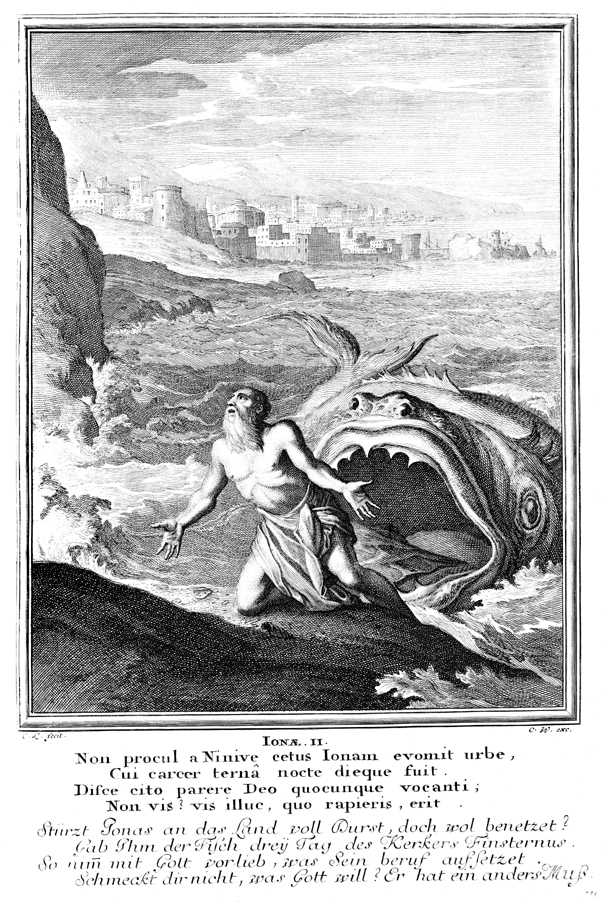
--Somehow, the image of a great fish being able to vomit a man out so that he lands directly on dry land . . . and so he doesn't have to first swim to the dry land or wash up on the dry land: I got an image in my mind of some late medieval artist's woodcut illustration of the event--where the fish sits upon the water and spits Jonah out. . . . And I got thinking: "Wait! Is this whole book more of a vision or a kind of 'moral tale' than it is a story of literal history?"

And as I read on into chapters 3 and 4, I came to think more and more that the question could--and probably should--be answered in the affirmative: This has more to do with God teaching us about the kinds of attitudes we ought to bear toward others than it does with any kind of literal cosmology.

Why? What evidence--or potential evidence--would lead me in such a direction?

[Let me note that what follows is my thinking. I have not done any research to find what other people have said (though I have done just enough looking online, now, to realize--what probably shouldn't come as a surprise to me, but, due to my background, actually is--that many others have thought the same thing that I am simply "toying" with, here (i.e., that Jonah may not be literal history).]
  • "Nineveh was an exceedingly great city, three days' journey in breadth" (3:3; NOTE: there are reasons for questioning whether the text really means three days' journey in breadth. It is possible it could mean something else--like, perhaps, "it took three days to walk around and see everything in it" [something like that]. But the next verse--which I'm about to quote--seems to speak against such alternatives). And (3:4), "Jonah began to go into the city, going a day's journey."

    --???!!! Was there such a large city anywhere in the world at that time? A city that would take three days to traverse? Even today: Is there any such city that would take three days to walk through? --Or should we view this reference to "Nineveh" as more of a vision of some quintessentially huge and wicked city (or civilization)?
     
  • Can I imagine any king, anywhere responding as the Book of Jonah suggests the king of Nineveh responded to the kind of message we are told Jonah preached? Some foreigner comes in and says, "Yet forty days, and Nineveh shall be overthrown!" and the king arises from his throne, removes his robe, covers himself with sackcloth, sits in ashes, and proclaims, "Let neither man nor beast, herd nor flock, taste anything. Let them not feed or drink water, but let man and beast be covered with sackcloth, and let them call out mightily to God. Let everyone turn from his evil way and from the violence that is in his hands. Who knows? God may turn and relent and turn from his fierce anger, so that we may not perish"?

    Sorry! That is really difficult for me to imagine. --It is certainly beyond my imagination as literal, "normal" history (which, of course, means: the only way this could possibly be history and not a vision is if God performed a truly astonishing miracle, perhaps sending a spirit of fear that completely unnerved the Ninevites [including their king]).

    [I should probably comment: Whether you want to call it a "spirit" or some kind of brain chemical imbalance, I know that only a day or two after I read Jonah, I woke up in the middle of the night--about 3 a.m.--and was fine. But then, suddenly, completely out of the blue, I felt the most awful, dark dread roll over me. Not fear, in the sense of feeling a "presence" "out there" that was coming to get me. Rather, some internal feeling of despair and darkness, a strange fear that maybe I would become so depressed that I would commit suicide. --Totally irrational. Totally without objective basis. But the feeling was there nonetheless. Absolute despair.

    Eventually, not wanting to awaken Sarita, I got up and began reading. My mental state lifted somewhat. Finally, at about 4:30 in the morning, I found myself both exhausted and feeling the need to move my bowels. Taking care of that business, suddenly: no more dark thoughts.

    I went back to bed, slept soundly for another hour and a half or two, and have been fine ever since.

    . . . So why did I go into those details? --Because I can imagine a similar overpowering "spirit" could come upon a political leader . . . or upon a whole nation . . . and they might behave as the Book of Jonah describes the Ninevites as behaving. . . .]
    But that is not "normal" history. Kings of mighty civilizations don't usually nor suddenly begin to quake in their boots because some foreigner comes to town and begins to say that the civilization is about to be overthrown. More usually, they respond defiantly and/or dismissively--as does the pharaoh in the Book of Exodus.

    So, as I noted above, though I want to be open to the possibility Jonah is "real"/literal history, I also sense and see evidence for the possibility--maybe even probability--that it is "something else" . . . perhaps, as I suggested above, some kind of "vision" or "apocalyptic."
Having said all that, however, I am up against the problems of the "slippery slope" ("If you're going to reinterpret Jonah--which sounds so much like literal/real history--as something other than literal history, then where do you end? Doesn't that open you to interpreting absolutely any- and everything in the Bible as something other than literal/real history?") and what about Jesus' comments that equate His death and resurrection to Jonah ("For just as Jonah was three days and three nights in the belly of the great fish, so will the Son of Man be three days and three nights in the heart of the earth" [Matthew 12:40] and, "For as Jonah became a sign to the people of Nineveh, so will the Son of Man be to this generation" [Luke 11:30])?

Yeah. Tough questions. And the main reason I haven't posted till now: These questions bother(ed) me too much to feel comfortable even to mention the thought that had niggled and continues to niggle at my brain.

But that's one of the reasons I like the Sonlighters Club forums and the entire blogosphere: I can raise these kinds of questions among friends (and, I realize, potential enemies!) who can help me work through issues, provide input both pro and con any particular viewpoint. . . .

So what initial replies do I have to these two key questions/critiques concerning the idea that Jonah might be more visionary than literal?
  1. Even the most ardent biblical literalists admit that, though "Most often, the biblical authors employed literal statements to communicate their ideas," still, "the biblical writers often used figurative language to communicate truth in a graphic way" (Hank Hanegraaff in his article about biblical hermeneutics titled L-I-G-H-T-S to The Word of God--referenced as a foundational source by one of the world's leading Young-Earth Creationist/literalist organizations, Answers in Genesis).

    Still, while Hanegraaff, for example, says that "in most cases, the meaning of such language is clear from the context," obviously, it isn't always clear . . . so we are left to wonder and puzzle these things out under the guidance of the Holy Spirit. There is no purely and wholly mechanical method by which we can determine whether a particular passage is to be taken literally or not.
     
  2. As for the problem of Jesus' references back to Jonah, I wonder: Is it necessary for Jonah to be literally historical in order for Jesus' references to bear weight?

    [Actually, it was this question, that I have just raised, that has held me back from posting for this past month.]

    --I have no good answers nor hints of answers.

    Do you?

  3. This kind of thinking and questioning, frankly, is scary to me. I have never been taught to question--or how, properly, to question Scripture in this way. But, somehow, I think it is important that we learn to do so . . . and how to do so.

    It is important so that we can "be prepared with an answer" to those from the "outside" who will raise these questions for us. --I think we, who believe in and desire with all our hearts to follow God and follow His Scriptures: We need to be able to confront these kinds of questions fairly, dispassionately, and without fear.

    It is important, too, I think, so that we can interpret Scripture rightly and so we can follow God with all our hearts, with all our souls, with all our minds, and with all our strengths. We ought not to feel we can follow it (and Him) only with our hearts but not with our minds (for example). And/or, we ought not to feel we can follow it (and Him) only half-heartedly and/or "half-mindedly."

    --Any ideas or thoughts you'd like to provide?

    [Please understand that, if you are reading this on Facebook, it appeared first on my personal blog.]
Reblog this post [with Zemanta]

Saturday, October 03, 2009

Music education: Waxing nostalgic a bit . . .

A couple of employees at Sonlight have started a blog about music education. Their first post inspired me to write about my musical training/background.

I'm curious to see where Tim and Anne Marie go with their blog. (I have some knowledge of what they have in mind. But they are also doing "their own thing," here, so there's also a huge gap in my knowledge and I really am curious to find out where they take this.) Even more--and this is why I'm writing this post--I am curious to find out what others think about music education and what they remember as they think about their own experiences with music education.

Indeed, I got thinking about writing this post because I want to ask my best friend from elementary school (whom I mention below) what he might have to say about these things.

Got any inputs you might want to share?

Here's what I wrote:
Let me start with my dad: He was a fairly accomplished pianist and violinist and--by everything I ever saw--really LOVED classical music. I mean, it MOVED him.

He wanted his 6 children--of whom I am #2--to love it the same way he did. As a result, he pushed me--at least, I think he pushed me! (I don't know anything about my other brothers and sisters)--to take piano when I was in first grade.

I hated it.

I hated having to walk the three miles to the lessons. I hated the practice. I thought it was "stupid." And it was certainly boring.

I don't remember the psychology of it all. Maybe I had asked for the lessons. Maybe. But, whatever, he kept on threatening me: "If you don't practice, I won't pay for your lessons."

I think I finally escaped the pain within about six months. Something like that.

But then, when I was in 4th grade, we (everyone in my class at school) learned a bit about the flutophone (cheap recorder). In 5th grade, we were encouraged to take up a real instrument.

I chose clarinet. I loved it. I got pretty good at it. My dad sent me to private lessons in addition to the public school lessons. I got up to Mozart's Concerto in A. Loved the music. Loved the sound of the instrument.

But my public school music teacher ("our" teacher) was an absolute witch. She verbally abused so many of the kids so badly, I "couldn't take it" anymore. (Honestly, as I recall: I don't think she abused me very much, if at all; I "simply" remember she would yell at kids and abuse them . . . and there was enough other noise going on in my life at the time at home that) I quit. I "just" left my instrument in the music hall at school one day with no intention of returning.

And I didn't.

My best friend went on with his clarinet playing and became quite good at it. In fact, last I knew, he does music for a living now (though not as a clarinetist).

Anyway.

I sang in church and in the church choir. Loved that outlet. Especially the tenor line.

Throughout high school, I used to listen to groups like the Moody Blues and sing along and especially enjoyed the high background wailing vocals.

Sometime about, maybe, 10 years ago, as the church moved more and more into "praise" music and completely abandoned four-part harmonized singing, I got the idea in my head that I would start harmonizing like the Moody Blues. So, at this point, whenever I can hear myself (i.e., the "worship band" doesn't play too loudly!) I try to improvise and add interesting ornamentations to whatever the rest of the congregation is singing.

*******

I think, honestly, if I had the opportunity to learn anything I wanted, I would love to learn how to play percussion (the only time I can recall ever laughing out loud for joy over someone's playing, it was because what a drummer was doing in the middle of a song; it moved me).

And the one other thing I would love to do is learn how to compose music. But/and, I'm afraid, I would have to learn a lot of music theory and, somehow, figure out (or be taught) the way music "fits together."

[I remember reading a good portion of Gödel, Escher, Bach by Douglas Hofstadter and being amazed at the patterns he described. I also recall watching/listening to and attempting to follow some of the early lessons in Piano for Life and being amazed at how regular the patterns are. --But I certainly don't understand these things! I can "feel" the harmonies when I sing; I have no idea where I am on the musical scale.]

Anyway.

FWIW.

John


--In case you're reading this on Facebook: This post originally appeared on my personal blog.