Showing posts sorted by relevance for query lamoureux. Sort by date Show all posts

Tuesday, July 21, 2009

Denis Lamoureux's Evolutionary Creation, Part II

Back to Denis Lamoureux and his book Evolutionary Creation.

I have taken so long to speak of his book again because I find the things he says so difficult, even, to acknowledge, much less talk about.

In my last post on this subject, I concluded with a series of examples of how Lamoureux views the specific content of Genesis chapters 1 through 3. In each case, he says, we need to ignore the history and science the Bible presents--they were, he says, the best history and science available to the people of that time and place (when and where the Scriptures were written), but they don't come close to matching what we know today. Instead, Lamoureux urges, we need to focus solely upon the spiritual messages contained in these passages: that, for example, God is the Creator (Genesis 1); that human beings are "the only creatures in a personal relationship with the Creator," "men and women were made to enjoy the mystery of marriage," and "God sets limits on human freedom, and failure to respect these boundaries has serious consequences" (Genesis 2); and so forth.

Lamoureux says we ought not--because we cannot (and still do justice to the Scriptures as written)-- . . . we ought not to reinterpret these passages as if they were intended as anything but literal history referring to literal (what we might call "scientifically verifiable") events and structures. Clearly, Lamoureux asserts, let us not pussy-foot around this:
  • The human authors of these portions of Scripture really and truly did intend for their readers to believe in (because they themselves believed in) a flat, immoveable/stationary, circular (not spherical!) earth that is set on (literal, physical) foundations and is surrounded by water.
     
  • They expected their audience to believe in (because they themselves believed in) a three-tiered universe composed of the flat, circular world in which we humans live, the underworld (beneath ours), and the heavenly realm (above).  
  • They spoke of the raqia or "firmament," a solid, dome-like structure held up by (solid, physical) foundations--a structure in which God has embedded the sun, moon, and stars and upon which He has placed a body of water "above" (the ancient explanation for why the sky is blue) . . . --They spoke of this raqia or "firmament" as a literal, physical, real entity because they really and truly believed it exists; its existence was questioned by no one; that was the "science of the day."
Lamoureux continues in this vein when it comes to history.

As far as he is concerned, it is clear that
  • The author/editors of Genesis chapter 1 had absolutely nothing to say about a slow, progressive, multi-million-year creation process. They didn't believe in such a creation and they didn't expect their audience to believe in such a creation . . . because it wasn't the science of the day.
Rather, he says,
  • The science of the day was, as the young-earth creationists urge it: carried out in the equivalent of six, 24-hour days. . . .
--I have been galloping along, here in my exposition of Lamoureux's teaching.

I want to take a break to note some places where I think Lamoureux probably failed, adequately, to do all his homework. Or, if he did his homework, he failed, adequately, to express what I believe he should have.

But let me do that in another post.


1 As Lamoureux writes (p. 106),
Never once is earth referred to as spherical. Nor is a globular shape implied by the context of any passage. Indeed, if it was God's purpose to reveal in Scripture the scientific fact that the earth is a sphere, then there were nearly 3000 opportunities to do so. He could easily have done this by comparing the earth to something round like a ball or an orange. [But He did not.]
Return to text.

2 The raqia or "firmament" is not an "expanse" as some modern translations try to soften it--a translation or interpretation that is wholly unsupported either by philology or history. Lamoureux is very detailed in his development of this point (p. 123):
The root of this noun [raqia] is the verb raqa which means "to flatten," "stamp down," "spread out," and "hammer out." That is, this Hebrew verb carries a nuance of flattening something solid rather than opening a broad empty space. . . . The verb raqa is even found in a passage referring to the creation of the sky, which is understood to be a firm surface like a metal. Job 37:18 asks, "Can you join God in spreading out [raqa--JAH] the skies, hard as a mirror of cast bronze?" (cf, Exod 24:10; Job 22:14; Ezek 1:22).
Return to text.

Saturday, July 04, 2009

Denis Lamoureux's Evolutionary Creation

Okay. It's time for me to begin talking about Denis Lamoureux's book Evolutionary Creation.

I finally concluded reading this tome on our flight home from Europe last Sunday. It was a painful--but, I thought, necessary--task.

I want to do for you what I don't normally do and what Lamoureux himself failed to do in his book: I want to summarize the guts of his "message" before I present the "arguments" he offers and my detailed critique of what he says and how he says it.

Basic Thesis

Lamoureux's basic thesis: the narratives contained in Genesis 1-11 convey uniquely God-inspired messages about spiritual realities and spiritual truths that human beings throughout history--all people--have needed and still need to take seriously. At the same time, he says, these narratives contain virtually no information that anyone should attend to in order to inform or shape their views of history or science.

Put another way: We need to apply the same kind of discernment to our interpretation of Scripture that we naturally afford our interpretation of Jesus' incarnation. We understand that, in order to speak to the people of His day, Jesus had to utilize the language and cultural forms appropriate to that time and place. Even if He had wanted to, He would not--because He could not, properly--speak of galaxies, bacteria, thermonuclear energy, or calculus. The concepts themselves didn't exist at that time in human culture, and there was no need for Jesus to "enlighten" them concerning their ignorance. Jesus spoke real (spiritual) truth, but He accommodated Himself to the limitations of His audience.

So it is, says Lamoureux, with Scripture. God speaks real (spiritual) truth in the Bible, but He accommodated Himself to the limitations of His audience when it came to the literary forms and the assumptive history and science communicated throughout. Rather than confusing and upsetting His audience with long-winded and, ultimately, almost assuredly non-understandable discourses about "the way things really are" in the physical realm, God utilized the history and science of their day-- the things they understood (whether literally true or not [and Lamoureux says they are not!])-- . . . God utilized what the people of that day understood concerning history and the physical realm in order to convey true Truth about spiritual realities.

Lamoureux's perspective: He calls it the "Message-Incident Principle." Anything in Genesis 1-11 that we might perceive as impinging on history or science . . . --Any such thing is merely an incidental vessel, the "packaging," if you will, designed to carry the spiritual message of Scripture--the central purpose for which the Bible was written.

In essence, then: We can toss the wrapper, even while we savor what the wrapper contains.

What Does Such a Perspective Mean . . . and How Far Should We Apply It?

Lamoureux is unable to hold his application of the Message-Incident Principle to Genesis 1-11 only. Indeed, part of his "argument" for the Principle rests on the historical debate over how one can adopt a Galilean-Copernican perspective concerning the universe in light of passages like 1 Chronicles 16:30b, Psalm 93:1b, or Psalm 96:10b--all of which unmistakably declare: "the world is firmly established, it will not be moved."

"No Christian today believes the earth is stationary," Lamoureux asserts, "and no one interprets [these passages] literally. For that matter, the Galileo affair teaches us that science contributes to biblical interpretation" (p. 112). And what it ought to contribute to our interpretation of Genesis 1-11, Lamoureux says, is the realization that Genesis 1 to 11 has nothing to contribute to us in the realm of science or history.

Moreover, while
[t]he Old Testament clearly presents the immovability of the earth, . . . the purpose of [1 Chronicles 16:30, Psalm 93:1, and Psalm 96:10] is not to reveal any fact about nature. Rather, [the phrase about the world's immovability is] found in passages that praise God's Lordship over the creation. In other words, this ancient geological understanding is an incidental vessel used to reveal the message that the Lord is the Ordainer and Sustainer of the world.

--Ibid.

In the same way, then, we need to (re)interpret Genesis 1-11. Thus, Genesis 1 is "not a record of the history of the creation of the heavens, and . . . [it] is not a history of the origin of life, including humanity" (p. 192); rather, "Christians throughout the ages [have recognized and need, today, to recognize] that the primary purpose of Gen 1 is to reveal the Message of Faith that God is the Creator" and, moreover, that men and women enjoy a "unique position" in the world as creatures made in God's image (p. 198).

Thus, too, Genesis 2 "is not historical" (p. 198) and "is not a historical account of human origins" (p. 201). "[I]ts purpose is not to disclose how God made the universe and life, including humanity" (p. 201), but it
complements the Divine Theology in Gen 1 and asserts that humanity is a special and unique creation. We are the only creatures in a personal relationship with the Creator. This chapter also reveals that men and women were made to enjoy the mystery of marriage. . . . And most importantly, Gen 2 reveals little God sets limits on human freedom, and failure to respect these boundaries has serious consequences.

--p. 202

As for Genesis 3:
[T]he ancient motifs in Gen 3, the ancient understanding of causality, and the fossil record all point away from the historicity of this chapter and the causal connection between sin and death. . . .[T]he Message of Faith in Gen 3 is not dependent upon the historical reality of a lost idyllic age, a talking snake, mystical fruit, or cherubim. Instead, these ancient motifs are incidental to a Divine Theology that was radically different from the pagan beliefs surrounding the Hebrews.

Genesis 3 reveals the reality of human sin. . . . [It] reveals that humans are responsible for their actions and are accountable before God. The consequences of disobedience are significant because the Creator judges men and women for their sins. . . .

Despite the traditional literal reading of Gen 3 as actual history, the revelatory power of this divinely inspired account has been affirmed over and over again throughout the ages. It has consistently convicted men and women of their sins, and has left him knowing that God judges them accordingly. . . . Who has not experienced the spiritual-intellectual dynamic of the Garden of Eden? Is anyone not tempted to disobey their Maker? And who has not tried to rationalize their sin before the Holy Spirit? Clearly, the inerrant and infallible Messages of Faith in Gen 3 transcend the incidental ancient motifs and ancient categories of causality through which they are revealed.

--pp. 202, 203, 206

And so it goes.

Lamoureux(re)interprets each chapter of Genesis 1-11 along these lines.

And beyond Genesis 1-11?

. . . I'll have to address that in my next post on this subject.


Reblog this post [with Zemanta]

Wednesday, October 07, 2009

Jonah

It's been almost a month since I read Jonah as part of my reading-through-the-Bible-in-a-year program. At the time, the thought hit me: What if . . . ? What if Jonah is not history (as I think I was encouraged to believe as a youngster), but, rather, more like a vision--like the dreams and visions of Daniel . . . or the Apocalypse of John?

I'm not completely sure why the thought hit me.

Partially, I'm sure, it was because I had read Daniel only about a week before, so his dreams and visions were still rather fresh in mind.

Another reason why the thought may have hit me: Throughout my reading of the Old Testament, I have kept being reminded of some of the things Lamoureux said about the ancient Hebrew and ancient near-eastern cosmology. (I still have to finish my series on Lamoureux's book. Let it suffice for me to say: Lamoureux asserts that [many of] the ancient Hebrews and [many of] the people living in the ancient near-east viewed the world very differently than we do today. Thus, for example, when Daniel speaks [Daniel 4:10-11, 20] of a tree that appears in the middle of the earth/land that grows so large that it is able to reach to the sky and be visible to the end of the entire earth/land--"Obviously," says Lamoureux, "there is no 'center' on the surface of a sphere. Only in the context of a two-dimensional circular earth does this verse make sense. . . . But again, the purpose of the Bible is not to disclose science and the shape of the earth. . . . [Rather,] the Holy Spirit descended to Nebuchadnezzar's level and used the geology-of-the-day. . . . Only in the context of a flat earth with ends does this passage make sense. On a spherical planet, it is not possible to see the 'whole' earth from any tree, no matter how tall it might be" [Denis O. Lamoureux, Evolutionary Creation, pp. 116-117].) --I've been "testing" Lamoureux's thesis: Do I believe--and, supposing I do, why do I believe--that someone in the ancient near east (a Jew) would have believed that this, that, or the next passage was really "teaching" or "revealing" a literal cosmology? [For example, did the writer of Psalm 78:23--"Yet He commanded the clouds above/And opened the doors of heaven"--really believe in some kind of literal ("real") "doors" in heaven? Or could he have "simply" been using imagistic language?])

And so, in Jonah, I began thinking:
  • Jonah says he fears YHWH the God of heaven, who made the sea and the dry land (1:9), and yet he is trying to flee from the presence of this God (v. 10). --What kind of worldview must he have had if he could both believe that YHWH is the God of heaven and He created the sea and the dry land . . . and yet Jonah is trying to flee from Him? (???)
     
  • What kind of view of nature did the author--and/or Jonah and/or the seamen who tossed him into the sea-- . . . What kind of view of nature must any of these people have had for Jonah to say (1:12), "Pick me up and hurl me into the sea; then the sea will quiet down for you" and/or for the author to write (1:15), "So they picked up Jonah and hurled him into the sea, and the sea ceased from its raging"? --Are these expressions indications of possible animistic worldviews in which the sea has a mind or spirit of its own?
     
  • God appoints a great fish to swallow Jonah . . . and Jonah remains in the fish's belly for three days and three nights. --Clearly, this should at least raise a question about the physical difficulties of survival associated with living inside a fish--no matter how large it may be--for any extended period of time. (From where was Jonah supposed to get his air?)
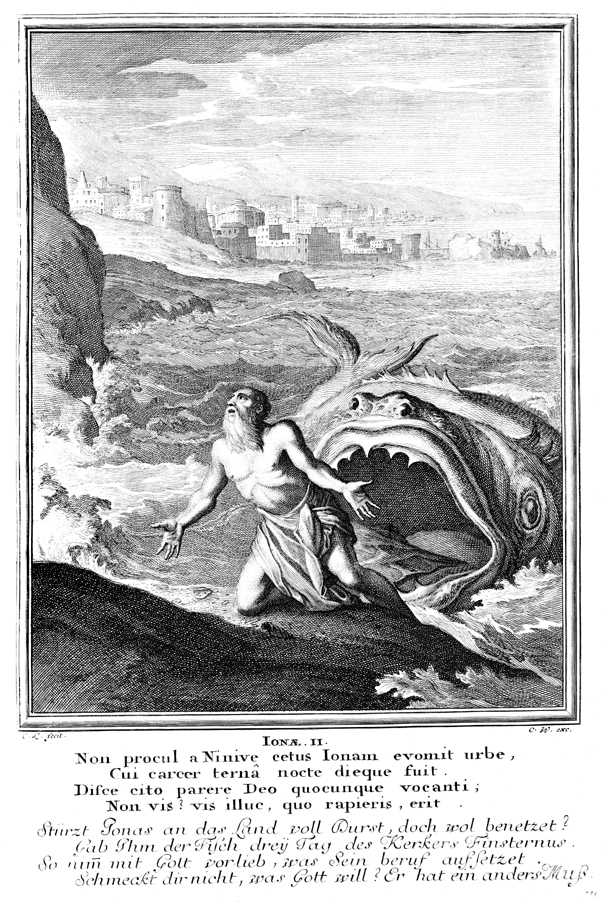
But the point at which my mind really shifted was at Jonah 2:10:
And [YHWH] spoke to the fish, and it vomited Jonah out upon the dry land.
--Somehow, the image of a great fish being able to vomit a man out so that he lands directly on dry land . . . and so he doesn't have to first swim to the dry land or wash up on the dry land: I got an image in my mind of some late medieval artist's woodcut illustration of the event--where the fish sits upon the water and spits Jonah out. . . . And I got thinking: "Wait! Is this whole book more of a vision or a kind of 'moral tale' than it is a story of literal history?"

And as I read on into chapters 3 and 4, I came to think more and more that the question could--and probably should--be answered in the affirmative: This has more to do with God teaching us about the kinds of attitudes we ought to bear toward others than it does with any kind of literal cosmology.

Why? What evidence--or potential evidence--would lead me in such a direction?

[Let me note that what follows is my thinking. I have not done any research to find what other people have said (though I have done just enough looking online, now, to realize--what probably shouldn't come as a surprise to me, but, due to my background, actually is--that many others have thought the same thing that I am simply "toying" with, here (i.e., that Jonah may not be literal history).]
  • "Nineveh was an exceedingly great city, three days' journey in breadth" (3:3; NOTE: there are reasons for questioning whether the text really means three days' journey in breadth. It is possible it could mean something else--like, perhaps, "it took three days to walk around and see everything in it" [something like that]. But the next verse--which I'm about to quote--seems to speak against such alternatives). And (3:4), "Jonah began to go into the city, going a day's journey."

    --???!!! Was there such a large city anywhere in the world at that time? A city that would take three days to traverse? Even today: Is there any such city that would take three days to walk through? --Or should we view this reference to "Nineveh" as more of a vision of some quintessentially huge and wicked city (or civilization)?
     
  • Can I imagine any king, anywhere responding as the Book of Jonah suggests the king of Nineveh responded to the kind of message we are told Jonah preached? Some foreigner comes in and says, "Yet forty days, and Nineveh shall be overthrown!" and the king arises from his throne, removes his robe, covers himself with sackcloth, sits in ashes, and proclaims, "Let neither man nor beast, herd nor flock, taste anything. Let them not feed or drink water, but let man and beast be covered with sackcloth, and let them call out mightily to God. Let everyone turn from his evil way and from the violence that is in his hands. Who knows? God may turn and relent and turn from his fierce anger, so that we may not perish"?

    Sorry! That is really difficult for me to imagine. --It is certainly beyond my imagination as literal, "normal" history (which, of course, means: the only way this could possibly be history and not a vision is if God performed a truly astonishing miracle, perhaps sending a spirit of fear that completely unnerved the Ninevites [including their king]).

    [I should probably comment: Whether you want to call it a "spirit" or some kind of brain chemical imbalance, I know that only a day or two after I read Jonah, I woke up in the middle of the night--about 3 a.m.--and was fine. But then, suddenly, completely out of the blue, I felt the most awful, dark dread roll over me. Not fear, in the sense of feeling a "presence" "out there" that was coming to get me. Rather, some internal feeling of despair and darkness, a strange fear that maybe I would become so depressed that I would commit suicide. --Totally irrational. Totally without objective basis. But the feeling was there nonetheless. Absolute despair.

    Eventually, not wanting to awaken Sarita, I got up and began reading. My mental state lifted somewhat. Finally, at about 4:30 in the morning, I found myself both exhausted and feeling the need to move my bowels. Taking care of that business, suddenly: no more dark thoughts.

    I went back to bed, slept soundly for another hour and a half or two, and have been fine ever since.

    . . . So why did I go into those details? --Because I can imagine a similar overpowering "spirit" could come upon a political leader . . . or upon a whole nation . . . and they might behave as the Book of Jonah describes the Ninevites as behaving. . . .]
    But that is not "normal" history. Kings of mighty civilizations don't usually nor suddenly begin to quake in their boots because some foreigner comes to town and begins to say that the civilization is about to be overthrown. More usually, they respond defiantly and/or dismissively--as does the pharaoh in the Book of Exodus.

    So, as I noted above, though I want to be open to the possibility Jonah is "real"/literal history, I also sense and see evidence for the possibility--maybe even probability--that it is "something else" . . . perhaps, as I suggested above, some kind of "vision" or "apocalyptic."
Having said all that, however, I am up against the problems of the "slippery slope" ("If you're going to reinterpret Jonah--which sounds so much like literal/real history--as something other than literal history, then where do you end? Doesn't that open you to interpreting absolutely any- and everything in the Bible as something other than literal/real history?") and what about Jesus' comments that equate His death and resurrection to Jonah ("For just as Jonah was three days and three nights in the belly of the great fish, so will the Son of Man be three days and three nights in the heart of the earth" [Matthew 12:40] and, "For as Jonah became a sign to the people of Nineveh, so will the Son of Man be to this generation" [Luke 11:30])?

Yeah. Tough questions. And the main reason I haven't posted till now: These questions bother(ed) me too much to feel comfortable even to mention the thought that had niggled and continues to niggle at my brain.

But that's one of the reasons I like the Sonlighters Club forums and the entire blogosphere: I can raise these kinds of questions among friends (and, I realize, potential enemies!) who can help me work through issues, provide input both pro and con any particular viewpoint. . . .

So what initial replies do I have to these two key questions/critiques concerning the idea that Jonah might be more visionary than literal?
  1. Even the most ardent biblical literalists admit that, though "Most often, the biblical authors employed literal statements to communicate their ideas," still, "the biblical writers often used figurative language to communicate truth in a graphic way" (Hank Hanegraaff in his article about biblical hermeneutics titled L-I-G-H-T-S to The Word of God--referenced as a foundational source by one of the world's leading Young-Earth Creationist/literalist organizations, Answers in Genesis).

    Still, while Hanegraaff, for example, says that "in most cases, the meaning of such language is clear from the context," obviously, it isn't always clear . . . so we are left to wonder and puzzle these things out under the guidance of the Holy Spirit. There is no purely and wholly mechanical method by which we can determine whether a particular passage is to be taken literally or not.
     
  2. As for the problem of Jesus' references back to Jonah, I wonder: Is it necessary for Jonah to be literally historical in order for Jesus' references to bear weight?

    [Actually, it was this question, that I have just raised, that has held me back from posting for this past month.]

    --I have no good answers nor hints of answers.

    Do you?

  3. This kind of thinking and questioning, frankly, is scary to me. I have never been taught to question--or how, properly, to question Scripture in this way. But, somehow, I think it is important that we learn to do so . . . and how to do so.

    It is important so that we can "be prepared with an answer" to those from the "outside" who will raise these questions for us. --I think we, who believe in and desire with all our hearts to follow God and follow His Scriptures: We need to be able to confront these kinds of questions fairly, dispassionately, and without fear.

    It is important, too, I think, so that we can interpret Scripture rightly and so we can follow God with all our hearts, with all our souls, with all our minds, and with all our strengths. We ought not to feel we can follow it (and Him) only with our hearts but not with our minds (for example). And/or, we ought not to feel we can follow it (and Him) only half-heartedly and/or "half-mindedly."

    --Any ideas or thoughts you'd like to provide?

    [Please understand that, if you are reading this on Facebook, it appeared first on my personal blog.]
Reblog this post [with Zemanta]

Sunday, May 17, 2009

A little more about evolution . . . and creation . . . and Intelligent Design

I haven't posted lately on this topic. Partially because I have been preoccupied with so many other subjects.

But I continue to read a bit on the subject. I've picked up a few additional books. . . . And I have continued to follow an email discussion list I'm on in which some highly educated Old-Earth Creationists (primarily ID advocates, as far as I can tell) discuss their views.

A few issues have bubbled high enough above the surface that I feel compelled to comment.

  1. I just discovered that Denyse O'Leary wrote a blog post at the end of last year in which she notes,
    Freelance reporter Suzan Mazur (Scoop, March 4[, 2008]) pulls back the veil on one of evolution's little known secrets--Darwinism is dead as a theory of evolution:
    It's not Yasgur's Farm, but what happens at the Konrad Lorenz Institute in Altenberg, Austria this July promises to be far more transforming for the world than Woodstock. What it amounts to is a gathering of 16 biologists and philosophers of rock star stature—let's call them ‘the Altenberg 16’—who recognize that the theory of evolution which most practicing biologists accept and which is taught in classrooms today, is inadequate in explaining our existence. It's pre the discovery of DNA, lacks a theory for body form and does not accommodate ‘other’ new phenomena.
    Mazur explores the views of the Altenberg 16 "self-organization proponents" and their attack on Darwinism as they desperately search for another materialistic explanation for life in a six-part E-Book.
    Frankly, I am grateful for this post because it encourages me in--what I have been thinking I need to do--maintaining my generally agnostic view with respect to origins . . . at least with respect to physical mechanisms.
     
  2. I thought I should encourage you, potentially, to follow the reference to Mazur's e-book. Mazur writes, in her introduction:
    No one knows how life began, but so-called theories of evolution are continually being announced. This book, The Altenberg 16: Will the Real Theory of Evolution Please Stand Up? exposes the rivalry in science today surrounding attempts to discover that elusive mechanism of evolution.
    Nice start. Helpful summary of her subject matter.

    But look where she goes!
    Evolutionary science is as much about the posturing, salesmanship, stonewalling and bullying that goes on as it is about actual scientific theory. It is a social discourse involving hypotheses of staggering complexity with scientists, recipients of the biggest grants of any intellectuals, assuming the power of politicians while engaged in Animal House pie-throwing and name-calling: "ham-fisted", "looney Marxist hangover", "secular creationist", "philosopher" (a scientist who can’t get grants anymore), "quack", "crackpot". . .

    In short, it’s a modern day quest for the holy grail, but with few knights. At a time that calls for scientific vision, scientific inquiry’s been hijacked by an industry of greed, with evolution books hyped like snake oil at a carnival.

    Perhaps the most egregious display of commercial dishonesty is next year’s [i.e., at the time of writing, 2009's --JAH] celebration of Charles Darwin’s Origin of Species – the so-called theory of evolution by natural selection, i.e., survival of the fittest, that was foisted on us almost 150 years ago.

    Scientists agree that natural selection can occur. But the scientific community has known for some time that natural selection has nothing to do with evolution. It also knows that self-assembly is real, that is, matter can form without a genetic recipe – like the snowflake (non-living). It does this without external guidance.

    And that the Hydra (living), for example, can self-organize its scattered cells even after being forced through a sieve. Yet, science elites continue to term self-assembly and self-organization "woo woo".

    Coinciding with the 2009 Darwinian celebration, MIT will publish a book by 16 biologists and philosophers meeting in Altenberg, Austria at the Konrad Lorenz Institute in July [2008 --JAH] to discuss a reformulation of the theory of evolution. That’s the mansion made famous by Konrad Lorenz’s imprinting experiments, where Lorenz got his geese to follow him because they sensed he was their mother.

    The symposium’s title is "Toward an Extended Evolutionary Synthesis?", although the event is expected to be the actual kickoff of an evolution remix.

    Some of the Altenberg 16 or A-16, as I like to call them, have hinted that they’re trying to steer science in a more honest direction, that is, by addressing non-centrality of the gene. They say that the "Modern Evolutionary Synthesis", also called neo-Darwinism – which cobbled together the budding field of population genetics and paleontology, etc., 70 years ago – also marginalized the inquiry into morphology. And that it is then – in the 1930s and 1940s – that the seeds of corruption were planted and an Evolution industry born. . . .

    But will the A-16 deliver? Will they help rid us of the natural selection "survival of the fittest" mentality that has plagued civilization for a century and a half, and on which Darwinism and neo-Darwinism are based, now that the cat is out of the bag that selection is politics not science? That selection cannot be measured exactly. That it is not the mechanism of evolution. That it is an abstract rusty tool left over from 19th century British imperial exploits.

    Or will the A-16 tip-toe around the issue, appease the Darwin industry and protect foundation grants? . . .

    --Bold emphases mine. --JAH

    I haven't read the entire e-book. I'm just sayin': It looks like it's got some fascinating content!

    ******

    Oh. Before I stop on this subject: I should probably note what actually happened at the A-16 conference since that was 10 months ago.

    I have to confess, I'm not impressed. Though perhaps I "simply" don't know enough. But here's what Massimo Pigliucci, the conference sponsor, wrote about it:
    By incorporating [a series of exciting empirical and conceptual advances that have marked the field [of evolutionary theory] in recent time] into our understanding of evolution, we believe that the explanatory power of evolutionary theory is greatly expanded within biology and beyond. As is the nature of science, some of the new ideas will stand the test of time, while others will be significantly modified. Nonetheless, there is much justified excitement in evolutionary biology these days. This is a propitious time to engage the scientific community in a vast interdisciplinary effort to further our understanding of how life evolves.
    Really. Truly. That's the "final statement emerging from the Altenberg workshop, agreed upon by all 16 participants"!

    Are you impressed?

    Yeah. I didn't think so. Nor am I.

    Oh. you wonder what the "exciting empirical and conceptual advances" might be?

    Here they are:
    The new information includes findings from the continuing molecular biology revolution, as well as a large body of empirical knowledge on genetic variation in natural populations, phenotypic plasticity, phylogenetics, species-level stasis and punctuational evolution, and developmental biology, among others.

    The new concepts include (but are not limited to): evolvability, developmental plasticity, phenotypic and genetic accommodation, punctuated evolution, phenotypic innovation, facilitated variation, epigenetic inheritance, and multi-level selection.
    Sorry, that still doesn't do it for me.
     
  3. Then there is this post about Philip S. Skell's Forbes magazine article, The Dangers Of Overselling Evolution.

    Skell writes:
    It is widely accepted that the growth of science and technology in the West, which accounts for the remarkable advances we enjoy today in medicine, agriculture, travel, communications, etc., coincided with the separation, several centuries ago, of the experimental sciences from the dominance of the other important fields of philosophy, metaphysics, theology and history.

    Yet many popularizers of Darwin's theory now claim that without the study of ancient biological history, our students will not be prepared to engage in the great variety of modern experimental activities expected of them. The public should view with profound alarm this unnecessary and misguided reintroduction of speculative historical, philosophical and religious ideas into the realms of experimental science.

    It is more crucial to consider history in the fields of astrophysics and geology than in biology.
    . . . And he goes on from there.

    I would recommend either Mats' blog post about Skell's article or Skell's article itself.

    *******

    As with my last comment: I should probably note that Mats seems like a very interesting person. He seems to be Italian Portuguese (see his Blogger profile and notice he lives in Lisbon; check out the "background" language on his site as well); yet he is very tuned-in to American society. It appears he identifies himself as an evolutionist (scan down to the very end of the post and look at item #4), yet he writes some of the most thoughtful and "deep" anti-evolutionary/pro-young-earth-creationist stuff I think I have ever seen. (Check out his recent Are Secular Geologists Ready to Consider a Global Flood? post.)
     
  4. From the email discussions: One member wrote,
    Here's my take on ID and Natural Selection:

    "Intelligent Design" is a tautology.

    "Natural Selection" is an oxymoron.

    The word "selection" is an anthropomorphism which implies intelligence - a series of items are evaluated against some standard and either approved or discarded. The term "natural selection" thus implicitly attributes such divine action to nature, causing the word "nature" to suddenly have two parallel and opposite meanings. It can mean "random, undirected process" or "intelligent, directed process", depending on the whims of the user. As such, the word "nature" loses its meaning. Linguistically, the correct terminology is "random patterning". While I believe that patterns still inherently reflect design, I am willing to concede this word to the evolutionists in order to have fruitful debate. At least "patterning" does not imply directionality, as "selection" does. And "random" in its popular usage cannot hold any implication of intelligence, no matter what noun it describes.

    TE's [i.e., theistic evolutionists] survive on this sleight of logic - they can truly and rationally talk of "natural selection", although issues of pan(en)theism inevitably crop up time and again, even if often hotly denied, then certain often indirectly implied.

    Darwinians should not be allowed to use the phrase "natural selection" at all and should be restricted to "random patterning". It would be interesting to see if any could manage to do so for longer than a few minutes at a time.
    I love that: "random patterning"! :-)
     
  5. Okay. Finally: I just got a copy of Denis Lamoureux's Evolutionary Creation. Whether he convinces me about the need to believe in a truly evolutionary creationism or not (something I am disinclined to expect at this time!), I am finding his discussion--even as I found Glover's and the Haarsmas' discussions--fascinating and useful.

    Just in Chapter 1, as he lays out the subject matter he wants to address, I think his distinctions are helpful:
    Today the origin of the universe and life is often seen in Black-and-white categories. For many people, the cosmos and its living organisms came about through one of two ways--either evolution or creation. In other words, the subject of origins is cast as a dichotomy. . . . It is an issue that is divided into only two simple positions. Regrettably, this either/or type of thinking fuels the popular perception that modern science and Christian faith are entrenched in an endless war. . . ..

    A critical factor that fuels the origins dichotomy is the popular use of the terms evolution and creation. These words are often merged inadvertently with concepts that narrow the range of meaning. This problem is known as the conflation of ideas. Defined specifically, conflation is the carelessly collapsing of distinct categories into one single poorly conceived notion. For many people today, evolution is blended with a godless worldview, and creation is dissolved into a strict six-day literal interpretation of Gen 1. Consequently, the common use of these terms limits thinking and traps the discussion and a never-ending evolution vs. creation debate. . . .

    For most people, the term evolution refers to a biological theory of molecules-to-people that is driven only by blind chance. this word is conflated with an atheistic worldview--the belief that God does not exist and that our existence has no ultimate meaning or purpose. Understandably, this popular use of evolution produces strong negative reactions within the Church. But for some Christians, evolution is simply the method through which the Lord created life, including humans who bear His Image. . . .
    What fascinates me is how Lamoureux goes on to distinguish two "types" of evolution, what he calls teleological and dysteleological evolution, the one having a plan and purpose (teleological more or less means, literally, "having an end" (i.e., goal or purpose)) and the other one having no plan or purpose, the one reflecting intelligent design and the other no intelligent design.

    Somehow, I find that simply having a precise vocabulary to describe a concept helps me to understand the concept.

    *******

    Finally
     
  6. A few nights ago, I was thinking again about the issue of God's sovereignty and chance . . . as the Haarsmas discuss it here and here.

    I got thinking about this because Sarita has been following the Denver Nuggets as they pursue the NBA championship. She wondered aloud whether they had thrown Game 4 in their series with Dallas simply so they could come back to Denver and win in front of the home crowd. I mean, really: they are up by 14 points at the half and then they lose by two?

    Anyway. That's Sarita. She's a skeptic when it comes to these kinds of things.

    But I got thinking: Can anyone be sure whether the team threw the game or not?

    And what about the teams where, historically, we know they threw games--like the Chicago "Black Sox" scandal of 1919? Or the widespread game fixing that went on in college basketball in the late '40s and '50s. --Can the fans tell that this is going on?

    Often not!

    So--to borrow and modify a phrase from Ken Ham--if fallible human beings are able to fix games and throw games and make certain events appear totally "random" or "unpredictable" even while they are very intentional . . . why can't we believe that God could make physical events (mutations or "self-assemblies") appear "totally random" even though they are not?

    Just a thought.

Okay. I'm done.

Thanks for listening!

Monday, June 29, 2009

Re-entry

So I've been not only out of town, but almost beyond reach of the web for a bit over two weeks, now. Sarita and I enjoyed a two-week river cruise from Amsterdam, Holland, to Budapest, Hungary, with the last few days actually spent driving around in Austria, Slovakia, and Hungary . . . because the Danube was flooded and river traffic was halted.

I want to share a few of my observations from the trip, but not in this post. I wrote a few posts at the time I experienced what I wrote about. I intend to "back fill" those posts. Hopefully later today.

And then I intend to do a major post--or two or three or four--on Lamoureux's Evolutionary Creation. --Talk about a potentially revolutionary book! . . . But, oh, so hard to read! Terrible! (But I will get into that later, in my posts.)

Okay.

This is just to say "hello," and "glad to be back," and, "sorry I missed you" for these last few weeks.

Saturday, January 01, 2011

A sermon, a quest, and a book . . .

Last Sunday our pastor preached a good end-of-year/beginning-of-year sermon. He asked us seriously to consider four questions:
  • What do [I] need to Celebrate?
     
  • What do [I] need to Change?
     
  • What do [I] need to Conclude [or End/Terminate]?
     
  • What [am I] Contending for?
At each point during the sermon, he paused and gave us time to write down answers to the questions.

What do I need to Celebrate?

I found myself filled with fear when he paused for the first question. It was as if my mind was completely blank. It wasn't that I was thinking there was nothing to celebrate; rather, my memory completely failed me. Last year was a complete blank in my mind. I was afraid he would begin speaking again before I could remember a single thing.

Happily, eventually I remembered a couple of things for which I am grateful:
  • My Passport to India. That was a very exciting program!
     
  • A general sense that I am gaining new purpose and direction in my life.
     
  • Related to the previous item (and very much freeing me to move in new directions!): A greater and greater confidence that staff members at Sonlight/InquisiCorp are fully competent to take on and complete more and more of the tasks that I used to do.

"What do I need to Change?"

Oh boy! Deep in my heart I have been anguishing over a number of intellectual and spiritual issues that I have been unable to put aside . . . for years.

[If you have been following this blog for the last couple of years, you may remember that I promised--back in July of 2009!--to "note some places where I think Lamoureux probably failed, adequately, to do all his homework. Or, if he did his homework, he failed, adequately, to express what I believe he should have." "Let me do that in another post," I said. But I have never returned to the subject. Because I have been afraid to confront the issues. I know a lot of what I need to confront; but it scares me to do so. It scares me even to ask the questions . . . because, I'm afraid, even to ask the questions will, for many people, brand me a heretic. I am afraid that if I ask the questions--or if I admit, even, to reading the books written by certain people--those actions on my part, in themselves, will open me to being branded a heretic. And so I have shied away from raising the issues or asking the questions or--to be most forthright about it--seeking the answers! (I have direct, personal, and very costly experience that has helped create the fear within me. And I have no doubt I will soon tell the story of that experience. But as I write this post, that is for the future.)

The fear of which I speak is not unfounded, I think.

It is as if you were an intellectually open person in the 1950s. Wanting to listen thoughtfully, analytically--maybe even skeptically and disdainfully! (but with care and concern for honesty and justice)--to the heartfelt concerns of leading Socialists and Communists, you purchased or borrowed books written by well spoken advocates for those positions. But, for your troubles, you suddenly find yourself hauled before HUAC--the House Un-American Activities Committee.

In a free society, especially in a self-described Christian society--one in which, I would expect, members are dedicated to honesty, care, love and respect for their fellow human beings! --It seems to me that intellectually rigorous and honest and compassionate concern for the truth and for those who may be of a different opinion or who may be held under sway of a different worldview . . . It seems to me that such behavior should be honored and valued rather than held in disdain or abhorrence.]
. . . Well, I determined on Sunday that I need to put an end to my anguish; I need to stop holding back on confronting the issues; I need to write the book that I've been figuring, for the last several years, at least, that I need to write.

I wrote in my sermon notes: "Write on blog each day?" [I figured that, by writing a blog post each day, I would eventually get my thoughts out of my head and could then, eventually, form them into a unified whole called a book.]

And then Pastor Peter asked his next question:

"What do you need to Conclude?"

Well, I said to myself, I guess I am moving in the right direction!

But I wrote under this item that I need to finish or complete editing on two books written by friends of mine (who often read my blog and so shall go nameless!). I very much want to do those projects for them; I think that they are valuable. But I need to get them out of the way so I can attend more fully to my own project.

And then, finally,

For what are you Contending?

I thought that was an interesting question. Pastor Peter illustrated his meaning by reference to a former assistant pastor in our church who has always had a sensitive spot in his heart for immigrants. "In any room, in any meeting, with any group of people, and he was always on the lookout for the person from another culture," Pastor Peter said.

In essence, he said (at least, this was the meaning that I took away!), "For whose interests are you looking out?"

I found that question rather easy to answer. Especially in the context of what I had written in answer to the previous two questions. I believe I am and always have been most sensitive to and concerned about those who struggle intellectually with issues of faith (or "the" faith). --And, of course (if you know me), that means people who struggle with issues related to Christian faith.

It feels to me as if Christians are "not allowed" to ask the deepest questions. Those who don't struggle find the questions of those of us who do impertinent, bothersome, offensive, demonstrating a fundamental disrespect or disdain for the things of God.

And while I can understand that . . . feeling . . . And while I am sure there are many atheists about whom such comments might be made in truth, I believe that those who assume anyone who asks such questions must be coming from a position of disrespect and disdain are, themselves, demonstrating a fundamental disrespect and disdain for the person who has legitimate and innocent reasons for asking such questions! Indeed, the (non-questioning) people who level such charges are exhibiting an immaturity and fear that ought to have no place in a church or community that claims to be filled with the Spirit, power and wisdom of an almighty and all-knowing God!

But backing off from the sociology or context of question-asking and returning to my conclusions from last Sunday's sermon (!!!), I decided my best course of action at this time is to start a new blog--something separate from John's Corner of the World--to pursue these issues head-on.

If you would like to join me in that particular area of interest, I invite you to visit (the first of) what may become a series of "Forbidden Questions" blogs: Forbidden Questions: Bible & Faith.

[I should probably also note: I am thinking I may create another blog or two--one to deal with health issues and, possibly, a second one to deal with matters related to food. But however much I might enjoy writing those other blogs, creation of the Forbidden Questions blog, I believe, is a responsibility from which I cannot escape. (See my excursus on calling from a few weeks ago.)]