Showing posts sorted by date for query hyperinflation. Sort by relevance Show all posts

Monday, May 23, 2011

"Kicking the can"

I thought I would post some of the most recent inputs I've been receiving about our government's failure to address the financial crisis.

From Dr. Gary North (5/17/2011):
The worst crisis from the government's point of view is the national debt crisis. It leads to calls for reduced government spending. For this crisis, the government has this well-orchestrated response:
  1. An admission that it is real, but not imminent
     
  2. A promise to deal with it later
     
  3. A call to spend more now to spend less later
     
  4. Kabuki theater [According to Wikipedia: "classical Japanese dance-drama . . . known for the stylization of its drama and for the elaborate make-up worn by some of its performers. . . . (The word) kabuki can be interpreted as "avant-garde" or "bizarre" theatre. The expression kabukimono (歌舞伎者) referred originally to those who were bizarrely dressed and swaggered on a street."]
This week, the issue of the U.S. government's debt ceiling comes up for discussion in Congress. The Secretary of the Treasury has offered a dire forecast. There will be a double-dip recession unless Congress votes to raise the debt ceiling once again. Congress does this every year, but this year there is pressure from new House members not to raise the ceiling. Meanwhile, the government is in the middle of a $1.65 trillion on-budget deficit. Like a tornado, the deficit will hit the political will of Congress. There is no basement storm shelter. There is no safe room.

Congress's will to resist will be flattened, as it is every year. Usually, this vote has been pro forma. The media may mention it, but not as a prime-time story. It is always assumed that Congress will rubber stamp the proposed increase, in order to avoid a partial shutdown of the government -- maybe 10% of operations. For Congress, this is regarded as a level-5 tornado, not a squall.

The debt limit will be reached this week. Geithner says that he can juggle accounts until August, but at that point, the government will have to default -- the big D.

Speaker of the House Boehner has said that there will be a hike in the debt ceiling, but it will be a very special kind of increase. He said on the CBS Sunday morning news show, Face the Nation, that "we're going to do it in a way that addresses America's long-term fiscal challenges." . . .

In a previously recorded segment of the show, President Obama invoked what has become a familiar refrain: the recurrence of the 2008 crisis. If investors ever "thought the full faith and credit of the U.S. was not being backed up, if they thought we might renege on our IOUs, it could unravel the entire financial system. We could have a worse recession than we've already had."

Of course, neither Boehner nor Obama mentioned the possibility of cutting Federal spending in order to balance the budget this year and thereby avoid having to raise the debt ceiling ever again. Such a strategy is too radical. The proposed official solution is to raise the ceiling again, and to promise that this will not always be necessary, because economic growth will raise tax revenues One of These Days, Real Soon Now. The budget will be balanced. The recession will not arrive. They promise.

This year is different. The discussion is front-page, prime-time news. This is because a handful of first-term Congressional Republicans in the House are making noises about cutting spending in order to reduce the size of the increase. They don't have the votes, as we will see. These Congressmen say publicly that they see what is economically necessary, but economics has little influence in Congress. The majority of the members think they can kick the can down the road for another year. In 2012, they will all campaign on responsible spending. The operational definition of "responsible spending" never changes: "kick the can again."

DEFAULT IS COMING

In his interview in front of an audience, President Obama warned about the consequences of a default by the U.S. government. It could unravel the worldwide economic recovery. You can see the video here.

He is correct. If the Federal government ever stops paying interest on its debt, the repercussions in the financial markets would be severe. It would be worse than the crisis in the fall of 2008.

The problem we face is this: with every increase in the Federal debt ceiling, the likelihood of default increases. The politicians' solution to the threat of default is to delay the default.

The government is trapped. It really does face the prospects of default if the debt ceiling is not raised. The alternative is to cut spending drastically before August. But that would be a form of default. Certain groups that have been promised largesse from the Federal government would find that the promises were not binding.

The problem is now selective default. The Congress and the White House always agree to defer any form of default. This is why we can be sure that selective default is inevitable. The deficit numbers do not allow the government to escape the increase in the debt ceiling.

We know from decades of experience that selective defaults are not politically acceptable. So, the deficit keeps growing. The debt ceiling keeps getting raised. This is done in the name of default-avoidance.

The battle over the debt ceiling is a sham. If Congress cannot legislate spending cuts that will balance the budget, then there is no possibility that it will put a cap on total expenditures by means of a debt ceiling. There was no significant reduction in the deficit earlier this year. The deficit in fact rose compared to last year's forecast.

This is why the debate over the deficit is American kabuki theater. It is a way to score debate points for next year's elections. Candidates will be looking for published statements of incumbents' opinion on the debt ceiling. Everyone in Congress wants to position himself or herself as taking the responsible path to national prosperity.

The problem they face is this: to cut the deficit specifically is to alienate voting blocs that are dependent on transfer payments from the Federal government. They refuse to make specific cuts for this reason.

Each political party is more afraid of the alienation of specific voting blocs than it is with the general threat of the debt ceiling as a political issue. So, they do not specify what must be cut. Therefore, nothing will be cut.

An interviewer who wants to sink a candidate asks him to identify what programs he recommends cutting. The candidate mumbles.

Boehner said that everything should be on the table except raising taxes. This plays well to conservative voters. But where is this table? Whenever the debate over the annual budget gets laid on the table, the specific cuts are not made.

Boehner says we must now look at "the big picture." Indeed, we should. But Congress never does. Congressmen look at the small picture: the swing voters in their districts. These voters can usually make or break a re-election campaign. So, the Congressman seeks to retain the swing voters who elected him two years earlier while not losing his core constituency. He does not want voters to defect to his rival. So, he dares not propose specific cuts. Specific cuts alienate specific swing voters.

He said that Congress must not kick the can. But he announced that it must kick the can on the debt ceiling this time. When a politician says that Congress must not kick the can, but then says it must kick the can this time, so that it won't have to kick it next time, he is saying that Congress will kick the can.
And this from Porter Stansberry (I hate his (and so many other internet marketers') videos; they take way too long to "watch"/listen to them. So if you wait till the video starts, then hit the "Close Window" X button, you will be given the opportunity to stay on the page. Click "Cancel" and you will be able to read a full typescript of the video.) Here's just a small portion of Stansberry's longer presentation:
as late as the 1970s, America was the world's largest creditor. But by the mid-1980s we'd become a debtor to the world. And since the late 1990s we've been the world's LARGEST debtor.

Today, our government owes more money to more people than anyone else in the world.

And that was before the financial crisis!

With all of these bad debts piling up, we've had to begin repaying our debts by printing trillions of new dollars. And now, finally, the impact of this is being felt in a big way.

As our creditors continue to figure out what's happening, we're going to have very, very big problems.

I believe our creditors (which includes foreign countries and other investors here and abroad) will either completely stop accepting dollars in repayment... or greatly discount the value of these new dollars. I'm sure you think that sounds crazy, but as I'll show you, it is already happening.

This will make our consumption-led way of life impossible to afford.

And I'm confident it will lead to an end of the U.S. dollar standard.

Keep in mind, the U.S. dollar has been the world's reserve currency for decades now... so most Americans don't have a clue about what the repercussions are of losing this status.

And maybe you think it could never happen... but the truth is, this is exactly what happens when countries get too far in debt or when they consume too much or produce too little.

In fact, the exact same thing happened to Great Britain in the 1970s.

Most people don't know this, but British Sterling was the reserve currency for most of the world for nearly 200 years... for most of the 18th and 19th centuries.

It continued to play this role until after World War II, when America was forced to prop up Britain's economy with foreign aid – remember the famous Marshall Plan, when we gave billions to help European countries rebuild?

Unfortunately though, Britain pursued a socialist national agenda. The government took over all of the major industries. Like Barack Obama, Britain's leaders wanted to "spread the wealth around." Pretty soon the country was flat broke.

The final straw for Britain came in 1967, when things got so bad the Labour Party (the socialists) decided to "devalue" the British currency by 14%, overnight. They believed this would make it easier for people to afford their debts.

In reality, what it did was make anyone holding British sterling 14% poorer, overnight, and it made everything in Britain, much, much more expensive in the coming years.

And for the country as a whole, it ushered in one of the worst decades in modern British history.

Most Americans don't know about Britain's "Winter of Discontent" in the late 1970s, when the government put a freeze on wages. There were continuous strikes in nearly every sector... grave diggers, trash collectors... even hospital workers. Things got so bad at one point that many hospitals were reduced to accepting emergency patients only.

In 1975, inflation in Britain skyrocketed 26.9%... in a single year!

The government also imposed what was known as the "Three Day Week" in 1974. In short, businesses were limited to using electricity for only three specified consecutive days' each week and they were prohibited from working longer hours on those days. Television companies were required to cease broadcasting at 10:30pm... to save electricity.

The extreme problems in the economy led to Britain being nicknamed, "the sick man of Europe."

Just how bad were things, exactly?

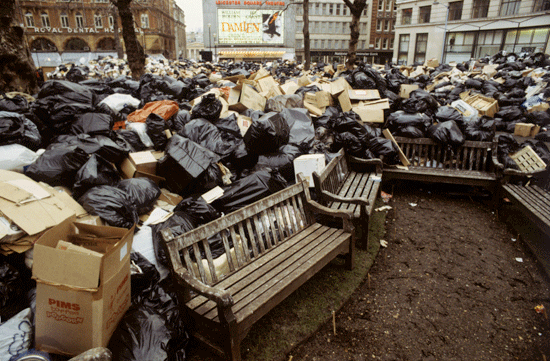
Well, here's a photo of the garbage that piled up because they didn't have enough money to pay trash collectors a fair wage...


And here's what John Blackburn, from Wetherby, recently told the BBC television channel about his experience during this period...

John Blackburn, from Wetherby said:
"I was a control engineer at Huddersfield Power Station at the time and part of my duty was to switch off the supply to various substations around the town, according to an official rota. On many an evening shift I would have to switch off the power to my own home before going back for a candle-lit supper!"


Imagine... Britain was a global superpower for 150 years. But when they started intentionally devaluing their currency, things went straight down hill.

Maybe you don't think something similar can happen here... but I'm telling you... it's already underway!

In fact, the exchange value of the U.S. dollar has fallen about 13% since June 2010. And its rate of decline is accelerating.

What happened to the British currency is now happening to the U.S. dollar.

As Barron's recently reported:
"When the monetary history...is written decades from now...2010 could be a watershed marking the beginning of the end of the dollar-based, Western-centric monetary system."
As the U.S. dollar continues to lose its position as the world's currency, gas, oil, and other commodities will continue to skyrocket. Almost EVERYTHING we consume will immediately get more expensive. All the clothing, furniture, and household goods we import from China.

All the food we get from Central and South America... all the electronics, televisions, computers, and cars we get from Asia and Europe. In fact, it's happening, right now before our eyes.

Everything is getting more expensive...

In fact, each week, The Wall Street Journal has a section called �Cash Prices.' It lists dozens of commodities, everything from wool, zinc, tin and pork... to gold, silver, platinum, and lead.

I recently checked these listings in the paper's March 1st, 2011 edition. And the numbers were mind-boggling...

In short, of the 88 prices quoted ... 85 items are more expensive today than they were just a year ago... many significantly so.

Oil is up more than 50% from a year ago. Silver is up more than 100%–so is cotton, and coffee. Tin is up 90%. Oats are up more than 70%. So is wheat. Butter is up more than 40%. So is sugar.

Again, of the 88 prices quoted, the only three physical commodities that are cheaper today than they were a year ago... natural gas, eggs, and chickens.

Everything is more expensive! In some cases... MUCH more expensive.

And yet the government says there is no inflation? How is that possible?

It's unbelievable to me that they think the American public is going to fall for this.

U.S. businesses have certainly caught on...

As Wesley Card, the head of a clothing company that includes brands like Dockers and Anne Klein, recently said: "It's really a no-choice situation. Prices have to come up."

And when you look back further than a year, the numbers are even more startling...

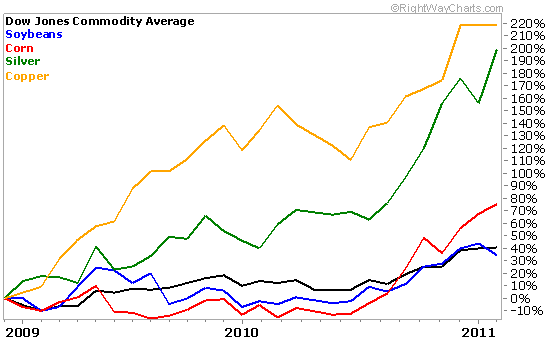
The chart below shows how much a few key commodities have skyrocketed in price, just since the beginning of 2009...


And the point here is simple: As we print more money, the price of the world's most essential commodities have soared. This is NOT a coincidence.

Around the world, as we print, prices soar... citizens protest... governments get overthrown. And it's only going to get worse...

Because we can NOT stop printing because we can't actually afford our existing debts. No one wants you to know this. No one.

That's why, despite the obvious inflation going on all around the world, the Fed continues to say there's no inflation at all.

And that's the scary part, to me. Just like in a Banana Republic, the government is radically devaluing the dollar and totally lying to everyone about what is really happening.

Whether you realize it or not, there is already a "run" on the dollar. Many of our creditors, like the Chinese, are getting out of the dollar as fast as they can via strategic commodities, like copper. That's partly why commodity prices are soaring.

Unfortunately, skyrocketing commodity prices are just the beginning.

There are other disastrous consequences to the U.S. dollar losing status as the world's currency...

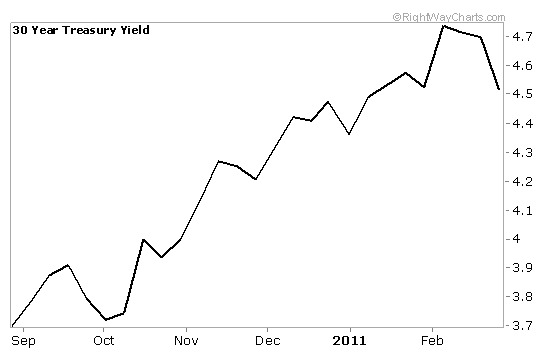
For example, there would be much less demand for U.S. dollars around the globe, so interest rates will skyrocket. Already, just look how quickly rates have moved up in recent months...


Instead of getting a mortgage at today's low rates of 5%, it may soon cost you 8% or even 10% or 15%.

Imagine what that would do to housing prices!

Stock prices will likely plummet by at least 40% in a matter of weeks as a result of this event in the currency markets.

It will cost every American business A LOT more money for supplies and materials. No one will be able to get a loan... and no bank will want to make loans.

In short, when the U.S. dollar loses its spot as the world's 'reserve currency,' it will cause a brutal downturn in the economy, which I expect will be about 10-times worse than the mortgage crisis of 2008.

As Barron's recently reported:

"The demand for dollars from the rest of the world has been of inestimable benefit to the U.S. economy. It quite simply allows Americans to consume more than they produce and save less than they invest; in other words, to live beyond our means."

You see, what will also happen as a result of this currency crisis, and the end of the U.S. dollar as the world's reserve currency, will be massive inflation, the likes of which we have never seen before.

When everyone is trying to get rid of their dollars, the government is printing more and more to pay debts, and no one wants to own them, the crisis will reach epic proportions.

Just look, for example, at what happened to one European country that faced this type of crisis in the 1990s...

This is what happens during a major hyperinflation in the real world.

The World's Most
Expensive Loaf of Bread

In the early 1990s, the national government of one European nation had spent nearly all its savings. So what did they do next? Simple... they began to steal the savings of private citizens by limiting people's access to their money in government-controlled banks.

And of course, to finance the daily operations of maintaining their basic infrastructure, they started printing money, big time. Even so, the country's basic infrastructure began to fall apart. There were potholes in the street, broken water pipes... elevators that never got repaired... and entire construction projects that simply shut down, before being completed.

The unemployment rate was more than 30%... and the government just kept printing money.

As San Jose State University Economics Professor Dr. Thayer Watkins, an expert on countries that try to inflate their way out of big debts, wrote on this particular disaster:

"The government tried to counter the inflation by imposing price controls. But when inflation continued, the government price controls made the price producers were getting so ridiculously low that they simply stopped producing. bakers stopped making bread... slaughterhouses refused to sell meat to the stores... other stores closed down"

So what did the government do next to try to curb inflation?

Well, one bright idea they had was to force stores to fill out government documents every time they increased prices. They thought that this would slow down price increases, because the paperwork would take so much time!

But like many government plans, this one had terrible, unintended consequences.

Since stores had to dedicate an employee to do nothing but register this paperwork, and since the process took so long, stores began to raise prices on basic goods at even higher rates, so that they didn't have to come back and file more paperwork!

Incredible, isn't it?

So next the government created a new currency... which basically removed six zeroes from the old one. So 100,000,000 old units were soon worth 100 new units. Of course, this didn't work either... it never does.

Between October of 1993 and January 1995, prices increase by, get this: 5 quadrillion percent. That's...

5,000,000,000,000,000%

In other words, a loaf of bread that cost $1 in 1993, suddenly cost

$50,000,000,000,001

Yes, that's $50 TRILLION.

I know, it's laughable... but I can guarantee that the people of this once proud European country weren't laughing one bit, especially those living on a fixed income.

[John's comment: "1993 to 1995"? I hadn't heard of this hyperinflation. Maybe Stansberry got his dates mixed up? He's pulling our leg? What's he talking about? . . . I did a Google search on inflation five quadrillion percent.

Oh! A paper by Dr. Watkins popped right up! --Yugoslavia. "The worst episode of hyperinflation in world history," says Dr. Watkins.

So now I can add Yugoslavia to my list of country's of whose hyperinflation I'm aware: Germany, Argentina, Chile, Vietnam, and so many others.

And we in the U.S. think we're going to escape?]

Of course, at this point, the country completely fell apart. As Dr. Thayer Watkins wrote:

"The social structure began to collapse. Thieves robbed hospitals and clinics of scarce pharmaceuticals and then sold them in front of the same places they robbed. The railway workers went on strike and closed down the country's rail system."

At this point, businesses and citizens across the country basically refused to take the local currency.

Instead, everyone started dealing in German Marks. Keep in mind, the daily rate of inflation was nearly 100%.

Can you imagine the panic in a society when the price of just about everything doubles... every single day? It was absolute pandemonium, and the economy basically came to a grinding halt. It was like living in a war zone. Truckers stopped delivering goods. Stores, restaurants, and gas stations all shut down.

In another ridiculous government move, the government actually made it illegal to NOT accept a personal check.

Imagine... you could write a check... and in the several days that it typically takes for a check to clear, inflation would wipe out almost all of the cost of covering your check.

Of course, as is typical, the government took none of the blame. As Dr. Thayer Watkins reported, the government's official position was that the hyperinflation occurred "because of the unjustly implemented sanctions against the people and state."

Again... I know what you are thinking... "just because it happened in Europe doesn't it mean it can happen here, right"?

Well guess what...

The same thing that happened in this European country – Yugoslavia – also just happened in Iceland and Greece, but on a less dramatic scale. . . .
And then there is Martin Weiss who asks--and answers in the assertive: Will the U.S. default? Is it really possible?

It's not only possible, it is already happening. They're just hiding it. Kind of.

Take a look.
*******


Okay. So we've got all these screaming "the sky is falling" disaster pundits. What is a nice, sane, reasonable person supposed to do?

I'd say, first of all, you want to get educated about this stuff.

Read Weiss' article. He makes some solid suggestions.

Read the rest of Stansberry's lengthy article. He concludes with several practical suggestions, including an appeal to subscribe to one of his newsletters.

Maybe you would like to read The Hyperinflation Survival Guide published at the behest of Harry E Figgie, Jr, the CEO of Figgie International, Inc., back in the late '80s. --I wrote about it back in November.

Come to think about it, maybe you'd even like to read some of my past posts about hyperinflation here on my John's Corner blog.

Friday, February 04, 2011

Inflation and the Hedonic Factor

Our CPA sent me a link to a Wall Street Journal article: Why You Can't Trust the Inflation Numbers by Brett Arends.

In general, I absolutely agree with Arends: "In the past 12 months the Consumer Price Index has risen just 1.5%—a remarkably low rate"--a statistic that Arends says (and I agree) "should be taken with a fistful of salt."
Over the past 30 years, the federal government has made a lot of changes to the way it calculates inflation. It's taken place under presidents of both parties. Each change in methodology has come with plausible-sounding justifications. But, as if by magic, each change has had the effect of flatte[n]ing the numbers. Funny, that. . . .

According to [economist John] Williams [of Shadow Government Statistics], if we counted inflation under the old system the official rate wouldn't be 1.5%. It would be closer to 10%.
And again, I agree with him.

I agree with him that the government economists engage in horrendous chicanery when--like Arends alleges--"if steak prices boom, the government just assumes you buy cheaper hamburger instead. Presto--no inflation!"

On the other hand, it was "funny" that, just a couple of days before I saw the link from my CPA, I happened to see an article by economist Gary North who, without specifying the article to which our CPA directed me, referenced the article . . . critically.

What is interesting--and I said this to our CPA--Gary North was the first person I ever read--way back in the early '80s--who was screaming bloody murder about the government's spendthrift ways and how it was going to destroy the dollar, wipe out Social Security, and send us into hyperinflation.

Yet North, last week, wrote an article that severely criticized Arends' article, especially Arends' comment about hedonics.

Arends wrote,
Or consider the case of Apple computers. We all know Macs are expensive. And we know Apple doesn't discount. The cheapest Mac laptop today costs $999. A few years ago, it also cost $999. So the price is the same, right?

Ha. Not according Uncle Sam. Using a piece of chicanery called "hedonics," Uncle Sam calls this a price cut. His reasoning? You're getting more for the money. Today's $999 Mac is lighter, fancier and faster than last year's $999 Mac. So the government calculates that the "real" price has actually fallen.

How's that work in the real world? Try it. Go into your local Apple store and ask for 50% off thanks to hedonics. (If you do, please, please video the exchange and put in YouTube. We could all use a good laugh.)

Instead, the government is worrying about deflation, partly because of all the "cheap" MacBooks out there.
In his semi-weekly newsletter Reality Check, North replies,
My daughter owns a 2005 Mac. It is slow. It is barely functional. So, I bought her a new PC for Christmas. It cost $500. It is vastly more powerful than the 2005 Mac. But so is the 2011 Mac. The Mac Air is a dream machine.

Mr. Arends' version of rhetoric is to ask us to try to get a discount Mac -- today's Mac -- based on hedonics. But you can surely get a discount on a 2005 Mac. My daughter will sell you hers for only $800. And if you are dumb enough to pay that much, I will put your story on YouTube, as he suggested.

Here is my challenge to Mr. Arends. I challenge him to find a YouTube video posted in January 2005 describing the 2005 Mac.

Problem: there was no YouTube in January 2005. The site did not exist.
And North uses that last reference--to YouTube--to make some rather mind-bending observations about the entire concept of hedonics.

I thought they were worth passing along.

Here North maintains integrity by arguing against one of the points people of his persuasion often use as one of their strongest pieces of evidence for their position.

North hasn't abandoned his conviction that the dollar is heading toward the incinerator. But he wants to make sure that the arguments he and others of his persuasion use are valid. And so he writes:
[I]n the world of Brett Arends, YouTube would not be in the hedonics formula. After all, YouTube is free today. It was free in January 2005, since it did not exist. Conclusion: there has been no economic change. After all, zero is zero. Right? We should compare numerators with numerators. Forget about denominators: the products. They are irrelevant. Price is all that matters.
That last sentence actually went on for a colon and one more word. The full sentence reads, "Price is all that matters: numerators." I cut that last word out of my quote because North had previously explained his meaning, and I have not.

So let me go back several paragraphs in North's email to explain the point. He writes:
Let's say that you were hired by the Bureau of Labor Statistics to compare encyclopedias at the end of 2000 with those at the end of 2010. You are asked to calculate the cost of information. You go to the "Encyclopedia Britannica" in 2000. There were about 15,000 articles. Do you calculate cost per article? Go ahead. Put 15,000 as the denominator. Do you calculate Wikipedia's cost per article with a denominator of 3.5 million or 17 million? Remember, there is translation software that did not exist in 2000. Is a translated article worth (say) 70% of an English language article? Or maybe only three-fifths? It does not really matter. The numerator is zero.

It will be zero next year and the year after. Then what? How should you calculate the price effects of (say) 7 million English-language articles with 3.5 million, when they all cost zero? This is not a trick question. It is a real-world question.

If the numerator is zero today, and it will be zero in ten years, but the supply doubles, is that relevant? Of course it's relevant. You get twice as much for free. I reply that the price has not fallen. It is still zero.

"But," you reply, "we have to do something with that doubled supply. We can't just pretend there has been no change. More is better than less, right?"

So, you propose a modification of the formula. You insist that there has to be an implicit price adjustment based on doubled output. The price per article remains the same -- zero -- but there has to be an implicit reduction of price. Otherwise, the public will be misled. People will think that things have not gotten better, when in fact things are twice as good. Well, not really twice as good. The next 3.5 million articles will be on less important topics. There is a declining rate of return. Economists say that the marginal value of each additional article falls.

Now what should you do? Things are obviously better by 3.5 million articles. But how can we estimate how much better? There is no theoretically valid answer. We cannot come up with a formula that estimates the collective value of those extra 3.5 million English-language articles. We cannot scientifically measure the subjective valuation of any reader, let alone all readers. That newly posted article on your brilliant career may not be worth much to the rest of us, but you will surely be ecstatic -- if it's nice. You will be outraged if it isn't. How do we measure the marginal value of that article? We can't.

Yet we have to say something relevant. After all, 7 million articles are better than 3.5 million. We just do not know how much better.

So, you will have to fake it. You have to do something that reflects the newer, better state of affairs. Even if you use some simplistic formula -- "articles cost half as much apiece" -- meaning half of zero, this still conveys a more accurate picture than if you say that nothing has changed: zero is still zero.

Do you agree so far?

HEDONICS

There is such a formula. The Bureau of Labor Statistics applies it. The rest of us really don't know how it works. Face it: we don't know much about how anything works.

The important thing is this: the formula does not change. We can see the trend, even though we cannot be sure if the formula is accurate. The fact is, no formula is accurate. But a formula that acknowledges that 7 million at zero price is better than 3.5 million at zero price is better than a formula that doesn't.

A hedonics formula says that improvements in quality count for something. Yes, we can always reply: "Count for how much?" The statistician replies, "I don't really know, but something." He is correct. If there is no implicit deflationary formula that reflects the fact that we are getting more than before at zero monetary price, then we cannot begin to understand economic history.
North concludes his article like this, and I will do the same here:
To get some idea of what Mr. Arends is ignoring, read my article on Moore's law and the other parallel laws that are transforming our world. Output in the realm of silicon and fiber optics is now doubling every 12 to 24 months in two dozen fields. This is transforming our world as never before.

http://www.garynorth.com/public/7497.cfm

These changes will create a new world -- hopefully brave, but unquestionably new. The BLS is trying to deal with this statistically. If it did not, it would be ignoring the most important development in the last 4,000 years.

Let's [hear] it for hedonics! More free Wiki articles, more free YouTube videos, more free LewRockwell.com articles, more free books in Mises.org's Literature section. At zero price, I want more, more, more. I am not insatiable -- my time has value -- but I want lots of producers trying to meet my demand. Give it a shot, guys! See if I overload.

Friday, November 05, 2010

Whither the dollar?

I heard an economist on NPR last night, a former Federal Reserve governor, who spoke of the latest quantitative easing as if it poses absolutely no threat. He said something to the effect that "We are faced with, at best, 1% inflation; the Federal Reserve would prefer at least 2% if we are to have a healthy economy."

For some reason, I have a feeling he and Mr. Bernanke, and the federal government of the United States are all in serious denial.

I just wrote a letter to our CPA:
A couple of days ago, I purchased a copy of The Hyperinflation Survival Guide, a compendium of insights from businesspeople in Argentina, Brazil and Bolivia who survived the hyperinflations those countries experienced in the mid to late '80s. It was published at the behest of Harry E Figgie, Jr, the CEO of Figgie International, Inc., back in the late '80s. Interesting: the cover illustration is primarily composed of a graph of US government debt from 1780-2000.

Of course, since the book was written in 1988, the debt for the last 12 years on this chart was merely a prediction. In essence, the debt line went virtually straight up. In 1988, the debt was at $2.5 trillion, more or less (working solely from the chart). They predicted the total debt to be $13 trillion in 2000. Mr. Figgie wrote in the preface: "At that point, our annual deficit would be as much as $2 trillion, and $1.6 trillion of that would simply be interest on the debt!"

Obviously, Figgie and company missed the mark by about 10 years. But considering how alarmist such talk would have sounded back in 1988, I'm astonished how prescient he sounds. And as for that graph line: The angle of the line hardly shifts if you account for those extra 10 years. It is still almost straight up.

I'm finding the book quite eye-opening. Especially as our government, in the form of, or by means of, the (yes, non-governmental) Federal Reserve, keeps inflating the currency, I think we need to be on our toes.

I have long been aware of the hyperinflation of Germany in the early 1920s. I have heard anecdotes of what that inflation meant for private citizens. But it is hard to imagine oneself in those circumstances. And I have never read any real practical advice.

What I like about The Hyperinflation Survival Guide is the very nuts-and-bolts illustrations of what 20% to 25% monthly inflation (experienced by Argentina and Brazil) or 50% average monthly inflation (experienced by Bolivia in 1985) does to the value of money and/or the prices of goods. But even more valuable, I think, are the strategies the book offers for what a business needs to do to survive under such circumstances.

I'm writing you today partially to get your take on a couple of the strategies mentioned. They sound very reasonable in hyperinflationary times, but I am wondering what the legal limitations may be for us to implement them.
  1. "Base your inventory valuation on NIFO rather than LIFO."

    I had never heard of NIFO. It stands for Next In First Out.
    NIFO valuation is, in effect, a company's best guess as to the impact of the future rate of inflation on the cost of the materials it uses.

    If a company were to use LIFO during high inflationary periods, it would be greatly underpricing the value of its inventory and therefore eroding its profit margin. At Brazil's [then] current 20% monthly inflation rate, and inventory evaluated at $1 million with LIFO would have an actual replacement cost of $1.2 million after just one month. In such a case, NIFO would have avoided a potential $200,000 undervaluation of inventory.

    --p. 30

     
  2. "Develop an appropriate inflationary adjustment for capital replacement."
    Taxed appreciation deductions are normally based on original purchase costs rather than replacement costs. However, high inflation has a major impact on a firm's capital replacement costs and failure to take this into account during such times can be suicidal, because it can cause the firm's capital base to disappear.

    For example, if a Brazilian company purchases a piece of equipment for 300,000 cruzados, it might be allowed to deduct 100,000 per year from its taxable income for three years. But at 400 percent per year inflation, the replacement cost three years later would be more in the neighborhood of 37,500,000 cruzados. Unless the company increases its annual depreciation to account for this inflationary effect, the value of its capital stock for tax purposes will decline to virtually zero.

    Under such circumstances, inflation will not only eliminate a company's ability to recapture its capital base, but will also cause the firm to have virtually no depreciation deductions for tax purposes.

    The inability of a country's businesses to recapture the true cost of the capital will obviously have a very negative impact on capital formation within the country as a whole.

    --pp. 30-31

So, ________: I wrote in the margin concerning the second item: "Can one do this unilaterally? Is there a good legal basis [for developing an inflationary adjustment for capital replacement]?" But I would say the same question can be asked about NIFO, too: Is there anything standing in our way of using NIFO when that becomes necessary?

. . . [T]here's a whole lot more in this book and I intend to pass it along to [our company's staff]. I think we need to begin flexing our mental muscles to be prepared for the hyperinflation just around the corner.

Lest you think I am being alarmist, . . . let me note the input I have seen in just the last few hours:
  • From Mike Larson of Weiss Research's Safe Money Report (November 2010 issue):

    The Dollar Index has plunged as much as 14 percent since June. Meanwhile, crude oil has surged as much as 31 percent ... soybeans have climbed up to 32 percent ... cotton has skyrocketed 72 percent ... corn has jumped 75 percent ... and wheat has shot up 85 percent. Gold, silver, copper, and other metals are flying higher, too.
    That doesn't sound like 1% inflation to me.
     
  • From The Hyperinflation Survival Guide:

    "A . . . sobering discovery the team made in South America was that inflation can accelerate without warning into hyperinflation--or severe, debilitating inflation--in a period as short as a few days. (p. iii)

    "The problem with hyperinflation is that it happened so fast. We never realized what was happening until it was too late." --South American bank director (p. 1)

Monday, February 08, 2010

The financial future of the United States

Last Saturday evening, Sarita and I went out to dinner with some old friends. He works at a major aerospace company. Whenever we talk with this couple, I know I have to be careful about touching on subjects that could be touchy from a security/secrets perspective.

At some point in the conversation, we got talking about the state of American technology and infrastructure. He mentioned that his group is doing very little truly transformative, new development but is, instead, always having to write code to work around equipment that is breaking down.

????!!!!????

I didn't understand. It didn't make sense to me.

"Wait a second. You're saying the equipment--computer processors--are breaking down? Why wouldn't your clients either get new equipment or fix what they already have? I mean, computing power is getting less and less expensive. . . ."

"But suppose we can't get to the equipment . . . ," he suggested.

????

"Suppose, for example, that we're talking about, say, a communications satellite in geosynchronous orbit. . . ."

"Yes . . . "

"Well, you can't get to it."

"Why not?"

"It's out about 26,000 miles."

"So? . . . I mean, the Earth is only--what?--about 18,000 miles around the equator. So it's not that far. . . ."

So we got talking about the space station and the Hubble Telescope--which are only a couple hundred miles above the Earth's surface--and how difficult and expensive it is for us to get to them to make fixes and adjustments.

Now push that distance out by a factor of 130 times.

The conversation drifted pretty quickly, then, to other subjects, including, for some reason, the interstate highway system: Could the United States possibly do, today, what it did in the mid-50s and through the very early '70s?

We all agreed that such exploits would be virtually impossible.

We could not build another interstate highway system. We could not send a mission to the Moon beginning from scratch (the way the U.S. did back in the '60s). . . .

As Sarita and I were driving home, we drove along a small portion of an interstate highway and the road was pretty broken up.

As we drove across a bumpy section of soaring interstate bridge, I got thinking about the crumbling infrastructure of the United States--how so many hundreds of bridges in the U.S. are in serious need of maintenance, repair, or replacement.

I realized the U.S. can't afford to maintain, repair or replace these roads or bridges, partially because it has never fully paid off the original costs of these bridges . . . since it borrowed money to buy the roads and bridges in teh first place.

But/and now it's 40 or 50 years later, and the U.S. government is like the family that bought a car beyond its means, hoping and praying it would be able not only to pay it off before they figured they would need a new car in five or seven or 10 years, but, perhaps, they would even be able to lay aside some money to have a bit of extra cash on hand to pay for the next vehicle.

Too bad for the family: Having signed up for a $17,000 loan when they first bought the vehicle 17 years ago, they have never really paid it off. Oh, yes, the original debt instrument is no more. But in order to finish their payments, they "simply" bought more of their then-current food, clothing, furniture, toys, etc., etc., on credit (using their credit cards) and used the cash that had thus been "freed up" to pay off the vehicle.

Today, they are still driving the car they bought 17 years ago; it is in truly horrible condition. They have have $35,000 in credit card debt, a $247,000 home mortgage, and . . . well . . . the screws are tightening.

That's the U.S. Most especially at the federal government level.

The U.S. federal government hasn't paid off a lick of debt in 80 years.

And its acknowledged debt obligations amount to almost $13 trillion. Add in all the unfunded Social Security promises it has made (in case you are unaware: the government has saved absolutely nothing for Social Security; it has absolutely no investments set aside to make its promised payments), and the unfunded Medicare and Medicaid promises, and the retirement payment promises it has made to federal employees (who, on average, as wage-earners, earn twice what people in the private sector make), and the . . . well, let's not go into all the details . . . --But if we add in all the unfunded promises the federal government has made--promises to pay that no private company would be permitted to make if it hadn't set aside resources to pay them: the federal government is well over $110 trillion underfunded and/or in debt as we speak.

And who is going to pay these bills?

You and me? People over 40? Not likely!

It's our children, grandchildren, and great grandchildren who will, somehow, have to shoulder the burden. Oh, and some Boomers and X-ers as well, I imagine, as we, who have failed to make preparations for ourselves, will find the government cannot fulfill its promises in any form we might expect based on the government largesse of the '60s, '70s, '80s, and '90s.

A Parable for Our Day

I happened to locate an article yesterday that placed what I had already begun to feel into stark, concrete, historical terms. It's sub-titled Your Future of Blackouts and Shortages as the U.S. Becomes a Third World Country. James Dale Davidson, the author, lives in Buenos Aires, Argentina, and, he says, "There is perhaps no better place on earth to contemplate economic decline than in" Buenos Aires.

In essence, he says, beginning in the late 19th century, and up until 1929, Argentina was a very wealthy country. One of its great advantages: It was in close relationship to Great Britain.

Following WWI, however, with the decline of the British Empire, it didn't fare so well. Still, many analysts believe that, even in 1929, Argentina was one of the wealthiest countries in the world per capita. It was certainly ahead of Germany, France and, of course, Japan (since Japan was still a backward "developing" economy at the time).

In the meantime, however, Argentina has fallen hard. It is now far behind Europe, North America and Japan. The United States ought to look to Argentina as an object lesson for what will happen if we follow the siren song of government salvation.

Human nature being what it is, however, I'm afraid we are going to follow Argentina's path to destruction.
Like the US today, Argentina entered the Great Depression in 1929 heavily dependent on foreign capital, with highly unequal income dispersion, wide political resentments and lots of what would become bad debts in the banking system.

The path Argentina took out of depression led from bank bailouts to runaway budget deficits, hyperinflation and decades of negative compound growth.

An open, free economy was replaced by a closed system, hobbled by intervention and inward-looking strategies after the Great Depression.
Argentine economist Mauricio Rojas writes in his book, The Sorrows of Carmencita (p. 89), “The [Argentine] government couldn’t pay its bills, so it tried to inflate them away. The rise in prices between 1976 and April 1991 was an incomprehensible 2.1 billion times. During approximately the same period, per capita income sank by over 25% and the poverty rate among Argentine households soared from 5% to 27%.”

Argentine pesos worth a billion dollars in 1976 were worth only 47 cents 15 years later. And this was the result of ongoing government deficits averaging only 14% of GDP. Sound familiar?

Of course, it was not merely government borrowing that got Argentina into trouble. It was also government policies.

To illustrate his thesis, Davidson summarizes the sad story of Unión Telefónica del Río de la Plata Ltd., the British-owned Argentine telephone company that operated efficiently and profitably far into the 20th century . . . until the Argentine government under Perón bought it, renamed it Empresa Nacional de Telecomunicaciones (ENTel), and drove it into the ground. (By 1990, Davidson says, ENTel's service was "arguably the worst in the world, even worse than the poorest African countries. Argentines had to wait as long as 15 years to obtain a phone line, and then installation cost as much as $1,500.")

Davidson also describes the Huemul Project--a government program that was supposed to produce nuclear fusion. Energy produced by the process, Perón believed, would be able to be delivered in milk-bottle sized containers for use in airplanes and other vehicles. "Success was proclaimed; but no proof was given. When independent scientists investigated Perón’s Huemul Project to provide nuclear fusion in milk bottles, they revealed the project was a fraud."

[Will the United States endure similar frauds under the ever-louder siren call of research projects "needing" to be funded by the government in order to meet the legislated deadlines of alternative energy? Davidson asks.]

As decision-making power here in the United States becomes ever more centralized, I think Davidson is correct: We can expect greater and greater inefficiency, greater corruption, more and more serious repercussions from every decision that is made.
  • The "punitive cap-and-trade carbon taxes" being urged by certain big-government environmentalists, "will make Al Gore richer," Davidson suggests (see this article and this one, too, for some perspective on Gore's expected windfall); but will it make you and me poorer? (Hate to say it, but I think most likely!)
     
  • "When Perón took office, Argentina had the world’s second largest gold reserves. But these were soon squandered nationalizing industries and funding politicized investments, like the Huemal Project." (Kind of off-subject, here, but I think it's interesting: I just read that in 1940, when paper dollars were actually redeemable for silver (the face of a silver certificate said, "This certifies that there is on deposit in the Treasury of the United States of America one dollar in silver payable to the bearer on demand."), the United States government held 6 billion ounces of silver--to fulfill its promise. Today, with the "dollar" meaning, really, nothing more than a sheet of paper with printing on it that declares "This note is legal tender for all debts, public and private," the government holds no silver. None. Nada. . . . As for gold, it holds just over a quarter of a billion ounces. . . . A lot of people will say: "Who cares? No one--well, no one who counts--thinks money needs to be tied to precious metals. There are other ways to value currencies" . . . and they will mention land, labor, energy, and other things of value [how about, "a force-backed claim on . . . the productive power and wealth-producing capacity of the sovereign economy on the whole"--i.e., a government's ability to extract wealth from its subjects?] that might be pledged as the foundation for the currency's intrinsic worth. And maybe they are correct. Though it sure feels crazy that an entity like the Federal Reserve can create "money" out of nothing whenever the U.S. government asks. . . .

    But while we're on the subject, let me note that, while a quarter billion ounces of gold sounds like a lot, it's really not. At today's prices [just over $1,000 per ounce], that amounts to only slightly more than a quarter of a trillion dollars: "nothing more than pocket change on the Federal balance sheet," the equivalent of little more than "a rounding error . . . and irrelevant to overall governmental finances," according to Bill Zielinski.)
     
  • "As the US follows the same policy path as Argentina," Davidson suggests, "it will obtain similar results. Perverse policies will destroy prosperity and inspire thinking people to get out, and/or get their money out." ("This is already happening," says Davidson. "In 2008, more than two million Americans emigrated, marking the first time that net legal and illegal migration . . . reduced the population of the US.")
     
  • As more people seek escape, Davidson suggests, the federal government will do what Perón's government did: impose exchange controls. Moreover, "Soon after, the government will demand that people who had the foresight to take their money out bring it back."
     
  • "Although the U.S. government will resort to draconian measures to tax the 'rich,' . . . destructive economic policies will diminish tax revenues even as government spending runs amok."

    "Diminish tax revenue"? Davidson notes that,
    Among other consequences of runaway budget deficits and hyperinflation was the virtual disappearance of the income tax in Argentina. It shrank to just 1% of GDP as the value of the previous year’s income became pocket change by the time taxes were due.
     
  • Next consequence? Wage and price controls.
     
  • . . . And so on and so forth.
In sum: As the government's true bankruptcy becomes more and more obvious, the U.S. will not be a pleasant place in which to live. And, I might add, it will be especially unpleasant for those of us who grew up here because so few of us have ever lived with any real deprivation. We are not used to the kind of basic living arrangements that so many people around the world experience. We "expect" better. We "demand" better. The government--at least many of us seem to believe--"owes" us better. Y'know, it "owes" us things like free health care.
*******


For more on the subject of the economic future of the United States, I recommend the following articles I discovered in the midst of researching and writing the above:
  • What you must know about bankruptcy of the United States--an interesting and, I dare say, informative analogy between the federal government today and General Motors three years ago, before it went bust.
     
  • For a brief, crisp summary of Argentina's demise, see Stephen Cox's review of Rojas' The Sorrows of Carmencita: Once a Great Nation.
     
  • 20 Reasons Why The U.S. Economy Is Dying And Is Simply Not Going To Recover--a concise, and graphically-rich summary of significant economic data.
     
  • Another alarming article by James Dale Davidson, this one from February 2009, subtitled Why the U.S. Banking System is Toast. Davidson offers analogies to and perspectives from the bankruptcy of Iceland in October 2008 . . . and the trillion percent hyperinflation in Brazil during the '80s and '90s . . . to Japan's economic downfall in '89 (from which it has yet to recover) . . . to the Great Depression in the U.S. --To save a bit of time, begin reading from the paragraph that starts "A decade and a half ago there were few subprime mortgages."
I'll stop here. Sorry to have gone on so long.

[NOTE: If you are reading this article on Facebook and can't use links or don't see photos, please realize it originally appeared and is still available on my personal blog.]

Monday, February 01, 2010

The long-term demise of the U.S. dollar

For various reasons (including the fact that I do a fair amount of international travel), I pay attention to the relative value of the dollar and other currencies.

Long before I ever left the United States, I was well aware of the German hyperinflation of 1921 through 1923, and was disturbed by the demise of silver coinage in the United States (1965) and the closing of the gold window by Nixon (1971).

I have been deeply concerned about inflation here in the U.S., and have tried to pay attention to how the dollar shifts in value compared to other currencies.

Recently (in the last couple of weeks), the value of the U.S. dollar has risen compared to the Euro. The reason for this shift? Greece among others (the PIGS they are called all together: Portugal, Italy, Greece and Spain) . . . but Greece, in particular, is running too great a deficit: 12 percent of GDP when the agreement among the Euro countries is that they would not borrow more than 3 percent of their GDP in any year.

A number of pundits have chortled over the European Union's bad practices. "Oh!" they say. "How awful that Greece has placed the Euro in jeopardy."

"See," they seem to suggest, "the U.S. dollar cannot be replaced as the international reserve currency."

I think they are sadly mistaken.

The U.S. may be granted a few more months--maybe even a few years--of reprieve. But our day of reckoning is near, I have no doubts!

I thought this commentary by Ashish Advani of World Currency Watch is particularly cogent and to the point:
Greece (along with Portugal, Italy and Spain) has always been the weaker of the Euro partners. The fact that Greece has a GDP deficit of nearly 12% is not a surprise. And yet, we have seen such panic in the markets that it has surprised most currency investors.

Let’s get some facts straight. The deficits of Illinois, New York, California and Florida, to name a few, is significantly higher than Greece. Their economies are significantly worse than Greece with no immediate end in sight. And while I [question] Greece’s plans to reign in its deficit, I have not heard of any significant plan from our states on their plans to cut their deficits.

The states mentioned above are [at] different stages of preparing to default unless they get re-financed. And with the federal demand (via new Treasury issuances of $2.5 Billion in 2010) growing each year, it is very likely we will see a state default on its debt before Greece defaults on its. . . .
Reblog this post [with Zemanta]