Monday, March 31, 2008

Conversation v Argument

I just started Brian McLaren's third "A New Kind of Christian" book. Apparently, I'm somewhat rare. I read books' introductions and prefaces and all their footnotes!

So I'm in the middle of Mclaren's introduction when I read three thoughts that ring true for me. They express the way I think, the way I approach so many subjects:
  • [C]larity is good, but sometimes intrigue may be even more precious; clarity tends to put an end to further thinking, whereas intrigue makes one think more intensely, broadly, and deeply. Jesus' teaching on the kingdom of God is a case in point; his parables don't score too well on clarity, but they excel in intrigue. . . .

    [L]ike some politicians, we often seek clarity at the expense of truth: we would rather have something simple and clear than continue to search beyond convention for a truth that won't resolve to a neat formula, label, category, or pat answer.
And then:
  • [A]sking me . . . whether I'm an ******ist or a ******ist is like asking a vegetarian whether she prefers steak, pork, or venison. [It] is a question I have no taste for asking.
--I like the analogy. But I like, even better, where McLaren goes with this:
  • My intentional avoidance of this question does not spring from fear of saying what I really believe; a fearful writer wouldn't even begin a book like this. Rather, I am more interested in generating conversation than argument, believing that conversations have the potential to form us, inform us, and educate us far more than arguments.
My response? Amen!

Thursday, January 31, 2008

Is Ron Paul crazy . . . or brilliant?

If you watched the Republican "debate" last night, or you listen to the media, Ron Paul "doesn't have a chance." But he seems to think he does. . . .

Why?

Take a look!

Interesting perspective!

From: mail@ronpaul2008.cpro30.com On Behalf Of Ron Paul 2008
Sent: Monday, January 28, 2008 4:23 PM
To: Ron Paul Supporters
Subject: Message from Ron

January 28, 2008

When I started this campaign more than a year ago, I was a somewhat reluctant candidate. I knew our message of freedom, peace, and prosperity was the right one for our country, but frankly, I didn't know how many people today would have ears to hear it.

Well, did I learn a lesson! Millions of Americans understand what ails our country, and what is needed to fix it. So, with you at my side, I am in this effort to win. Not only by building the ideas of liberty, but by getting the nomination. Our opponents would call that nuts -- you know, the advocates of more inflation, more spending, more taxes, more war. But let me explain why they are, as usual, all wet.

For one thing, for the first time since 1952, we are headed towards a brokered convention. Instead of a coronation of one of the establishment candidates, the delegates, influenced by the people, will decide. And I am afraid that this will take place in a time of heightened economic crisis. That means even more Americans will be ready to hear our message. But it also means I am really going to need your help.

One would never know this from the mainstream media, but we've only had a few primaries and caucuses, and even after the extremely important date of February 5th, we will still have more than half to go. And the Republican nominee will not be decided by the popular vote among the "leading candidates" in a few states also handpicked by the media. The nominee will be decided by the delegates. So let me tell you a little about our "under-the-radar" strategy to get those delegates.

On "Super Tuesday," February 5th, there will be 22 primaries and caucuses. I have a hunch that we're going to do very well. But, of course, the media and the rest of the establishment refuse to recognize that. It's the attitude of the small child who covers his eyes to make something scary go away. But we are not going away.

While the media focus on the couple of states they claim are important, we're competing everywhere. And the reason that we're able to do that is because of your grassroots support. You all are an asset that no other campaign has: donors, and activists who want no special deals from the government, just the Constitution.

We're competing very strongly in all the caucus states, and in all other states where delegates are up for grabs. And we're going to keep picking up delegates. Our strategy's already working.

And we're committed to winning states. I have little doubt that if we can double our efforts in this coming week, we're going to grab many delegates from other candidates. Then we'll start getting ready for the biggest moment of all - the convention in September.

The path to the convention is twisty, however. When we were in Iowa, we got 10% of the vote. But no delegates were awarded that night. That's because voters didn't directly choose national convention delegates; they selected the county and state delegates who will make that decision. And if another candidate like Mike Huckabee is no longer in the race at the time of the state convention in June, his delegates are free to support whomever they want. If we work extra hard, we can convert them into delegates for our campaign!

A similar thing happened in Nevada. We won 14% of the straw poll vote that the media reported on, but what they didn't tell you was that we may have gotten up to a third of Nevada's delegates to their county conventions! I always laughed when I heard some people say Nevada didn't matter. Nevada chooses more delegates to the national convention than South Carolina.

So, while the media will focus on the results from Florida, and probably take down the campaign of my friend Rudy in the process, those results are less important to you and me. Let them fight in Florida while we bring our message to Americans in other areas, like the economically hard-hit state of Maine.

We want to win as many delegates to the Republican National Convention as possible, even if other campaigns don't see some areas of the country as "important. But in this work, I need your help. Help me get many, many delegates to this historic convention, by these three methods.

1. Donate. Your generous contributions are essential if we're going to keep going until September. We need, frankly $5 million by February 5 to run more TV and radio ads in the Super Tuesday states. Your help means everything: https://www.ronpaul2008.com/donate.

2. Canvass. You can help us identify those who support our message in your precinct. You can help us to convert others, too. After all, your neighbors pay attention to you. I am going to visit as much of the country as I can, but I need you as my partner in your area: https://voters.ronpaul2008.com.

3. ASK others to sign-up on our website. I meet so many people on the campaign trail who don't even receive my letters! I've told my campaign to make communication with you, the engine of all this, much better. But if people don't sign up for my e-mails, that won't happen. If you could just get one extra person to sign-up, that would be great. More would be tremendous.

Help me by forwarding this e-mail to every other Ron Paul supporter you know, and urging them to join our efforts! https://www.ronpaul2008.com/join.

We've come so far, but now the fun is really starting! I have a feeling the mainstream media will move from ignoring us to attacking us. But that will be a sign of our success. Join me as we continue this great movement into year two, and to a hot convention in Minneapolis-Saint Paul. We can do it!

Sincerely,

Ron


Saturday, January 26, 2008

How bad are things, anyway? Pessimism, Optimism, and The Economist

I've had a pile of old clippings on my desk. I'm finally trying to deal with them.

The December 22, 2007-January 4, 2008 issue of The Economist included what I thought was a witty--actually, very encouraging--commentary on Americans' collective consciousness. Sometimes it takes an outsider to help you see yourself accurately.

The author, known as "Lexington" to his readers, describes a certain scene in Jim Carrey's "Dumb and Dumber":
Lloyd Christmas [Carrey's character] . . . falls in love with a classy beauty, Mary Swanson. In one scene he asks her the chances of “a guy like you and a girl like me” ending up together. The answer is “Not good”. “Not good like one out of a hundred?” asks Lloyd. “More like one out of a million,” Mary replies. Lloyd pauses for a moment, then shoots back, “So you're telling me there's a chance?”
"That," says the author, "is the American spirit" and why "Americans have traditionally been much more optimistic than Europeans, and happier too. They believe that people determine their own destinies rather than being the mere playthings of fate. They also believe that their children will have a better life than they do."

The problem is, says the author, right now Americans are believing too much pessimistic talk from the media:
The likes of Bill O'Reilly and Lou Dobbs have transformed themselves into cable stars by ranting about cultural decay and “broken borders”. Patrick Buchanan's latest book is called “Day of Reckoning: How Hubris, Ideology and Greed are Tearing America Apart”. “We are on a path to national suicide,” he says. America is not just “coming apart”, but also “decomposing”.

There is certainly no shortage of bad news. But coming apart? Decomposing? The current issue of Commentary—a magazine hardly noted for its sunny disposition—contains an excellent article, “Crime, Drugs, Welfare and Other Good News” by Peter Wehner (a former senior White House aide) and Yuval Levin, which shows why Mr Buchanan is talking through his hat.

Both violent crime and property crime have declined dramatically since 1973. New York City will probably notch up less than 500 murders this year, the lowest since the early 1960s (the figure for 1990 was 2,262). Teenagers are cleaning up their act. Teenage drug use has fallen by 23% overall since the 1990s, and by 50% for LSD and ecstasy. Teens are drinking less, smoking less, having sex less and dropping out of school less. The birth rate for 15-19-year-olds has fallen by 35% since 1991. At 10%, the high-school drop-out rate is at a 30-year low.

Welfare reform is working. The welfare caseload has dropped by 60% since 1994. A series of social evils—overall poverty, child poverty, child hunger—have all decreased. Employment figures for single mothers have surged. The number of abortions fell from over 1.6m in 1990 to fewer than 1.3m this year. The divorce rate is at its lowest level since 1970. Education scores are up.

And so it goes.

Oh, yes, there is plenty of bad news, too. But--the kicker for me--let's look at America's history.
Americans have always had a vigorous tradition of pessimism, in counterpoint to the optimistic one. In 1819 John Adams worried about the duration of “our vast American Empire”. In 1948 Richard Hofstadter complained that “competition and opportunity” had gone into decline and that Americans were looking “wistfully back toward a golden age”. Much of today's pessimism may prove as unfounded.
And so, concludes our author: "Americans should rediscover the spirit of Lloyd Christmas, idiot though he was."

Ah! The Economist! I love how they report the news!

Jane Austen and the way we communicate

A few weeks ago, Sarita and I had the opportunity to watch Jane Austen’s Pride and Prejudice as interpreted by Jon Jory and presented onstage by the Denver Center Theatre Company.

In the program notes, I read a brief piece about “the fashions of the day” as interpreted by Austen in private letters to her sister. I was astonished by what I read.

“Next week [I] shall begin my operations on my hat, on which You know my principal hopes of happiness depend,” Austen wrote in October 1798.

I thought: “You've got to be kidding! Her happiness depends on a hat? How shallow!”

A couple of months later, having changed the look of her hat, she writes with satisfaction concerning the effect: “I think it makes me look more like Lady Conyngham now than it did before, which is all that one lives for now.”

Truly?!?

Besides her apparent shallowness, I was struck by Austen’s rapier and naughty wit . . . and I wondered what it is about phrases such as the following that makes them humorous? Why do we groan with bemused shock?

I don't think I've come up with an answer. Perhaps you can help?

I was as civil to them as their bad breath would allow me.

I do not want People to be agreeable, as it saves me the trouble of liking them a great deal.

Mrs. Blount . . . appeared exactly as she did in September, with the same broad face, diamond bandeau, white shoes, pink husband, and fat neck.

Even the concert will have more than its usual charm with me, as the gardens are large enough for me to get pretty well beyond the reach of its sound.

Mrs. Hall of Sherbourn was brought to bed yesterday of a dead child, some weeks before she expected, owing to a fright. –I suppose she happened unawares to look at her husband.

[We] met a Gentleman in a Buggy, who on a minute examination turned out to be Dr. Hall--& Dr. Hall in such very deep mourning that either his Mother, his Wife, or himself must be dead.

We plan having a steady cook, and a young giddy housemaid, with a sedate, middle-aged man, who is to undertake the double office of husband to the former and sweetheart to the latter. No children of course to be allowed on either side.

Saturday, January 19, 2008

Mutualism

I watched a video series a couple of months ago called Incredible Creatures that Defy Evolution. Truly astonishing examples of creatures which defy evolutionary explanation . . . either on their own--in the manner their bodies are constructed (the woodpecker whose tongue goes over its skull before re-entering the mouth), or in combination with symbiotic companions (the mussel that requires a certain species of fish to incubate its eggs).

Well, I just bumped into a recent story about another symbiotic relationship that "just" doesn't seem to speak well for evolution as the source of all varieties of life on earth. Check out Ants and Trees Rub Each Others' Backs by Randolph E. Schmid.

Friday, January 18, 2008

No Excuses!

This past week I bumped into two videos that seemed, in my mind, to "preach" the same message: no matter what your condition, what your limitations, what your "handicap": don't use it as an excuse. Move beyond it. I think, sometimes, we as parents need these kinds of reminders not only for ourselves, but for our kids, too.

So, if I may urge you: check out No Excuses, just 61 seconds long, and She without arm, he without leg: Hand in Hand, a five-minute ballet performance. Stunning!

I pray one or both of them will encourage you and, perhaps, your kids or your spouse: you can do great things . . . if you will persevere.

Sunday, January 13, 2008

Ready to fly to work?

Check out the flying motorcycle!

Sunday, December 23, 2007

Twitter: I'm afraid it would drive me crazy!

I don't recall how I bumped into Twitter, but I'm really curious why anyone would really want to be so hyper-connected, why Wired supposedly said* it is "incredibly useful," and why, as Time apparently said, it is "on its way to becoming the next killer app."

Got any ideas?

* "Supposedly said" because I did a search for Twitter on Wired's magazine website, and came up empty-handed.

Thursday, December 20, 2007

Learn about blogging from Simpleology

Kind of a no-brainer for me.

I've been a member of Simpleology for some time. Some of their courses, I can attest, are worthwhile. And they offer some pretty nifty software as well (for free).

I've completed Simpleology 101 which pushes you (especially with the aid of the free software) to establish new and useful habits. So far, I am impressed, too, with their new course on drawing which I've just begun.

Anyway. They've just come out with a new multi-media course on blogging and for a while, they're letting you take it for free if you post about it on your blog--like I'm doing here! (And if you don't have a blog? --They pop you through to help you begin.)

The course covers:
  • Best blogging techniques.
  • How to get traffic to your blog.
And,
  • How to turn your blog into money. (??!!!)


I'm looking forward to learning a whole lot more than I know now about blogging. (I've been blogging long enough. I just don't know how to do all those things you're supposed to do in order to attract readers! [For example.])

Hopefully I'll remember to write a bit more about the course (while it's still available for free) once I've had a chance to check it out. Meanwhile, why not go grab your copy now! :-)

Thursday, December 13, 2007

Matthew Murray

As you're probably aware, last Saturday evening, a young man, Matthew Murray, murdered two young people at the YWAM base just north of us, here in Colorado, and two young women at a church not so far south of us. In case you had not heard or realized: he was a homeschooler.

Shows how my mind works: "I hope he wasn't a Sonlighter!" (It turns out he wasn't .) . . . But it is unnerving nonetheless. Especially since we know many people involved in YWAM and in the church down south.

Yesterday, someone directed me to a collection of posts Murray made during the period between the shootings in Arvada and the ones in the Springs. From the initial collection, I found additional posts. And they are disturbing.

I think there is little question Murray was suffering some kind of severe mental derangement. How much of the derangement was unavoidable--i.e., completely physiologically based--I cannot say. I think there is little question that he had made decisions over the past several years that intensified the dark state of his mind. (Having found myself "on the edge," emotionally, psychologically, when I was a young man (very young--say, about 12); having been closely associated with at least one person who had to be hospitalized for mental problems--indeed, having been so close to the situation that I had to sign him in to the hospital; and having read or heard the stories of many others; I think I can testify: we humans are able both to improve our mental states through careful self-disciplined mental exercise (think of a person like Corrie ten Boom); we are also able to cause ourselves great mental and emotional harm thro! ugh foolish--shall we call it--"wound-picking": calling to mind, over and over, all the insults to our dignity--insults real or imagined--that others have caused us.)

Murray obviously chose the latter route, constantly bringing to mind the ways in which he believed his parents had wronged him.

That, in itself is disturbing. And as a result, I would like to urge you: if you find yourself having been wounded, or if you find yourself being wounded, even right now by someone you know: I urge you to pursue the path of forgiveness, the path of yielding vengeance to the Lord, the path of speaking blessing upon your enemies rather than curses, etc., etc. --These behaviors, I believe, are at the root of the Gospel. Of course, they arise from an understanding that, as Jesus said, you yourself have been forgiven . . . "forgiven much" (Luke 7:37-50).

I have no doubt many of my readers need to hear this message. And, as I said, if you're one of them, I urge you to meditate on the Scriptures that call you to such forgiveness, to such "giving up of your rights."

But there is something else Murray wrote that disturbs me possibly even more. And it's a second direction for which I sense Murray's comments might offer a useful path to follow and which some of us parents in the homeschool world may need to hear . . . possibly even more than the message of forgiveness.

Murray wrote, "Growing up, TV, Internet/computers, video games, music, Christian contemporary music, movies and books were all extremely restricted. All those things carried this . . . mystique about them. They were like these mythical things imbued with incredible power straight from Satan." One example: "[W]e were told that The Simpsons was a very evil and Satanic TV show with the intent of causing people to leave Christianity"--and, therefore, he would never be permitted to watch it.

Now, I have to admit, I have never watched The Simpsons. I really have no interest. From what little I've seen or heard about the program, it seems quite low-brow and a waste of time. (But then, I have pretty much the same attitude toward most TV. In general, as far as I'm concerned, I have better things to do with my time.) HOWEVER, . . .

I was talking with the president of an international mission yesterday morning about some of these matters. As we spoke, he suggested we (parents) might reduce the "incredible power" of so much of the media if and as we interact with our maturing children about these things rather than simply and solely declaring them "off-limits."

This was the path that Sarita and I followed. As I've written in our catalog over the years, we wanted to be there with our children as they confronted the more difficult issues of life. We tried not to "protect" them so much that they would never be exposed to non-Christian media, to the arguments (or satire or sarcasm or . . . ) aimed at Christianity. We didn't want to keep them from seeing the uglier sides of life.

Instead, we wanted to be able to help them think through the implications of what they were seeing or hearing.

As the ministry leader told me he has said to missionaries who, he thought, had been, perhaps, overly protective: "When would you rather your daughter first saw an 'R' rated movie--after she has left your house, or while she is still with you and you can talk about it?"

I'm not advocating that you seek out rotten movies or degrading literature, music, websites or video games. All I am attempting, here, to say is that an extreme, fearful, complete censorship can actually create what Matthew Murray described: a mystique about these things that actually increases the perception on the part of our children that they must, indeed, hold "incredible power"--more power, apparently (to our kids' minds!), than anything that He Who is within them (1 John 4:4) is able to withstand. . .

So. Rather than, as it were, declaring by our actions that these things do, indeed, hold an "incredible power straight from Satan," may I suggest that we demonstrate how completely foolish and weak they are? At the appropriate time, let us take the initiative and mock them, these "weak and miserable principles," the "beggarly elements" of the world (Galatians 4:3, 8-9).

Do my comments, here, cause you discomfort? . . . I invite you to reply via a comment. . . .

Friday, December 07, 2007

Microsoft launches a viral promotion

Pandora.com online radio features ads that I usually ignore. But, for some reason, this morning as I went to turn it on, I clicked on the ad:


Clicking brought me to the following page, complete with faux video "debates" (see left side segments) and a faux "children's book" (lower right corner)--complete with $5.95 price and properly coded bar code on the back cover--that utilizes a visual and verbal style that mimics children's "how are babies born" books so well, one almost has to laugh:


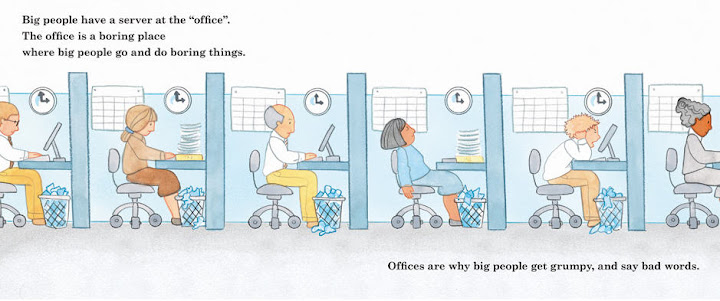
Probably the most boring part of the entire presentation is the "offices are boring" spread in the Mommy, Why is There a Server in the House? children's book:


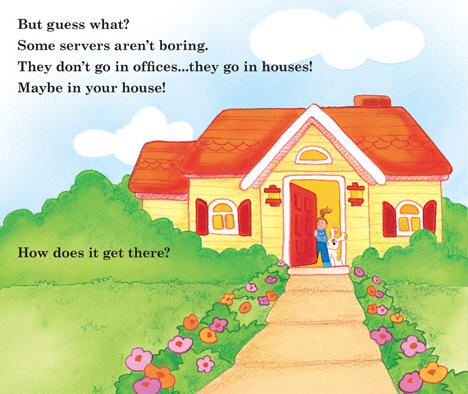
The text on the next page reads, "When a mommy and a daddy love each other very much . . . "

But you'll have to turn the page to find out what happens!

The entire site is unbelievably tongue-in-cheek.

Concerning the book's author, Dr. Tom O'Connor, we read:
Just so you know, Tom O'Connor does not actually have a Ph.D. He is also not actually a person. And the entire premise of this book is fictional. But on the bright side, a Windows Home Server is a real product. Perhaps you'd like to buy one!

You can find out more about Windows Home Server at . . .
And in a sidebar:


Back cover copy tells us O'Connor "first gained prominence in the '80s with his pioneering work on electric pencil sharpeners in the home. 'Mommy' is his eighty-seventh book."

Clearly, I think this is viral-worthy marketing: humorous, shareable. . . .

Enjoy!

Wednesday, December 05, 2007

Letting go . . .

I'm trying to clear out my mailbox and came upon an old piece of correspondence.

Those who know me well know I've been going through a faith crisis for many years. Right now, the pressure seems to be off. But about a year and a half ago, I was feeling it intensely.

Someone wrote to me:
There is a story about a man who was wandering about on the top of a mountain. He slipped, fell, and grasped the edge of a cliff. He was hanging there. So he shouted to the heavens, "Is there anyone up there?" There was no answer. So he really prayed, "Is there anyone, please, up there who can help me?"

An answer came. "Yes I will help you, but you must do exactly as I say."

The man said, "Yes, yes, I will do everything that you say."

The voice said, "Release your grip."

There was silence. One second. Two seconds.

Then the man said, "Is there anyone else up there?"
I replied,
Yes, I've heard this story, and it always elicits laughs in every audience in which I have been present. Except I don't laugh, because it frightens me that I may be that man.

Date and Dabitur

I recounted the tale of an online surfing safari. I noted it began with a hunt for an article about usury. That search led, fruitfully, also, to a blog post . . . whose author, I discovered, quotes from Martin Luther by way of explaining the otherwise obscure name of his blog: "Date-Datur."

The following text comes from Martin Luther (The Table Talk of Martin Luther, William Hazlitt, Trans (London: H.G. Bohn, 1857). "Of Justification," CCCXVI--pp. 151-152):
I would not boast, but I well know what I give away in the year. If my gracious lord and master, the prince elector, should give a gentleman two thousand florins, this should hardly answer to the cost of my housekeeping for one year; and yet I have but three hundred florins a year, but God blesses these and makes them suffice.

There is in Austria a monastery, which, in former times, was very rich, and remained rich so long as it was charitable to the poor; but when it ceased to give, then it became indigent, and is so to this day.

Not long since, a poor man went there and solicited alms, which was denied him; he demanded the cause why they refused to give for God's sake? The porter of the monastery answered: We are become poor; whereupon the mendicant said: The cause of your poverty is this: ye had formerly in this monastery two brethren, the one named Date (give), and the other Dabitur (it shall be given you). The former ye thrust out; the other went away of himself.

We are bound to help one's neighbor three manner of ways - with giving, lending, and selling. But no man gives; every one scrapes and claws all to himself; each would willingly steal, but give nothing, and lend but upon usury. No man sells unless he can over-reach his neighbor; therefore is Dabitur gone, and our Lord God will bless us no more so richly. Beloved, he that desires to have anything, must also give: a liberal hand was never in want, or empty.

Sunday, December 02, 2007

FWIW: The record of an online surfing safari

I recounted, below, the story of bumping again into an old acquaintance. I said I found him by a circuitous path.

I thought I would tell the story of that path.

I was looking, this afternoon, for some material about biblical and historical attitudes toward usury--the practice of charging interest on loans.

I have read some good stuff on the subject in the past. I seem to recall it was written by Gary North.

So . . .

* I did a search on Google: gary north scripture on borrowing.

Oh!

* A PDF essay by Ian Hodge titled Usury. I am aware of Hodge. He's pretty good. And he interacts with North.

On page 4: a footnote reference to a book called Christianity and Law: An Enquiry into the Influence of Christianity on the Development of English Common Law by Stephen C. Perks.

Ooh! That looks interesting!

* Does Amazon carry it? (No. Indeed, they don't even list it.)

Where can I find the book?

* I do a Google search.

Kind of slim pickings. But my search yields a Wikipedia article about Stephen Perks. (That's interesting! Who has heard of him? Why would Wikipedia include an article about him?)

* I go to the Wikipedia article. Not bad!

Perks founded the Kuyper Foundation. --Oh, yeah! Abraham Kuyper!

* I click on the Kuyper Foundation link in Perks' article.

Bummer! "Wikipedia does not have an article with this exact title. " Indeed, "If you expected a page to be here, it has probably been deleted (see Why was my page deleted? for possible reasons)."

So . . .

* I click on through to the Why was my page deleted? article.

Not terribly informative.

Due to past sad experience, I know if I write an article about something I know intimately--like Sonlight Curriculum, Ltd.--even if I only use publicly available sources, even if my article follows pure, objective, encyclopedic standards, Wikipedia almost promises to remove it. But I "just" want to see the rules. So . . .

* I click on the link from the Why was my page deleted? to Wikipedia: Criteria for speedy deletion. I read it. And then I get thinking: Maybe I'm not permitted to write such an article, but perhaps someone else wrote an article about Sonlight! So . . .

* Is there an article about Sonlight on Wikipedia? (No.) . . .

Okay. Then how about one of our competitors?

* Bob Jones University Press? . . . (Nah, I tell myself. Don't even go there. Why not start with Bob Jones University, period?)

Turns out there is an article about Bob Jones University. [Later addition: Turns out there is also an article about BJU Press! --But I'm sidetracking.]

* When you get way down the Bob Jones University page, you'll find there's even a separate article about Notable people associated with Bob Jones University.

* And a whole section in that article about Notable former students of BJU who didn't graduate. (Did you know Billy Graham attended BJU for a semester? . . . And Fred Phelps, the pastor of Westboro Baptist Church--the "God Hates F*gs" guy who leads members of his congregation on cross-country protests at the funerals of known h*mos*xuals? . . . And then, way at the bottom of the list, a guy named Barry Rogers (including the link I've just copied). He was thrown out of BJU midway through his senior year because he "came out" as a h*mos*xual. Soon after "coming out," he began making g*y p*rn movies. He became HIV positive and eventually committed suicide . . . last year. But I returned to the Notable former students of BJU who didn't graduate section and clicked on the last link: Chris Sligh, a finalist on the sixth season of American Idol . . . (He was thrown out of BJU because he attended a 4Him Contemporary Christian Music concert. . . .)

Well, by the time I finish reading about Sligh, I begin to wonder: If Wikipedia is willing to feature pages on guys like Sligh and Rogers, . . .

* Is there a page on me? (No.)

* A page on my book, Dating With Integrity? (No.)

* How about on Josh Harris' book I Kissed Dating Goodbye? Yes. (!!!) . . . Hmmmm. (Josh's book has sold more than a million copies, while mine has sold only about 80,000.)

Well,

* There's a link on that page to another Wikipedia page about Josh Harris . . .

And then, way down at the bottom of that page,

* There is a link to "The Way of a Man With a Maid", "an online book critiquing the courtship movement. See Appendix A, titled 'Joshua Harris and the Courtship Movement.'"

So I click on that link.

Oh! "I know this book!" The Way of a Man with a Maid is the online version of Robin's book . . .

And

* The online version of The Way of a Man with a Maid includes a link to Robin's blog. . . .

*****

Oh.

And guess what?

When I got to Robin's blog . . . and I read his article about the "Thought Police"? . . . It was originally published by (you're not going to believe this) . . . the Kuyper Foundation!

What a small world we live in!

Finding a soul mate?

Robin Phillips and I have a little--very slight--history together. He has written a book, The Way of a Man with a Maid, available online, that critiques the "courtship" movement--a form of male-female relationship that was--and, in certain circles, still is--popular in homeschool circles. He mentions me and my book, Dating With Integrity, within his work. At one point, almost exactly five years ago, we engaged in correspondence on this subject of mutual interest.

And now, today, while surfing the web for some information about biblical and historical arguments concerning usury (the practice of charging interest on loans), I bumped into Robin once more. (The happy reunion, as it were, was the result of an extremely circuitous path which I will recount in a separate post, momentarily.)

Anyway.

So there I was on Robin's blog when, what to my wondering eyes should appear, but an article of deep--and ever deeper--personal interest . . . An article wholly unrelated to the subject of male-female relationships but, rather, free speech and, even, epistemology: Robin's Readings & Reflections: Thought Police article in HTML.

"And so we meet again!" I thought. [Apologies to Snoopy--or was it the Red Baron? ("Snoopy vs. The Red Baron" by The Royal Guardsmen, 1966)]

I was first intrigued by Robin's introductory remarks about the increasing restrictions on free speech being enforced by so-called "liberal" protectors against so-called "hate speech":
[T]he reign of Big Brother is being introduced to Britain from the liberalism of the far left, a tradition that has historically championed Orwell’s defence of civil liberties and free expression.

This observation is particularly germane when considering the new corpus of offences restricting speech, religion, public debate and, in some cases, even thought itself, to that cluster of ideas which the liberals have designated ‘politically correct.’[2] The State’s eagerness to function as Guardian, not simply of law and order, but also of the ideologies of its citizenry[3], was made patently obvious last year when New Labour tried to push through legislation as part of the Religious Hatred Bill which would have made it an offence to criticise different religious truth-claims.

Even without the impetus of such a law, UK police currently operate under ‘guidance’ that defines a ‘hate incident’ so broadly that it can include debating another person about their lifestyle.[4] Although this guidance has no statutory force, and has been called ‘pseudo-law’ by one distinguished constitutional lawyer, it can influence the policy of police constabularies provided it does not lead to an actual charge being issued.[5] The effect is that simply to express certain viewpoints is at least treated as criminal.[6]

It was this tendency to police beliefs that Dr. N. T. Wright, the Bishop of Durham, lambasted in an address to the House of Lords on 9 February, 2006. Dr. Wright referred to a new class of crimes which “have to do, not with actions but with ideas and beliefs.” He said:

"People in my diocese have told me that they are now afraid to speak their minds in the pub on some major contemporary issues for fear of being reported, investigated, and perhaps charged. My Lords, I did not think I would see such a thing in this country in my lifetime…. The word for such a state of affairs is ‘tyranny’: sudden moral climate change, enforced by thought police."[7]

From religious organisations that must now navigate the increasingly complex labyrinth of gay rights laws[8] to Christian Unions that are being forced to admit atheists into their ranks[9], it is clear that today’s liberals are making sure Big Brother does more than merely watch us: he’s checking out our credo.[10] Chesterton was surely prophetic when he conjectured that, “We may eventually be bound not to disturb a man’s mind even by argument; not to disturb the sleep of birds even by coughing.”[11]
But my eyes grew wider when I saw the second subhead within his article: "The Self-Destruction of Epistemology."

Wow! I think I may have found a fellow-traveler in the world of thought!

******

I didn't really have any further purpose for this post than what I have written here. Just a desire to record my bemused astonishment.

******

But, y'know, while we're on the subject of Big Brother and the problems of eroding freedom of speech, let me quote from Robin's footnote #11 concerning Chesterton's quote about disturbing men's minds and the sleep of birds. After attributing the quote to G. K. Chesterton, Orthodoxy: The Romance of Faith (New York: Doubleday, 1908), p. 113, Robin continues:
Chesterton’s words are a pretty good description of the Protection From Harassment Act 1997. Worded so vaguely that almost any form of repeated conduct can become a crime, it gives the crown authority to prosecute anyone causing a person ‘alarm or distress’ if this involves ‘conduct on at least two occasions.’ Because such conduct ‘includes speech’, and because it is not necessary to demonstrate that the person causing distress has used abusive or insulting words, merely disturbing a man’s mind by argument could become a criminal offence if another person finds it distressing. The penalty is six months imprisonment or an order preventing the person from repeating the offence on pain of 5 years behind bars. It is now used routinely against peaceful protestors.

The anti-intellectual implications of the Serious Organized Crime and Police Act 2005 is equally disturbing. Although this Act is most known for removing freedom to demonstrate outside Parliament, it also includes a section on ‘harassment intended to deter lawful activities’. Under this act, it is an offence to cause alarm or distress to ‘two or more persons’ by ‘harassing’ them. ‘Harassment’ is defined as seeking ‘to persuade any person ... to do something that he is not under any obligation to do’. This means that if I try to persuade two or more people to change their philosophical views, then because they are under no legal obligation to do so, in theory I could be taken to court for harassment if the other person finds my axioms sufficiently distressing.

See George Monbiot's article 'I'm pleased the case against this ranting homophobe was dropped', The Guardian, October 3, 2006, available online at
www.guardian.co.uk/Columnists/Column/0,,1886185,00.html. See also my article ‘The Orwellian Legacy of Tony Blair’, available online at http://robinphillips.blogspot.com/2007/05/good-bye-tony-blair.html See also Peter Kitchens, The Abolition of Liberty (Atlantic Books, 2004).

Saturday, December 01, 2007

Context is everything . . .

I posted the following message on the Sonlighters Club Forums:
This video disturbs me . . .

As someone who is charitably minded, I'm concerned that this video contributes to an almost insurmountable cultural cynicism. And . . . I wonder why people like Geldof and Bono (I don't recognize the others) would agree to participate in such a program? Doesn't it basically say that everything they are involved with (or have been involved with) is (or was) a sham?

Can anyone help me acquire a counter-balanced perspective?

How can truly godly charities fight (what I see as) this cultural drift to total cynicism? . . . I'm astonished and appalled at the comments of viewers. "Ha ha ha"?!?

Wilberforce had to fight the pro-slavery forces who suggested his pleas in behalf of the slaves were (to use modern verbiage) the result of mindless, bleeding-heart liberalism. . . . How do we reply in today's climate?

Concerning the video: it is a bit lengthy, by video standards. The first two minutes (exactly) set the stage . . . then watch out!

[FWIW: We watch no TV at our home. So let me apologize up front if my lack of standard viewership is contributing to a "poor" response.]

Thanks for your input.
Before you read on, I encourage you to watch the video. (And if you have young children around, be aware that when Geldof makes his appearance, he lets an f-bomb fly.)

Once you watch it, feel free to return.

Or not. You may keep reading. But please understand that there are contextual "spoilers" in what follows.

You want to watch through my eyes as they were . . . or through slightly adjusted spectacles?

******

An Aussie wrote the first helpful reply:
I believe this was shown on a comic relief show, which is an annual comedy show with all the proceeds going to help african charities. I don't think it says everything they are involved with is a sham, they are just pointing out that it seems to be the 'hip' thing for celebrities to be doing right now.
Whoa! That helped! Indeed, I could see the humor.

But my lack of familiarity with the participants beyond Geldof and Bono also hurt.

Another community member added:
It's a satire on celebrities who do a lot of visible charity work for the wrong reasons--publicity to plug a product or to burnish a public image.

Ricky Gervais and the tall guy in glasses, Stephen Merchant, are famous comedians and were in character.

The blond guy, Jaimie Oliver, is a famous television chef, so it was funny to see him eating onion rings and McNuggets. I looked this up, but he has tried to teach children to eat better and had a show where they made school lunches. This is probably what he meant by the "fat chav" line and why it was so funny to see him eating bad food.

Bono and Bob Geldof were taking very broad pokes at their public images of humanitarians.
Ah-ha! CONTEXT is everything! Because with that CONTEXT in mind, suddenly, the sketch really does become humorous! . . . Talk about how someone's words (or, in this case, actions) can be made to say something they didn't intend at all . . . "simply" by having them taken out of context!

In this case, by taking the sketch out of context, I thought it said exactly opposite what the speakers (or, in this case, the participants) really meant . . . !!

Whew! Mind-blowing!

******

And while we're on the subject: It strikes me how a brand or brand image--and, in this case, a person's character--can be so important. Jaimie Oliver, a TV chef concerned about proper nutrition, eating onion rings and Chicken McNuggets. . . .

Political Do-Not-Call Registry

From Direct magazine:

When the federal [Do-Not-Call] registry was established, politicians claimed exemption, arguing that their pitches were not sales calls but free-speech efforts aimed at informing voters.

Perhaps. But sometimes the information given out is mighty dubious. . . . And when even genuine informational calls are followed by direct mail campaign contribution solicitations, the combined effort smacks more of multichannel marketing than political discourse.

So . . .

Shaun Dakin wants to give politicians a taste of their own medicine.

Dakin, a database marketer, was once a volunteer political telemarketer. In 2006 he got an earful of complaints about candidate calls, especially from people who had added their names to the National Do Not Call Registry. Now Dakin has set up his own list for those seeking to avoid political telemarketing. . . .

Dakin's registry is an initial response to the arrogance of politicians who pass restrictive marketing laws they don't intend to follow themselves.

Is it perfect? Probably not. But it gets the debate started. . . .

“If this thing takes off, there'll be a lot of very angry voters who may not vote for candidates who don't participate,” Dakin says of his registry. He hopes to sign up 1 million names by next March.

It's an ambitious goal. The registry (www.stoppoliticalcalls.org) launched in late September.
You'll want to read the article to see exactly what the registry does and does not do.

I know I was frustrated, last presidential round, at how many stinkin' phone calls we received from political operatives. Our phone is normally very quiet. But for a two- or three-month period . . . !!!!

Wednesday, November 28, 2007

Merry Tossmas!

Whoa! The other side of "Happy Holidays!"

Feliz Navitoss!

Sunday, November 11, 2007

Creative artistic expression

I was blown away by the videos of Phil Hansen and his unique artistic expressions--not only the final works of art but, much more, his techniques. How, especially, can he do something like his "A Moment"? --How can you keep the sense of the whole even while dealing with the minutia . . . and while the entire piece spins?

I think you may find these videos interesting as well (to put it mildly).

Check out his website at http://www.philinthecircle.com/.

Monday, November 05, 2007

The office of the future (???)

Popular Science magazine features seven products--some big, some small--that may transform the office of the future. From my perspective, the most interesting was, by far, the smallest. Swingline, the staple and stapler manufacturer wants to create RFID-embedded staples:
Soon, staples won’t just keep papers together—they’ll make sure you keep them, period. As RFID tags shrink in price and size, Swingline wants to embed them in staples so that lost documents can radio their location to a tracking device.