Wednesday, November 28, 2007
Sunday, November 11, 2007
Creative artistic expression
I think you may find these videos interesting as well (to put it mildly).
Check out his website at http://www.philinthecircle.com/.
Monday, November 05, 2007
The office of the future (???)
Soon, staples won’t just keep papers together—they’ll make sure you keep them, period. As RFID tags shrink in price and size, Swingline wants to embed them in staples so that lost documents can radio their location to a tracking device.
Saturday, November 03, 2007
Xobni ("Inbox" spelled backwards)
I clicked on the next video that was supposed to be an ad looking for Software and Software QA Engineers. Obviously, it's a total joke. But a funny one. (Wait for Sundeep Patel [or however his name is spelled] who claims (about 2:05 into the video) that "Yesterday I singlehandedly reduced indexing time 25.44 percent.")
Or . . . maybe this is no joke at all. Maybe Xobni's foray into offbeat videos on YouTube is an absolutely brilliant ploy to find exactly the kinds of employees it wants. . . .
Another technical humor post . . .
I visited again and found myself entranced once more with a discussion of Security Practices Gone Wild. First in the original post but perhaps even more by the comments made as a result of the post. Amazing what computer programmers have to deal with . . . and the kinds of things, then, that they think about.
To get you started, let me quote from the original post:
It's common knowledge that a security system is only as effective as its weakest point. You can install a reinforced steel door with a two-phase palm-print/retinal-scan entry to protect your home, but if you leave a first-floor window open, you're more vulnerable than your neighbor with a simple deadbolt. One of Nate's clients learned this lesson first hand with its e-commerce Web site. The operation didn't involve terribly sensitive data: there were no bank accounts, no Social Security numbers, nor even any credit card numbers. Pre-approved customers would simply sign in and place their orders. Accounts payable and fulfillment would take it from there.Enjoy!
Yet the Web site painted a different picture, featuring two-factor authentication, encrypted databases and a giant padlock graphic advertising "secure."
Before Nate's team arrived, hacking the Web site proved to be about as difficult as entering a house through an open, ground-floor window. The original developers managed to implement virtually every type of vulnerability:Every time the Web site was hacked, the original developers insisted it was an infrastructure problem. They had the company buy a secure certificate. Then they added a separate database server. Then they installed a firewall to put between the servers. Then an intrusion detection server. And so on. Still, hackers waltzed right in.
- Query String Replacement. Users could (and did) fiddle with the URL in the address bar (for example, changing "/viewOrder.asp?OrderNumber= 80023" to "/viewOrder.asp?OrderNumber= 80024") to view other customer's data.
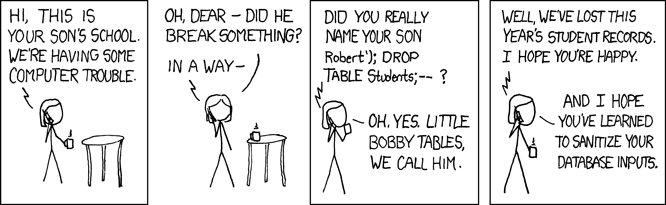
- SQL Injection. By using single-quote characters, attackers were able to easily "inject" SQL code. For example, typing "' OR '' = '" in the Password textbox would result in a query that asked for users "WHERE Password='' OR '' = ''." Because an empty string ('') is always equal to itself, this would always return a user.
- Trusting the Browser. Instead of using server-side code to disable and hide unauthorized navigation links, CSS and JavaScript were used. A quick "View Source" or even a line or two of JavaScript type in the address bar could (and did) easily bypass the protection.
Eventually, the company decided that enough was enough and hired Nate and his team to remediate the problems. But his hands were tied as the client insisted on dictating security requirements. And dictate they did. . . .
. . . Oh. I posted this partially to "explain" how I got to Spamusement.com (see my post directly beneath this one). --One of the respondents said the proposed security measures everyone was talking about reminded him of this "Security Issues" cartoon.
And if I'm gasping in awe at the astronomical photos . . .
I'm astonished: I've looked at 29 cartoons so far--just clicking on the buttons beneath whatever cartoon I'm viewing at the moment: all the cartoons have been "clean" . . . even though quite a number of them have been based on gross subject lines--where the language alone makes you cringe, expecting a perverse cartoon.
If you can handle the language of the subject lines, based on my experience so far, I expect you will find the cartoons themselves at least non-offensive, and, more probably, hilarious. . . . A good example: "s*xy baby and bad erection?"
--Somehow, I appreciate the fact that the cartoonist is making fun of people whose "business" really is perverse.
Amazing astronomy
Friday, November 02, 2007
One for the Scientific Community
I received it from my brother who is founding president of the International Christian Technologists Association.
Anyway. Once more: please go to http://2007.weblogawards.org/polls/best-science-blog-1.php and vote for Climate Audit for "Best Science Blog."Right now, the 2007 Best Weblog Contest is going on. Ten blogs in each of a number of categories. One category is science.
An underdog blog is the mouthpiece for a guy who, on his own dime, is working hard to see better scientific work done on the challenge of climate change. Leslie and I [that's my brother and his wife--JAH] have enjoyed helping a bit in our spare time.Last year's contest (in the science arena) was won by 4000 votes -- and voters are allowed to vote every 24 hours for a week. (The last day of voting is Nov 7... it's already well under way.)
The great blog: http://www.climateaudit.org/
The vote: http://2007.weblogawards.org/polls/best-science-blog-1.php
Climate Audit is by Steve McIntyre -- the guy who demonstrated errors in the "hockey stick" graph for Global Warming -- a graph created using such bad math that almost *any* data set -- even plain noise! -- will generate hockey sticks. (Steve also proved that the NASA scientist (Mann) at fault KNEW his method was bad: Mann denied he had done a particular statistical test for spurious data... yet Steve discovered Mann had an analysis hidden away in a "CENSORED" folder...with exactly the analysis Mann denied having done!)
Steve is also the guy who recently proved errors in NASA's "revisionist" temperature history, forcing them to update their data. (Yes -- today is not warmer because it was measured warmer. Today is "warmer" because they keep revising OLD temperatures DOWNWARD. I'm not kidding.)
And,
Steve is the guy who keeps highlighting unbelievable practices among climate scientists. Practices that, despite the nasty things said about him, are slowly but surely causing the rest of the scientific community to wake up. For example, this is an actual quote, in print, from a leading climate scientist:
...this does not mean that one could not improve a chronology by reducing the number of series used if the purpose of removing samples is to enhance a desired signal. The ability to pick and choose which samples to use is an advantage unique to dendroclimatology.Oh, yes: these guys literally believe that data that doesn't fit their hypothesis can be TOSSED OUT! (Earliest post on the theme: http://www.climateaudit.org/?m=200509 -- search for "A quote from Esper." It's been used more often since then, and picked up elsewhere.)
THAT is actually one key reason Leslie and I helped collect new data up near Pike's Peak.
The claim has been consistently made that Trees tell a temperature story of global warming. And that it's too hard, too expensive for the Boulderites to go back up and update the data (last collected in 1984.) Yet we'd been hearing rumors that maybe all was not well. So, based on Steve's Starbucks hypothesis (can a team start at Starbucks in the morning, collect tree ring samples and be back in time for dinner?), we went on our adventure. And proved his hypothesis right.
Photo Gallery, by the way: http://picasaweb.google.com/Almagre.Bristlecones.2007
Some of the story (google Almagre climate audit and you'll get more than you want to know)... http://www.climateaudit.org/?p=2189
Monday, October 29, 2007
Differences between the wealthy and not-so-wealthy.
The one set of characteristics, I am convinced, does lead to success. The others do not.
Time Frames.
- Extremely poor people think in terms of days.
- Poor people think in terms of weeks.
- Middle class people think in terms of months.
- Wealthy people think in terms of years.
- Extremely wealthy people think in terms of decades.
- Wealthy: FREEDOM
- Middle class: COMFORT
- Poor: SURVIVAL
- "Seek and you shall find," said Jesus. It takes longer to seek and find freedom than comfort. It takes longer to seek and find comfort than mere survival.
- "Where there is no vision, the people perish" (Proverbs 29:18, KJV). A corollary: With vision, you can flourish.
- Wealthy are comfortable with delayed gratification.
- Middle class seek instant gratification.
- Delayed gratification is giving up something that you want today so you can have what you want even more tomorrow:
- Putting aside comfort today for the opportunity to gain freedom tomorrow.
- Being willing to put aside instant rewards (as a single person: sexual involvement before marriage; as a salesperson: a quick sale . . . ) so as to build a long-term (and, therefore, far more mutually profitable/beneficial) relationships.
- Wealthy people think active thoughts about the future: "What can I do? How can I change things?"
- Non-wealthy people think passive thoughts about the past: "What happened? How was I victimized? Why am I the way I am?"
Big people talk about ideas.
Average people talk about things.
Small people talk about other people.Some people make things happen.
Some people watch things happen.
Some people ask "What happened?"
- Wealthy people
- think and talk about ideas ["How do I ___?" "Why does . . . ?" "What might [explain, enable, . . . ]?"] and
- cause events to happen.
- Middle class people
- think and talk about things [(baseball, basketball, football . . . ) games, houses, cars, boats] and
- watch events transpire.
- Poor people
- think and talk about other people and
- ask, "What happened?"
- Non-wealthy people talk about sports, cars, movies, vacation spots. The wealthy own all those things! They talk about how to make or own the things the non-wealthy are willing to spend their money on.
- The observations concerning speech and thought ought to reinforce the idea that you need to associate consciously and purposefully with people who think and talk in a manner that will help you become what you want to become rather than with those who are where you've been in the past and/or where you are right now.
- "The tongue has the power of life and death" according to Proverbs 18:21. Our lives are reflections of the things we think and talk about. What you think and talk about, you get. So if you think and talk about things about which you are unhappy, and you concentrate on complaining: expect to find more and more things about which to be unhappy, and expect to "enjoy" a negative attitude. But if you think and talk about things that delight you and for which you express gratitude: expect to find more and more such delightful things in your life and expect to enjoy the blessings of gratitude.
- Beware of negative vocabulary. Use can more than can't. Use possible more than impossible.
Ask a crowd:
Their almost universal response:
But ask them,
And they will say,
- Non-wealthy people assume change is going to be bad.
- Wealthy people figure, if the change is positive, then that's great! And if it's negative . . . why, that gives me an opportunity to learn and grow.
- Wealthy embrace change.
- Non-wealthy fear and are threatened by change.
Some Words of Wisdom- You don't "get lucky" because you're in the right place at the right time. You "get lucky" because you're prepared.
"Luck" happens when preparation meets opportunity. - Don't ask, "Why is this happening to me?" God permits change in order to help us [possibly us, personally, but, certainly, us as a society as a whole] to grow and to become who and what we should become.
- You don't "get lucky" because you're in the right place at the right time. You "get lucky" because you're prepared.
- Wealthy take calculated risks.
- Non-wealthy are afraid to take risks.
- becoming educated first,
- doing your due diligence, then, before acting,
- considering the consequences of failure.
Ask three questions:
- What's the best that could happen?
- What's the worst that could happen?
- And what's the most likely to happen?<
- If the most likely thing to happen will bring you closer to your goals, and you're willing to "live with" the worst thing to happen, then you should go for it.
- If the most likely thing to happen will NOT bring you closer to your goals and/or you're unwilling to go through whatever is the worst thing that could happen, then you ought not to do whatever it is.
- Wealthy embrace failure: "I can learn from it."
- Non-wealthy see failure as negative or bad.
- Wealthy concentrate on their personal goals and aspirations rather than the approval of others.
- Non-wealthy alter their goals and aspirations based on what others say.
- Wealthy "play to win"; they concentrate on what will enable them to succeed.
- Non-wealthy "play defense" in hopes of avoiding loss.
Some Words of Wisdom- Think of failure as a verb, not a noun; it's something you do, it's not what or who you are (i.e., "I failed to ____," or "That experiment failed." NOT "I'm a failure.")
- You have to have a stronger desire for success than desire for the approval of others.
- You have to play to win in order to win. If a team only plays defense, then they cannot possibly win. Same with you: If you seek only or primarily not to lose, then you are virtually destined to lose.
- Wealthy continuously learn and grow.
- Non-wealthy are convinced learning ends at the end of school.
- Wealthy recognize that knowledge is expensive. They are willing to pay for good advice.
- Non-wealthy look for free advice.
- Wealthy think in terms of investment.
- Non-wealthy think in terms of expense.
- Wealthy think of money as seeds to grow.
- Non-wealthy think of money as grain to eat.
- Wealthy people [those who are joyful, happy, rich in spirit] believe in being generous.
- Non-wealthy people [those who are poor in spirit] believe they can't afford to give.
- Wealthy have (or create) multiple sources of income.
- Non-wealthy have only one or two sources of income.
- Wealthy work to generate profits (passive income).
- Non-wealthy work for wages.
- Wealthy people seek to increase their wealth (assets that produce passive income).
- Non-wealthy people seek to increase their pay.
Some Words of Wisdom.- Seeking merely to build one's paycheck with no view to increasing wealth--profits, passive income--is not only not smart, it is risky.
- As pay goes up, so do your taxes. You make money; you're taxed immediately, and then you spend what's left over. (Wealthy people, by contrast, make money, spend much of it as they want [as "investment," "seeds," doing good], and then get taxed on the remainder.)
- As pay goes up, so does your dependence on someone else. Big paychecks are relatively RISKY! (Think airline pilots or the top-dollar employee who does little more than the relatively recent college grad who is making half or a third the salary.)
- Wealthy say: "I can hire someone to do a task better than I can do it."
- If you believe only you can do a task, you severely limit your income potential.
- You need to build teams and seek passive income. When you seek to build teams and acquire assets that produce passive income, hard work comes first; money comes later.
- An asset that doesn't produce passive income [for example, houses and cars produce no passive income for most owners] is not really an asset from a wealthy person's perspective. As you build your net worth, make sure it is in the form of things that build your passive income.
- Seeking merely to build one's paycheck with no view to increasing wealth--profits, passive income--is not only not smart, it is risky.
Empowering vs. Disempowering Questions
- Wealthy people ask themselves empowering questions.
- Non-wealthy people ask themselves disempowering questions.
Empowering Questions Disempowering Questions How can I make the money I need to do what I want? How can I get my boss to give me a raise? What can I do today to show my wife I love her? Why is it so hard to get along with my wife? What can I--indeed, what will I--do today that will help me stay fit and healthy? How did I get to be so fat? What can I think about right now that I would enjoy thinking about? Why am I always so stressed?
- Wealthy people think, "What must I be and do in order to have ____?"
- Non-wealthy people, meanwhile, ask, "What must I have so that I can do ___ and be ___?"
- Wealthy people believe . . . Who I am determines what I do and what I have.
- Non-wealthy believe . . . What I have determines what I can do and who I can be.
- Wealthy people ask What, Why and How:
- What kind of person do I want to be?
- Why do I want to be that kind of person? (Is it what's on my heart?)
- How do I become what I want to be?
Then they ask,- What do I want to do?
- Why do I want to do that?
- How can I enable myself to do that?
And, finally, they ask, - What do I want to have?
- Why do I want to have it?
- How can I create or acquire it?
Sunday, October 14, 2007
Who am I?
I sent them what I imagine may be the strangest résumé they have ever received. But it felt good.
Since then, I think I have come to understand a bit more about why I must have felt compelled to send them such a strange document.
First I told them about things I thought they might like to know about me "from a functional/professional/historical perspective": achievements, jobs and positions of responsibility (other board memberships, for example) that I've held, education, . . . things like that, but also key relationships that could impinge on my relationship with them, and current "primary concerns and interests" in life.
--Why would I "bother" them with such details? . . . I think such details would help anyone get to know me better: who I "really" am.
Personal information: when and where I was born, where I've lived (lots of places), family relationships with my wife and kids.
Stuff about my broader family--parents, brothers and sisters--that has shaped "who I am" and "how I view" and "how I deal with" life.
The agency is religious, so I included a bunch of information about spiritual faith realities which differentiate me from a lot of others.
Then, a lengthy discussion of what I called "John's character." And for this post, that's what I would like to concentrate on and reproduce here:
John's character:I realized, when I wrote this résumé, that it would come in handy--perhaps to make me more attractive to the non-profit organization, or, potentially, to make me very unattractive. After all, if they want or think they need someone who will strongly maintain "distinctives" in opposition to others--someone who will gladly "take on" those who are less than enthusiastic about the organization's mission, then I am probably not their man.
- John is intensely interested in and concerned about integrity--saying what he means and meaning what he says . . . and expecting similar behavior on the part of people with whom and organizations with which he deals.
- Functionally, that means he speaks up quickly and forcefully--i.e., he will become highly confrontative--if or when he senses someone (or the group in which he is present) refuses either to address a truth "out there" or to speak the truth about what is happening "here." Put another way,
- He refuses to permit unacknowledged "elephants" to remain in the room!
- John seeks to bring opposing people and parties together through mutual understanding.
- John tends to avoid "group think" or pitting "our" side against "their" side. If he observes, in a group of which he is a part, a near-universal adoption of a certain mood or emotional feeling; or if he observes what he thinks may be a too-quick rush to affirm one point-of-view, he will often--almost as a knee-jerk response, it seems--place himself, emotionally, in the opposite mood or feeling and/or rouse himself to speak for the (or an) "other" perspective.
- John asks probing questions. He is interested in "everything."
- John tends to prefer finding whatever is "good" and potentially useful in an idea or proposal; he does not automatically or quickly seek to identify what is "bad" or unworkable in an idea or proposal. Depending on the circumstance, then, one might characterize him as (positively) "a possibility thinker," "good at research," or (negatively). . . rather "indecisive."
- With all that, however, John is relatively merciless when it comes to communication barriers. He is quick to notice--and finds it difficult not to comment on--features or factors that hinder communication: use of jargon, grammatical errors, circumlocutions, and so forth. Indeed,
- John is more acutely aware than most people of "environmental" factors and "background noise" that may cause difficulties. Not only is he aware, but he will turn his attention to identify these matters explicitly, and then address them. Thus, by way of examples:
In these ways, then, John is a problem-solver.
- When a room becomes too hot, John is usually the first person to attempt to adjust the thermostat, turn on a fan, etc.
- If a sound system is too loud, too soft, provides too much treble or too much bass: John is often the first person to seek adjustments.
- If a publication or video seems muddled in presentation, John often identifies non-verbal factors--visual, spatial, sequential, aural, etc.--that contribute to the problem . . . and he normally expresses his concerns. . . .
If they need someone to build bridges, I may very well be.
And, as I intend to discuss in my next post, being clear about who you are--your strengths and weaknesses--can readily improve help you and those with whom you intend to work maintain your focus on those tasks where you will serve most effectively and efficiently. . . .
The result of one of my rare immersions into the tech world . . .
and the following entry:
Do Not Click! 2007-10-10
by Alex Papadimoulis in Error'd
This popped up for Steve in Lotus Notes. I wonder if this is what happens when you click buttons labeled "do not click!"
Alan C. came in to work one morning to find that someone had helpfully labeled all the cables on one of the hotdesks. How did they ever cope before?
Brian was using an internal tool at work and ran into this next error. Naturally, the window doesn't actually detect key strokes ...
Best comments in reply:
Made me think of WTF:
http://xkcd.com/327/
and:
The cable labels gave me flashbacks. At my old position we had to label every cable to a ridiculous degree.. . . Which comment yielded a reference back to an earlier WTF post:
Ethernet data cables had to be a certain color and Ethernet management cables (DRACs, LOM) had to be a different color. So right off the bat we had to swap out 95% of the cables in our facility.
Every Ethernet cable had to be labeled on both ends with:
1. Server name
2. Server port (in case the server had multiple NICs)
3. MAC Address
4. Switch name
5. Switch card
6. Switch port
So you would end up with a cable "flag" that was about 6 inches long. It was obviously useful, in the case when someone sneaked into the server room and unplugged a random cable (which never happened). Of course if you ever moved anything or renamed a server for a new project you had to make 2 new labels.
The best part was labeling the power cords. You needed to have the server name and the "slot" the cord was plugged into on the surge suppressor. Then you had to label the end of the surge suppressor and which circuit breaker it plugged back into.
Clean design and thorough documentation are essential in every type of engineering, from aerospace to software. Network Engineering is no different: with miles of cables wired to thousands of jacks in a typical office building, an unlabeled block of cable is just as good as a dead one. Fortunately, the fine folks at Patrick McGoohan’s office made sure to carefully label everything . . .
*****
Well. I was about to leave WTF having ignored the following post. I was sure it was some kind of joke. Someone must have done some Photoshopping:
Sorry, You Used That Password 28,452 Times Ago 2007-10-08Amazing! There really is such an error message:
by Jake Vinson in Error'd
This one's from the Microsoft Knowledge Base:So assuming 60WPM and 4-5 characters in a word, it'd take you over an hour to type in your password. And hopefully you'd type the correct one in, rather than one of your last thirty thousand passwords.
(submitted by Sean)
SYMPTOMSWhew! I'm so glad to discover this is not a common case!
If you log on to an MIT realm, press CTRL+ALT+DELETE, click Change Password, type your existing MIT password, and then type a new, simple password that does not pass the dictionary check in Kadmind, you may receive the following error message:Your password must be at least 18770 characters and cannot repeat any of your previous 30689 passwords. Please type a different password. Type a password that meets these requirements in both text boxes.Note that the number of required characters changes from 17,145 to 18,770 with the installation of SP1.
NOTE: This is not a common case; it occurs only when you configure Windows 2000 to authenticate against an MIT Kerberos domain.
Sunday, October 07, 2007
Something about humor . . . or a lack thereof
Through about a 10-step surfing expedition beginning from Thou Shalt Not Kill, Except in a Popular Video Game at Church, . . . I discovered that FDR (Franklin D. Roosevelt) could be quite a humorist.
This is from a September 1944 campaign speech he made to the Teamsters:
These Republican leaders have not been content with attacks on me, or my wife, or on my sons. No, not content with that, they now include my little dog, Fala. Well, of course, I don't resent attacks, and my family doesn't resent attacks, but Fala does resent them. You know, Fala is Scotch, and being a Scottie, as soon as he learned that the Republican fiction writers in Congress and out had concocted a story that I had left him behind on the Aleutian Islands and had sent a destroyer back to find him - at a cost to the taxpayers of two or three, or eight or twenty million dollars- his Scotch soul was furious. He has not been the same dog since. I am accustomed to hearing malicious falsehoods about myself - such as that old, worm-eaten chestnut that I have represented myself as indispensable. But I think I have a right to resent, to object to libelous statements about my dog.
While I'm on the subject of humor, however, let me note two of the stops I made on my way to reading FDR's comment.
I didn't first bump into the two of them in the sentence, "How they laugh doesn't tell you much; what they're cackling at says a lot: Conservatives Are Such Jokers."
I believe the sentence should actually read, "How they laugh, sadly, can tell you a lot; and what they're cackling at can reveal more than you'd like to know."
The first reference is to an article about Hillary Clinton's laughter. (I don't watch TV nor do I listen to radio, so I can make no personal comments on her behavior.)
The second reference is to an Op-Ed piece by Paul Krugman in the New York Times. When I read what he wrote, assuming he is telling the truth, I found myself truly disgusted.
As a libertarian (notice I am not using a capital L!), I do not believe the government should be providing the benefits Krugman and others seem to think it ought to provide. BUT. I hate to find my anti-government-funded-services position represented by "humor" of the forms he quotes:
Ronald Reagan thought the issue of hunger in the world’s richest nation was nothing but a big joke. Here’s what Reagan said in his famous 1964 speech “A Time for Choosing,” which made him a national political figure: “We were told four years ago that 17 million people went to bed hungry each night. Well, that was probably true. They were all on a diet.”
. . . On Wednesday, President Bush vetoed legislation that would have expanded S-chip
. . . providing health insurance to an estimated 3.8 million children who would otherwise lack coverage.In anticipation of the veto, William Kristol, the editor of The Weekly Standard, had this to say: “First of all, whenever I hear anything described as a heartless assault on our children, I tend to think it’s a good idea. I’m happy that the president’s willing to do something bad for the kids.” Heh-heh-
heh. . . . Before the last election, the actor Michael J. Fox, who suffers from Parkinson’s and has become an advocate for stem cell research that might lead to a cure, made an ad.
. . . It was an effective ad, in part because Mr. Fox’s affliction was obvious.And Rush Limbaugh
. . . immediately accused Mr. Fox of faking it. “In this commercial, he is exaggerating the effects of the disease. He is moving all around and shaking. And it’s purely an act.” Heh-heh-heh. . . . I believe that the lack of empathy shown by Mr. Limbaugh, Mr. Kristol, and, yes, Mr. Bush is genuine, not feigned.
Ouch!
Krugman goes on:
Mark Crispin Miller, the author of “The Bush Dyslexicon,” once made a striking observation: all of the famous Bush malapropisms — “I know how hard it is for you to put food on your family,” and so on — have involved occasions when Mr. Bush was trying to sound caring and compassionate.
By contrast, Mr. Bush is articulate and even grammatical when he talks about punishing people; that’s when he’s speaking from the heart. The only animation Mr. Bush showed during the flooding of New Orleans was when he declared “zero tolerance of people breaking the law,” even those breaking into abandoned stores in search of the food and water they weren’t getting from his administration.
Yowzie!
Okay. Now I'm going to wander away from the primary subject of humor (or lack thereof).
Way down the page of commentary in response to the blog article from which I quoted the single-sentence reference to both Hillary and Krugman, someone objected to Krugman's reference to Miller and his "Dyslexicon":
All? . . . Did Mr. Miller say "all [Bush malapropisms]"? Here's a genuine Miller quote: "It's mainly when he tries to feign idealism or compassion that the man [Bush] stops speaking his own native language."
I have confessed it before. I will confess it again. I am a relative innocent when it comes to politics. I occasionally take a glimpse at what the politicians are saying or doing. Mostly, however, I remain blissfully ignorant of the primary parties' shenanigans.
I thought the immediately preceding commentator made some interesting observations, however, when he said,
As Altemeyer shows, certain relatively extreme political attitudes do tend to cluster together, and people in those clusters do tend to behave, politically, in somewhat predictable ways. The followers are not the same as the leaders, though. Altemeyer, for example, shows that right-wing authoritarian followers have definite egalitarian and socialist tendencies (as long as the socialism part isn't benefitting people outside their own group identity. . . .)
Followers have political attitudes. Leaders appeal to the attitudes, in order to pursue goals and policies. An attitude is not the same as a policy, and appealing to a political attitude is not sharing it.
Krugman's column could be viewed as having several partisan purposes, but whatever those purposes, its context is partisan division.
I suppose that my mixed feelings have to do with a David Broder-like wish for the kind of politics [another respondent to the original blog post--JH] projects onto the unlikely figure of William Kristol: "we should judge policies by a careful examination of the substance" where compromise in a deliberative legislative process would improve laws and programs, a world where liberal soft-heartedness is balanced by a good-natured conservative hard-headedness, and everyone wants the good of the country.
That's not the present state of our politics and partisan divisions, though. Our times are calling for sterner stuff.
This guy's comment about "right-wing authoritarian followers hav[ing] definite egalitarian and socialist tendencies" intrigued me. But I wasn't sure whether I really believed it until I read someone else's comment further below:
In regards to right-wing socialism. The military has free medical care for active and retired members, as well as access to reduced prices at the PX and commisary. Military people expect this for their own, but in general are right-wing and opposed to "socialism" for the rest of society.
!!!!
| Rate this : |
|
2.5 |
Sunday, September 02, 2007
Fiduciary Responsibility: "Read the Bill Act"
As DownsizeDC comments,
Most Congressmen are lawyers, and many others are businessmen. They know what "fiduciary responsibility" is. For Members of Congress, fiduciary responsibility means reading each word of every bill before they vote.
But Congress has not met this duty for a long time.
Boy! I know what fiduciary responsibility means for me as a business owner and board member! . . . If I let something untoward happen on my "watch," I'm in big trouble!
So how do our congressional representatives get away with not reading the laws they are seeking to pass?
RTBA requires that . . .See more at DownsizeDC. --I'm "all for" this proposed legislation! (Shall we make it a Constitutional amendment?
- Each bill, and every amendment, must be read in its entirety before a quorum in both the House and Senate.
- Every member of the House and Senate must sign a sworn affidavit, under penalty of perjury, that he or she has attentively either personally read, or heard read, the complete bill to be voted on.
- Every old law coming up for renewal under the sunset provisions must also be read according to the same rules that apply to new bills.
- Every bill to be voted on must be published on the Internet at least 7 days before a vote, and Congress must give public notice of the date when a vote will be held on that bill.
- Passage of a bill that does not abide by these provisions will render the measure null and void, and establish grounds for the law to be challenged in court.
- Congress cannot waive these requirements.
Is there room in evangelical/Protestant churches for committed communities that seek to do "great things" for God?
Break through, break through all my doubts
Break through, break through all my fears
Break through that I may worship You
Break through, break through all my pain
Break through, all my guilt and my shame
Break through like only You can do
Chorus
You are brighter than my darkest night
Stronger than my toughest fight
Just one touch from You my King, my friend
And I’ll never be the same again
Break through, break through
. . . like only You can do.
And I got thinking: I don't "live there." I don't want to "live there." I don't want even to try to "live there" with those emotions: doubts, fears, pain, shame.
Somewhere during the service someone mentioned infirmities.
I realize all of these emotions and physical experiences are part of life. Everyone experiences them. Sometime. Sometimes. But . . . Why would we--the church--"embrace" these things? Almost revel in them? . . . Isn't it true that the church, in history, has tended to "dwell" there? A major part of Christian "piety" through the years seems to have focused on remorse, regret, "woe is me," "I am unworthy," "I am but a worm." . . .
But then I look at the people who seem, often, to dwell in these regions--some of whom are very close to me: I don't want to be like them! I don't feel like a loser. I don't experience feelings of shame for the way I live. (At least not often!) And while I have plenty of doubts about a lot of things; and while I can think of things for which I realize I should be--need to be--afraid; and while I can think of battles I need to fight: somehow . . . I don't dwell in meditations about such things.
[I can imagine medieval knights meditated on such things--and needed to engage in such meditations. They were living in the midst of battles that deserved fear and required strength of a nature few of us today ever require. . . . ]
But then I got thinking: the things I think of as needing battle, as engendering fear: they are of a completely different nature than the things with which those I know, for whom life itself is a "struggle" . . . --The things I fear and battle are of a completely different nature than the things that those people "fear" and "battle."
I want to tell these others, "Get over [your (unfounded) fears and] your 'struggles'! It's time to move on with your life!"
. . . So . . . Where does one go if one wants to take on bigger battles than personal survival? Is there room in the Protestant church for committed communities that seek to do "great things" for God?
And . . . what about songs that focus less upon "me" and my (potential) "woe-is-me" state and more on the majesty and power and greatness of God . . . almost without reference to me? ----Even some semi-"contemporary" songs like Joey Holder's 17-year-old Scripture-based standard "Unto the King" (from 1 Timothy 1:17):
Now unto the King Eternal
Unto the King Immortal
Unto the King Invisible
The only wise God
The only wise God
(Repeat)
Unto the King be glory and honour
Unto the King forever
Unto the King be glory and honour
Forever and ever
Amen
Amen
Tuesday, July 10, 2007
A thought-provoking blessing . . .
I pray such a blessing for myself!
- May God bless you with discomfort . . .
at easy answers, half-truths and superficial relationships . . .
so that you may live deep from the heart.- May God bless you with anger . . .
at injustice, oppression, & exploitation . . .
so that you may work for justice, freedom and peace.- May God bless you with tears . . .
to shed for those who suffer pain, rejection, hunger and war . . .
so that you may reach out your hand to comfort them and turn their pain into joy.- May God bless you with enough foolishness . . .
to believe that you can make a difference in the world . . .
so that you can do what others claim cannot be done.
Sunday, July 08, 2007
How to Clean Up Your Family History . . . or Your Resume!
I have chosen the version alternate to Dave's and have edited it for smoother reading:
Let's say that your great-great uncle, Remus Starr, was hanged for horse stealing and train robbery in Montana in 1889. A cousin has supplied you with the only known photograph of Remus. It shows him standing on the gallows. On the back of the picture are these words:Remus Starr: Horse thief. Sent to Montana Territorial Prison, 1885. Escaped 1887, robbed the Montana Flyer six times. Caught by Pinkerton Detectives, convicted and hanged, 1889.Pretty grim situation, right?
Not to worry!
Simply crop the picture, scan in an enlargement and edit it with image processing software so that all one sees is a head shot. Next, rewrite the text:Remus Starr was a famous cowboy in the Montana Territory. His business empire grew to include acquisition of valuable equestrian assets and intimate dealings with the Montana railroad. Beginning in 1885, he devoted several years of his life to service at a government facility. Upon finally taking leave, he resumed his dealings with the railroad. In 1887, he was a key player in a vital investigation run by the renowned Pinkerton Detective Agency. In 1889, during an important civic function held in his honor, Uncle Remus passed away when the platform upon which he was standing collapsed.You have now given Uncle Remus a distinguished place inside the family tree, rather than hanging from it!
Tuesday, July 03, 2007
Children "unimportant" in the majority of American marriages
The Pew Research Center survey on marriage and parenting found that children had fallen to eighth out of nine on a list of factors that people associate with successful marriages - well behind "sharing household chores," "good housing," "adequate income," a "happy sexual relationship" and "faithfulness."Up to this point, even though I found the information disturbing and a bit too reminiscent and confirmational of what Mark Steyn said, the article "made sense."
In a 1990 World Values Survey, children ranked third in importance among the same items, with 65 percent saying children were very important to a good marriage. Just 41 percent said so in the new Pew survey.
Chore-sharing was cited as very important by 62 percent of respondents, up from 47 percent in 1990.
The survey also found that, by a margin of nearly 3-to-1, Americans say the main purpose of marriage is the "mutual happiness and fulfillment" of adults rather than the "bearing and raising of children." . . .
"The popular culture is increasingly oriented to fulfilling the X-rated fantasies and desires of adults," . . . wrote [Barbara Dafoe Whitehead of Rutgers University's National Marriage Project] in a recent report. "Child-rearing values - sacrifice, stability, dependability, maturity - seem stale and musty by comparison."
But then I got to a concluding comment and political proposal made by Virginia Rutter, a sociology professor at Framingham (Mass.) State College and board member of the Council on Contemporary Families. The article said she proposes that
the shifting views may be linked in part to America's relative lack of family-friendly workplace policies such as paid leave and subsidized child care.Oh, yeah! As if the United States had more family-friendly workplace policies 20 or 100 years ago!
"If we value families ... we need to change the circumstances they live in," she said, citing the challenges faced by young, two-earner couples as they ponder having children.
Is it not, rather, the result of the ever-increasing self-centered philosophy that permeates today's society, a philosophy of death . . . the philosophy that, as Mark Steyn notes, is causing the West to wither away?
Perhaps most striking about the survey results was how sharply divergent the results were in just this one matter concerning children.
- "Agreement on politics" was perceived as important to a successful marriage by 1% more people in 2007 as compared to 1990: 12% v. 11%.
- "Faithfulness" declined in reported importance by 2%--from 95% to 93%.
- "Shared tastes and interests": up 2% (46% v. 44%).
- "Happy s*xual relationship" was reported important by an additional 3% of respondents--70% v. 67% in 1990.
- "Shared religious beliefs"--up 4% (49% v 45%).
- "Adequate income" important to 7% more today v 17 years ago (53% v 46%).
- "Good housing" up by 9% (51% v 42%).
- "Sharing household chores" jumped by a remarkable 15%--from 47% to 62% in importance.
Monday, July 02, 2007
Robert Spencer's Proposals vis-a-vis Islam and the West
Here are Robert Spencer's proposals from The Politically Incorrect Guide to Islam (and the Crusades). I'll begin with the guts of pp. 224-228. Please recognize that all emboldened text is bolded by me to highlight the most concise statements of what I believe are Spencer's practical proposals.
Am I calling for a war between Christianity and Islam? Certainly not. What I am calling for is a general recognition that we are already in a war between two vastly different ideas of how to govern states and order societies, and that in this struggle the West has nothing to apologize for and a great deal to defend. Indeed, the struggle against sharia is nothing less than a struggle for universal human rights, a concept that originated in the West and is denied by Islam. Everyone in the fractured and fractious West--Christians, Jews, other religious believers, atheist humanists--ought to be able to agree that this is a concept worth defending, even if they disagree about the particulars.After laying out these, what we might call "national" objectives--objectives that I think any and all Americans, individually and collectively, can help institute, Spencer then turns to how we might defeat the jihad "domestically." Before I get to that, however, I want to respond to the repeated question: "But how can I "help institute" national objectives?"
What we are fighting today is not . . . a "war on terror." Terror is a tactic, not an opponent. To wage a "war on terror" is like waging a "war on bombs"; it focuses on a tool of the enemy rather than the enemy itself. A refusal to identify the enemy is extremely dangerous: It leaves those who refuse vulnerable to being blindsided--as proven by the White House access granted by both Bill Clinton and George W. Bush to now-jailed jihadists such as Abdurrahman Alamoudi and Sami al-Arian.
A forthright acknowledgement that we are facing a renewed jihad would go a long way to preventing that sort of diplomatic and intelligence embarrassment. . . . Jihad terrorists have declared war on the U.S. and other non-Muslim nations--all the U.S. and Western European countries need to do is identify the enemy as they have identified themselves. . . .
After the September 11 terrorist attacks, President Bush warned the world, "You're either with the terrorists or you're with us." But because of official Washington's persistent refusal to acknowledge exactly who the terrorists are and why they are fighting, that bold line in the sand has been obscured time and again. And few, if any, are even asking the right questions.
During her Senate confirmation hearings, Secretary of State Condoleezza Rice was grilled about Iraq, weapons of mass destruction, and how long our troops will be in that strife-ridden country. But no one bothered to ask her a more important question: When and how will American foreign policy be adjusted to defeat the goals, not just the tactics, of our jihad opponents? . . .
Other nations take this as axiomatic--including our enemies. Article 3 of the Iranian constitution stipulates that Iran must base its foreign policy on "Islamic criteria, fraternal commitment to all Muslims, and unsparing support to the freedom fighters of the world."
I recommend that the United States do the same: state its goals and interests regarding the global jihad. This would involve a serious re-evaluation of American posture around the globe. . . .
[I]t is scandalous that so many years after President Bush announced that "you're either with the terrorists or with us," the United States still counts as friends and allies--or at least recipients of its largesse--so many states where jihadist activity is widespread.[D]oes anyone in the State Department have the will to advocate these and other measures? Or is it only regimes like the bloody mullahocracy in Tehran that are allowed to speak openly about their principles and goals, and take all the necessary measures for their own defense? . . . Secretary Rice needs to ask and answer these questions.
- Tie foreign aid to the treatment of non-Muslims. A State Department that really had America's interests at heart would immediately stop all forms of American aid to Kosovo, Algeria, Somalia, Sudan, Egypt, Jordan, the Palestinians, Pakistan, Indonesia, and even Iraq and Afghanistan, and any other state, until each demonstrably ends all support--material, educational, and religious--for jihad warfare, and grants full equality of rights to any non-Muslim citizens.
[Note from John: You've got to read Spencer to understand what he is talking about, here--the depth of what he is talking about: the implications of dhimmitude, the way it has been and is being practiced around the world today. We hear so little of it! . . . When Spencer talked about the concept of universal human rights as a Christian and Jewish and definitely not a Muslim concept he is referring to such things as (extremely minor example!) Iraq's Grand Ayatollah Sistani, "who has been hailed by many in the West as a reformer, a moderate, and a hope for democracy in Iraq and the Middle East at large," making a list of things that are "essentially najis" (i.e., "unclean"). Among the things that are najis: urine, feces, semen, dead bodies, pigs, kafirs (i.e., non-Muslims).
"[T]he entire body of a Kafir, including his hair and nails, and all liquid substances of his body, are najis," Sistani declared. And yet he is respected throughout the Western world! Why? "Imagine the international outcry if, say, Jerry Falwell [had] said that non-Christians were on the level of pigs, feces, and dog sweat," Spencer suggests (p. 165).
Please. As I said, this is an extremely minor example. But it illustrates the disdain with which non-Muslims are viewed and the social and legal treatment they receive in most Muslim societies.]- Reconfigure our global alliances on the same basis. Pakistan, Saudi Arabia, and the other exporters of jihad should be put on notice. Continued friendly relations with the United States absolutely depend on an immediate and comprehensive renunciation of the jihad, including a reformation of schools that teach it. [Remember my post about Ahmed Omar Abu Ali, the young man educated in a Saudi-sponsored school in the United States. --JAH] It cannot be enough for a state to denounce or renounce terror; each must stop Islamic jihad as a means of undermining the integrity of other states. . . .
- [Require] Muslim states [if the United States is to recognize them] to renounce sharia's expansionist imperative. To be a friend of the United States, each state must renounce any intention to try to realize the Islamic goals enunciated by Pakistani Islamic leader Syed Abul Ala Maududi, who declared that when Muslims are ruled by non-Muslims, "the believers would be under an obligation to do their utmost to dislodge [the unbelievers] from political power and to make them live in subservience to the Islamic way of life." . . . This is the [declared] goal of the jihadists today; it should be the fundamental defining point of U.S. alliances with Muslim states.
- Initiate a full-scale Manhattan Project to find new energy sources--so that the needed reconfiguration of our alliances can be more than just words. . . .
During World War II, the United States invested millions and set the brightest scientific minds in the world on the atomic bomb project. Is a similar effort being made today to end our dependence on Saudi oil? . . .
The State Department . . . reflexively thinks it can work with the Islamic jihadists--as if dropping care packages into Indonesia will somehow blunt the force of the Maududi dictum that "non-Muslims have absolutely no right to seize the reins of power."
The State Department needs to come to grips with the fact that it is facing a totalitarian, supremacist, and expansionist ideology--and plan accordingly.
- I think you do that by speaking up, by forcing the issue onto the national stage. (Notice that this force is non-violent, by the way!). . . .
- I believe each and every one of us can write letters to the editors of local and national periodicals . . . to our congressional representatives, . . . to the president, . . . to our friends.
- We can keep it in front of our friends and neighbors by means other than writing: simply by talking about it.
As several people have noted: "we," seem happy to call each other's attention to issues of pollution and global warming and s*xual impropriety and federal budgets and presidential candidates and abortion and euthanasia and GLBT issues and on and on. . . . Why not this issue as well?
After laying these things out, Spencer comes very much closer to home and to each one of us individually.
"The first thing we need in order to defeat the jihad at home is an informed citizenry," he writes. And so, he urges,
- Read the Qur'an.
[I]n the United States, the idea that knowing something about Islam and the Qur'an might help clarify some issues regarding the War on Terror meets with ridicule, indifference, or charges of 'racism.' . . . [But is] it really astonishing that Americans would read the Qur'an to discover the motivation of men who [cite] the Qur'an repeatedly in their communiqués to explain their actions? . . . [F]or all the dark suspicions of the PC crowd about Bush's Christianity, modern American foreign policy has never proceeded according to Biblical or Christian precepts, either explicitly or implicitly--except perhaps in the military's zeal to avoid civilian casualties as much as possible (a principle that has been contravened more than once). The contrast with Osama bin Laden's Qur'an-filled messages should be immediately obvious--except to those who don't wish to see it, or who wish to obscure it.
--The Politically Incorrect Guide to Islam (and the Crusades), 229-230
- Report honestly about jihadist activity in the U.S. and the West.
An informed citizenry . . . demands responsible reporting from the media and honesty from law enforcement officials about jihadist attacks in the United States. . . . Official unwillingness to draw obvious conclusions hinders our ability to make informed decisions about how to conduct the War on Terror. It has to stop.
I think being awakened to this problem angered me more than almost everything else I read in Spencer's book. I was shocked and outraged at the examples Spencer presented (pp. 205-206) of exactly the things he is saying an informed citizenry must demand stop--most especially the dishonesty from law enforcement officials about jihadist attacks. Just a couple examples from a longer list:--The Politically Incorrect Guide to Islam (and the Crusades), 230
- the FBI initially saying that "there's nothing to indicate terrorism" when Hesham Mohamed Ali Hadayet killed two people at the El Al counter at LAX on July 4, 2002;
- officials finding "no link to terrorism" when a co-pilot of EgyptAir flight 990 kills 217 people by crashing the plane on October 31, 1999, . . . even though the cockpit voice recorder catches him repeating, 11 times, as the plane plummets to earth: "I rely on Allah, I rely on Allah, I rely on Allah. . . . "
- Or how about the story of firefighters conducting a routine inspection in a Brooklyn supermarket who
found two hundred automobile airbags and a room lined with posters of Osama bin Laden and beheadings in Iraq. An element in the airbags can be used to make pipe bombs. The owner of the building, according to the New York Post, "served jail time in the late 1970s and early 1980s for arson, reckless endangerment, weapons possession and conspiracy, according to the records." But officials were definite: The hidden stockpile had nothing to do with terrorism."
It doesn't?" Spencer asks. "What does it have to do with, then? Macramé?" - Similarly,
when explosions killed fifteen people and injured over a hundred at an oil refinery in Texas City, Texas, on March 23, 2005, the FBI quickly ruled out terrorism as a possible cause. When a group calling itself Qaeda al-Jihad and another Islamic group both claimed responsibility, the FBI was still dismissive. But then it came to light that investigators did not visit the blast site until eight days after the explosions and after they ruled out terrorism as a possibility. A more independent-minded investigator asked, "How do you rule out one possibility when you don't have any idea what the cause is?" Still later came the revelation that initial reports of a single blast were inaccurate; there were as many as five different explosions at the refinery.
It may still be possible that these blasts were accidental, and that five distinct things went wrong at the refinery to cause five separate explosions at around the same time. And maybe there was no terrorist involvement. But how did the FBI know that before even investigating? - And then, the story that completely put me over the edge (from p. 214):
On November 2, 2004, Theo van Gogh was shot dead by a Muslim on an Amsterdam street. . . . His assailant was a Dutch Moroccan who was wearing traditional Islamic clothing. After shooting van Gogh several times, he stabbed him repeatedly, slit his throat with a butcher knife, and left a note on the body containing verses from the Qur'an and threats to several public figures who had opposed the flood of Muslim immigrants into the Netherlands. Yet Dutch prime minister Jan Peter Balkenende said, "Nothing is known about the motive" of the killer.
What!!!??!!! I am incensed.
- the FBI initially saying that "there's nothing to indicate terrorism" when Hesham Mohamed Ali Hadayet killed two people at the El Al counter at LAX on July 4, 2002;
- Reclassify Muslim organizations.
Any Muslim group in America that does not explicitly renounce, in word and in deed, any intention now or in the future to replace the Constitution of the United States with Islamic sharia should be classified as a political rather than a religious organization, and should be subject to all the responsibilities and standards to which political organizations must adhere.
--The Politically Incorrect Guide to Islam (and the Crusades), 230
- Take pride in Western culture.
Western civilization has given the world notions of human rights that are universally accepted (except in the Islamic world), technological advancement beyond the wildest dreams of people of previous ages, and a great deal more. Yet our own leaders and teachers tell us we must stand before the world in a posture of shame.
It's time to say "enough," and teach our children to take pride in their own heritage. To know that they have a culture and a history of which they can and should be grateful; . . . and that their homes and families are worth defending against those who want to take them away and are willing to kill to do so.--The Politically Incorrect Guide to Islam (and the Crusades), 231
Sunday, July 01, 2007
Mark Steyn's America Alone, VII--So What Can We Do? Part 2
Overall, Steyn said, we need to pursue a policy of decentralized self-reliance; refuse to embrace the siren song of more centralized government.
[We] embrace big government at [our] peril. The silliest thing Dick Cheney ever said was a couple of weeks after September 11: "One of the things that's changed so much since September 11 is the extent to which people do trust the government--big shift--and value it, and have high expectations for who we can do." Really? I'd say September 11 vindicated perfectly a decentralized, federalist, conservative view of the state: what worked that day was municipal government, small government, core government--the firemen, the NYPD cops, rescue workers. What flopped--big-time . . . --was federal government, the FBI, CIA, INS, FAA, and all the other hotshot, money-no-object, fancypants acronyms.Steyn compares the U.S. immigration service to Amazon.America Alone, 183-184
"Amazon is a more efficient data miner than U.S. Immigration. Is it to do with their respective budgets? No. Amazon's system is very cheap, but it's in the nature of government to do things worse, and slower."
On a morning when big government failed, the only good news came from private individuals. The first three planes were effectively an airborne European Union, where the rights of the citizens had been appropriated by the FAA's flying nanny state. Up there were the air is rarefied, all your liberties have been regulated away. . . . But, on the fourth plane, they . . . used their cell phones, discovered that FAA regulations weren’t going to save them, and then acted as free men, rising up against the terrorists and, at the cost of their own lives, preventing that flight carrying on to its target in Washington. . . . The Cult of Regulation failed, but the great American virtues of self-reliance and innovation saved the lives of thousands: "Let's roll!" as Mr. Beamer told his fellow passengers.My friend summarized the specifics of Steyn's message as follows:America Alone, 185
- Be PRO-active instead of RE-active.
- Act as free men and women. Take responsibility for yourself!
- Have the government enlist/hire/contract with private database-marketing firms like Amazon to perform INS functions--that way, no flight school would get a letter, two years after the students died from having flown a commercial jet into the World Trade Center, that said students are being granted student visas.
- "Restore the balance between the state and the citizen . . ." (pg. 188). That means we have to vote for candidates who will actively work and we ourselves must also actively work to "shrink the state" (p. 190) and take more personal responsibility for our lives.
- "[R]estore advantages to parenthood . . . " (p. 189).
- "We need to redirect the system to telescope education into a much shorter period" (p.191). --How about reworking the school-church nexus altogether?
- "[U]se [our] own judgment in assessing a situation . . . " (p. 188).
[M]y basic rule of thumb since September 11: anything that shifts power from the individual judgment of free citizens to government is a bad thing, not just for the war on terror but for the national character in a more general sense.
Charles Clarke, formerly Britain's home secretary, gave a revealing glimpse into the big-government mentality in a column for the Times defending the latest allegedly necessary security measure: "ID cards will potentially make a difference to any area of everyday life where you already have to prove your identity--such as opening a bank account, going abroad on holiday, claiming a benefit, buying goods on credit and renting a video."
"Renting a video"? That sounds about right. When you go to Blockbuster, you'll need your national ID card. But if you're an Algerian terrorist cell coming in on the Eurostar from Paris to blow up Big Ben, you won't. And its requirement for the routine transactions of daily life--"opening a bank account . . . buying goods on credit"--will . . . relieve bank managers and store clerks of the need to use their own judgment in assessing the situation. You'd have to have an awful lot of faith in government to think that's a good thing.
Britain's religious "hate crimes" law is another example of . . . attempt[ing] to supplant human judgment with government management: the multicultural state is working out so well that we can no longer be trusted to regulate our own interactions with our neighbors. Islam, unlike Anglicanism, is an explicitly political project: sharia is a legal system, but, unlike English Common Law or the Napoleonic Code, for the purposes of public debate it will henceforth enjoy the special protection of Her Majesty's Government. Given that the emerging Muslim lobby groups are already the McDonald's coffee plaintiff of ethno-cultural grievance-mongers, you can be certain they'll make full use of any new law. Political debate in Europe is already hedged in by excessive squeamishness: Holland's "immigration problem" is a Muslim problem, France's "youth problem" is a Muslim problem, the "terrorism threat" that necessitates those British ID cards is in reality an Islamic threat. How is preventing honest discussion of the issue going to make citizens any safer?
The term "nanny state" hardly covers a society where you need retinal-scan ID in order to rent Mary Poppines but you're liable for prosecution if you express your feelings too strongly after the next bombing.America Alone, 187-188
It is absurd: how can the most advanced society in human history fall to a bunch of ignorant death cultists? Well, who do you think advanced societies do fall to? Something worse, something barbarous, something prepared to fight when you're not.Steyn quotes from an 1898 Sir Arthur Conan Doyle--yes, that Conan Doyle, the author of Sherlock Holmes--novel, The Tragedy of the Korosko (otherwise known as A Desert Drama), "the story of a party of Anglo-American-French tourists on a trip up the Nile who wind up getting kidnapped by the al Qaeda of the day--the followers of the Mahdi."
"It's my opinion that we have been the policemen of the world long enough," says Cecil Brown, a Brit.
"We policed the seas for pirates and slavers. Now we police the land for Dervishes and brigands and every sort of danger to civilization. There is never a mad priest or a witch doctor, or a firebrand of any sort on this planet, who does not report his appearance by sniping the nearest British officer. One tires of it at last. If a Kurd breaks loose in Asia Minor, the world wants to know why Great Britain does not keep him in order. If there is a military mutiny in Egypt, or a Jihad in the Sudan, it is still Great Britain who has to set it right. And all to an accompaniment of curses such as the policeman gets when he seizes a ruffian among his pals. We get hard knocks and no thanks, and why should we do it? Let Europe do its own dirty work."Will the West as a whole--and we in the United States, in particular, shirk our duty to do good?
"Well," said Colonel Cochrane, crossing his legs and leaning forward with the decision of n man who has definite opinions, "I don't at all agree with you, Brown, and I think that to advocate such a course is to take a very limited view of our national duties. I think that behind national interests and diplomacy and all that there lies a great guiding force--a Providence, in fact--which is forever getting the best out of each nation and using it for the good of the whole. When a nation ceases to respond, it is time that she went into hospital for a few centuries, like Spain or Greece--the virtue has gone out of her. A man or a nation is not placed upon this earth to do merely what is pleasant and what is profitable. It is often called upon to carry out what is both unpleasant and unprofitable, but if it is obviously right it is mere shirking not to undertake it."
Mark Steyn's America Alone, VI--So What Can We Do?
I have now read The Politically Incorrect Guide to Islam (and the Crusades) by Robert Spencer and I try to keep up on Dhimmi Watch and Jihad Watch.
So one becomes all alarmed . . . and then????? What can (or should) we do as a result of knowing or discovering the things Steyn points out? Steyn suggests several things. Spencer suggests many more. And then, through the auspices of Jihad Watch, I bumped into a third commentator who provides several additional very useful insights.
So let me pass along what I have learned.
I'll share Steyn's here, in this post, since his recommendations are from his book.
I'm not sure I "buy" too many of them as being truly useful, but they're not a bad start for a person like me who hasn't even begun to think about these issues on his own. . . .
I have to confess: I'm not very comfortable--indeed, I'm not comfortable at all--in the arena of Steyn's geopolitical recommendations. But I thought I should pass them along since it is he who "opened my eyes" to the issues we're discussing.
- Support women's rights--real rights, not feminist pieties--in the Muslim world. This is the biggest vulnerability in Islam. . . . The overwhelming majority of females in Continental battered women's shelters are Muslim--which gives you some sense of what women in the Middle East might do if they had any women's shelters to go to. When half the population of these societies is a potential source of dissent, we need to use it.
[Note from John: I'm not sure Steyn is correct about how readily Muslim women will be to go up against the system. As he and others have noted, it is often the women who are at the forefront of raising suicide bombers. And it astonishes me how many female converts speak up to say they feel "liberated" by Islam!]- Roll back Wahhabi, Iranian, and other ideological exports that have radicalized Muslims on every continent. We have an ideological enemy and we need to wage ideological war.
[Note from John: I like the concept, here. I'm not sure how the U.S. government or "we the people" are supposed to do this. But the government could certainly start with the Wahhabi and jihadist imams in the U.S. mosques. --Spencer provides a much more finessed perspective in his recommendations (yet to come).]- Support economic and political liberty in the Muslim world, even if it means unsavory governments: an elected unsavory government is still better than a dictatorial unsavory government. It's not necessary for Syria and Egypt to become Minnesota and New Zealand. All that's necessary is for them to become something other than what they are now. And on the bumpy road to liberty, every Muslim regime that has to preoccupy itself with intern dissent has less time to foment trouble beyond its borders.
- Ensure that Islamic states that persecute non-Muslims are denied international legitimacy and excluded and marginalized in international bodies.
[That, I can applaud!]- Throttle the funding of mosques, madrassas, think tanks, and other activities in America and elsewhere by Saudi Arabia, Iran, and others.
[Note from John: Again: sounds like a reasonable suggestion to me!]- Develop a strategy for countering Islamism on the ideological front. Create a civil corps to match America's warrior corps and use it to promote alternative institutions, structures, and values through a post-imperial equivalent to Britain's Colonial Office, albeit under whatever wussy name is deemed acceptable: Department of Global Community Outreach or whatever. . . .
[Note from John: Not sure what he means]- Marginalize and euthanize the UN, NATO, the International Atomic Energy Agency, and other September 10 transnational organizations and devote the energy wasted on them to results-oriented multilateralism.
- Cease bankrolling unreformable oil dictatorships by a long-overdue transformation of the energy industry.
[Note from John: I'll buy that!]- End the Iranian regime.
- Strike militarily when the opportunity presents itself.
--America Alone, 205-206