Showing posts with label technology. Show all posts

Thursday, June 14, 2012

End of an era, 8 1/2 years later . . .

Just came across this video. Kind of brings a tear to my eye, even though I never flew on the plane.

Were there any benefits to the Concorde aircraft? Should the planes have been grounded? What is the future of supersonic flight as a new era of energy abundance seems to be upon us?

Sunday, September 20, 2009

Water for space flights

Don't ask me how I got here.

Oh. I remember.

Many amateur astronomers noticed a strange glowing plume ejected from the space shuttle Discovery a week and a half ago (8:40 PM CST, Wednesday, 9/9/09). "What could it be?" one asked. "Something venting? An OMS burn? RCS thrusters? A massive, record breaking urine dump?"

As it turns out, it was the last: a dump of urine . . . and other waste water.

But/and, from that page, I bumped into a video that describes, in detail, how NASA has designed a water recycling unit for use on extended space flights. --Not just interesting. Pretty attention-grabbing. Especially as the interviewer notes that there is a definite "ick factor" related to drinking recycled urine, sweat, bathwater, food vapors, and so forth.

Enjoy!

Reblog this post [with Zemanta]

Sunday, December 23, 2007

Twitter: I'm afraid it would drive me crazy!

I don't recall how I bumped into Twitter, but I'm really curious why anyone would really want to be so hyper-connected, why Wired supposedly said* it is "incredibly useful," and why, as Time apparently said, it is "on its way to becoming the next killer app."

Got any ideas?

* "Supposedly said" because I did a search for Twitter on Wired's magazine website, and came up empty-handed.

Monday, November 05, 2007

The office of the future (???)

Popular Science magazine features seven products--some big, some small--that may transform the office of the future. From my perspective, the most interesting was, by far, the smallest. Swingline, the staple and stapler manufacturer wants to create RFID-embedded staples:
Soon, staples won’t just keep papers together—they’ll make sure you keep them, period. As RFID tags shrink in price and size, Swingline wants to embed them in staples so that lost documents can radio their location to a tracking device.

Saturday, November 03, 2007

Xobni ("Inbox" spelled backwards)

I bumped into a YouTube video this morning that "blew me away." Can this be real? What an amazingly useful feature set!

I clicked on the next video that was supposed to be an ad looking for Software and Software QA Engineers. Obviously, it's a total joke. But a funny one. (Wait for Sundeep Patel [or however his name is spelled] who claims (about 2:05 into the video) that "Yesterday I singlehandedly reduced indexing time 25.44 percent.")

Or . . . maybe this is no joke at all. Maybe Xobni's foray into offbeat videos on YouTube is an absolutely brilliant ploy to find exactly the kinds of employees it wants. . . .

Xobni outlook add-in for your inbox

Another technical humor post . . .

A couple of weeks ago, I posted some pieces I found at the Worse Than Failure Information Technology blog.

I visited again and found myself entranced once more with a discussion of Security Practices Gone Wild. First in the original post but perhaps even more by the comments made as a result of the post. Amazing what computer programmers have to deal with . . . and the kinds of things, then, that they think about.

To get you started, let me quote from the original post:
It's common knowledge that a security system is only as effective as its weakest point. You can install a reinforced steel door with a two-phase palm-print/retinal-scan entry to protect your home, but if you leave a first-floor window open, you're more vulnerable than your neighbor with a simple deadbolt. One of Nate's clients learned this lesson first hand with its e-commerce Web site. The operation didn't involve terribly sensitive data: there were no bank accounts, no Social Security numbers, nor even any credit card numbers. Pre-approved customers would simply sign in and place their orders. Accounts payable and fulfillment would take it from there.

Yet the Web site painted a different picture, featuring two-factor authentication, encrypted databases and a giant padlock graphic advertising "secure."

Before Nate's team arrived, hacking the Web site proved to be about as difficult as entering a house through an open, ground-floor window. The original developers managed to implement virtually every type of vulnerability:
  • Query String Replacement. Users could (and did) fiddle with the URL in the address bar (for example, changing "/viewOrder.asp?OrderNumber= 80023" to "/viewOrder.asp?OrderNumber= 80024") to view other customer's data.
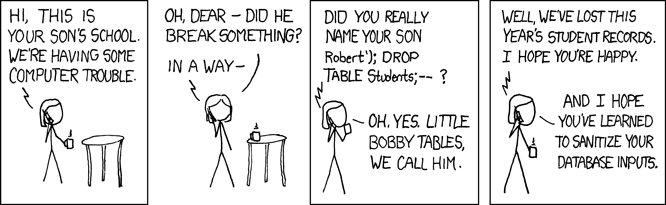
  • SQL Injection. By using single-quote characters, attackers were able to easily "inject" SQL code. For example, typing "' OR '' = '" in the Password textbox would result in a query that asked for users "WHERE Password='' OR '' = ''." Because an empty string ('') is always equal to itself, this would always return a user.
  • Trusting the Browser. Instead of using server-side code to disable and hide unauthorized navigation links, CSS and JavaScript were used. A quick "View Source" or even a line or two of JavaScript type in the address bar could (and did) easily bypass the protection.
Every time the Web site was hacked, the original developers insisted it was an infrastructure problem. They had the company buy a secure certificate. Then they added a separate database server. Then they installed a firewall to put between the servers. Then an intrusion detection server. And so on. Still, hackers waltzed right in.

Eventually, the company decided that enough was enough and hired Nate and his team to remediate the problems. But his hands were tied as the client insisted on dictating security requirements. And dictate they did. . . .
Enjoy!

. . . Oh. I posted this partially to "explain" how I got to Spamusement.com (see my post directly beneath this one). --One of the respondents said the proposed security measures everyone was talking about reminded him of this "Security Issues" cartoon.

Sunday, October 14, 2007

The result of one of my rare immersions into the tech world . . .

About a four-link-long surfing series from someone's blog entry about Sonlight, I bumped into the Worse Than Failure (WTF) blog


and the following entry:

Do Not Click! 2007-10-10
by
Alex Papadimoulis in Error'd

This popped up for Steve in Lotus Notes. I wonder if this is what happens when you click buttons labeled "do not click!"


Alan C. came in to work one morning to find that someone had helpfully labeled all the cables on one of the hotdesks. How did they ever cope before?


Brian was using an internal tool at work and ran into this next error. Naturally, the window doesn't actually detect key strokes ...


Best comments in reply:

Made me think of WTF:
http://xkcd.com/327/


and:
The cable labels gave me flashbacks. At my old position we had to label every cable to a ridiculous degree.

Ethernet data cables had to be a certain color and Ethernet management cables (DRACs, LOM) had to be a different color. So right off the bat we had to swap out 95% of the cables in our facility.

Every Ethernet cable had to be labeled on both ends with:
1. Server name
2. Server port (in case the server had multiple NICs)
3. MAC Address
4. Switch name
5. Switch card
6. Switch port

So you would end up with a cable "flag" that was about 6 inches long. It was obviously useful, in the case when someone sneaked into the server room and unplugged a random cable (which never happened). Of course if you ever moved anything or renamed a server for a new project you had to make 2 new labels.

The best part was labeling the power cords. You needed to have the server name and the "slot" the cord was plugged into on the surge suppressor. Then you had to label the end of the surge suppressor and which circuit breaker it plugged back into.
. . . Which comment yielded a reference back to an earlier WTF post:
Clean design and thorough documentation are essential in every type of engineering, from aerospace to software. Network Engineering is no different: with miles of cables wired to thousands of jacks in a typical office building, an unlabeled block of cable is just as good as a dead one. Fortunately, the fine folks at Patrick McGoohan’s office made sure to carefully label everything . . .


*****

Well. I was about to leave WTF having ignored the following post. I was sure it was some kind of joke. Someone must have done some Photoshopping:

Sorry, You Used That Password 28,452 Times Ago 2007-10-08

by
Jake Vinson in Error'd

This one's
from the Microsoft Knowledge Base:


(submitted by Sean)
So assuming 60WPM and 4-5 characters in a word, it'd take you over an hour to type in your password. And hopefully you'd type the correct one in, rather than one of your last thirty thousand passwords.
Amazing! There really is such an error message:

SYMPTOMS

If you log on to an MIT realm, press CTRL+ALT+DELETE, click Change Password, type your existing MIT password, and then type a new, simple password that does not pass the dictionary check in Kadmind, you may receive the following error message:
Your password must be at least 18770 characters and cannot repeat any of your previous 30689 passwords. Please type a different password. Type a password that meets these requirements in both text boxes.
Note that the number of required characters changes from 17,145 to 18,770 with the installation of SP1.
NOTE: This is not a common case; it occurs only when you configure Windows 2000 to authenticate against an MIT Kerberos domain.
Whew! I'm so glad to discover this is not a common case!

Sunday, February 11, 2007

“Who Killed the Electric Car?”

As I mentioned in Denver to New Zealand--A Midwinter/Midsummer Vacation, I watched "Who Killed the Electric Car?" while flying to New Zealand. And as I have indicated in I Want One, I am very interested in at least one electric car . . . and, possibly, others as well. (I have been interested in alternative fuel cars ever since I was a boy when I read that the Stanley Steamer was the fastest car of its era; that it could go from forward to reverse without shifting gears, and its major flaw--besides occasionally exploding (a charge that the Wikipedia "Stanley Steamer" article denies)--was, as I recall, that a person might push a bit too hard on the brake and find him- or herself suddenly thrown from the vehicle when it went from high speed acceleration forward to high speed acceleration backward in an instant.)

But back to "Who Killed the Electric Car?"

The film is an ode, more or less, to the EV-1, a General Motors vehicle I had never heard of before, and an investigation of why the vehicle was developed in the first place, why “no one“ ever heard of it, and why there aren't any more on the street today.

A very powerful piece of propaganda (if that's what you want to call it). Or an effective piece of investigative reporting. It impacted me deeply. In fact, it has caused me to question some of my political ideas and/or commitments.

Example: The film has someone--Ralph Nader, I believe--say that virtually "all" the major improvements in automotive safety and efficiency in the last 50 years have come about as a result of federal regulations. The car companies themselves, he said, didn't bring us seat belts, 20 mpg or better fuel efficiency, low-emission engines, etc. Oh, they developed the technology, all right. But they didn't make these a regular part of the cars that all of us drive until the federal government mandated the improvements.

Now, that gets me thinking. From a marketing perspective. Of the three technologies I have mentioned--seat belts, fuel efficiency, and low-emission engines--which could have been achieved without federal mandates?

Seat belts. Couldn't they have become standard equipment without mandates? It would have required some significant education to get people, first, to purchase them in significant enough quantity to lower their costs.

Or would it?

I wonder if the Detroit manufacturers of the late 50s and 60s would have been "able" to put in seat belts if the Japanese manufacturers of the 70s and 80s had been present to spur them on? Aren't there a lot of manufacturers today who build their cars with additional steel bars and plates and additional airbags . . . and who tout their resultant superior safety records?

Apparently, they find these safety features pay for themselves through added sales.

Or do they? Or, should I say, would they if they were seeking to appeal to the mass market? Is it the case that, yes, they can make money as long as they are selling to the high-end car buyers, but no, they would lose money if they added all these additional features and tried to sell them to the lower end of the market--the people who can afford the $10,000-25,000 new vehicles?

Fuel efficiency and emissions are very similar, to my way of understanding.

A year or two ago, I thought I would like to buy a Prius for Sarita. The Prius would be our second car, a commuter car. (What hybrids are supposed to be best suited for: efficient for stop-and-go, around-town driving.)

Except, as I recall, even calculating an average of $3.50 a gallon for gas, it would take something like 10 years or more, at the rate Sarita drives, to make up the $9,000 price differential (as I recall) between the Prius and the Corolla. . . . So we bought the Corolla.

So it is, I'm afraid, with most automobile technologies. Unless and until they become mainstream and/or mandated, so that all new cars use the technology, the price differential is too great for most consumers. . . .

*****

Another example of how the film caused me to question my previous ways of thinking:

Overall, I have been only moderately critical of George W. Bush from early in his presidency for a number of reasons.

Some things have driven me absolutely nuts:
  • He (and the Republicans in general) have seemed wimpy, lacking in backbone or conviction.
  • I "can't believe" what a fiscally irresponsible "leader" he has proven to be, refusing to veto any spending increases and, in fact, adding large sums of money to plans already approved by the supposedly "liberal" Democrats.

    (In the '80s, it was popular to speak of the "tax-and-spend" liberal Democrats. I had come to the point where I began speaking of the "borrow-and-spend" [supposedly conservative] Republicans who put our nation in horrendous debt.)
I have questioned his wisdom in venturing into what appear to be foreign entanglements. (Although in today's world, as at least one friend has noted, people around the world are so interconnected economically, let along socially and politically: it is hard to argue that what happens in a place like Iraq is truly of no concern "back home.")

But I am no knee-jerk Bush-basher, either.

However, in "Who Killed the Electric Car?" I was stunned by revelations about Bush and about Reagan and their policies concerning oil . . . and energy. Absolutely stunned. (Assuming, of course, that the film speaks the truth.)

According to the film, Jimmy Carter, in 1977, I believe, announced a policy that, he said, would keep the United States from every importing more oil than it had in 1976. I believe the figure he mentioned was 8.5 million barrels of oil imported per day. Something like that.

I vaguely remember some of the policies and regulations put into place during Carter's tenure. Vaguely.

Some of the policies had to do with automotive fuel efficiency--CAFÉ, as it was called--Corporate Average Fuel Economy, "the sales weighted average fuel economy, expressed in miles per gallon (mpg), of a manufacturer’s fleet of passenger cars or light trucks with a gross vehicle weight rating (GVWR) of 8,500 lbs. or less, manufactured for sale in the United States, for any given model year."

And between 1976 or '77, when the regulations went into effect, and early 1980-something, the average car sold in the United States went from something like 14 mpg to almost twice that.

Whatever. Automobile fuel efficiency skyrocketed.

When Reagan came into office, however, many of Carter's energy policies were reversed.

Tax credits that Carter had helped enact in order to encourage greater investment in solar energy--solar roof panels to heat buildings and water, for example--were reversed.

Carter had placed solar panels on the White House roof; Reagan had them removed almost the moment he moved into the White House.

The film offered no reasons why Reagan had done such a thing. I imagine it was largely symbolic: Carter's era and the years immediately preceding him had been full of austerity and economic hardship. Reagan probably wanted to signal--what I recall was a chief campaign theme--a new day in America.

But why waste the benefits we, the people of the United States, had already paid for? Why waste the energy that the Sun provides and that the White House had been equipped to capture?

The film's revelations of these things bothered me.

I have been very interested in fuel efficient buildings and cars, not just intellectually, but practically . . . if I could possibly justify the purchase of such things in economic terms.

I mentioned the Prius.

I had us pay an outside consultant who specializes in these things evaluate the feasibility of us using geothermal energy as a conservational measure for the building we constructed for Sonlight back in 1999. Sadly, under even the most positive analysis, as I recall, the energy savings wouldn't have paid for the additional costs in 20 years. --A 20-year payback is equivalent to a 3.53% compound return on investment.

And some analyses suggested the payback could take up to 50 years. . . .

So that measure made no sense to me and I refused to make the investment.

But Reagan destroyed an energy conservation measure that had already been paid for. Why? That made even less sense, it seemed to me.

The film emphasized these shifts at the federal level. And the revelations bothered me.

But what really burned me up was the revelation that, under George W., at the very time the federal government was removing $4,000 tax credits for fuel-efficient electric cars like the EV-1 (and others), they added tax deductions for 6,000-pound fuel-guzzlers like the Hummer: up to $100,000 per vehicle!

A $100,000 deduction for purchasing a gas guzzler, and the elimination of the very modest $4,000 benefit for electric cars?

I was shocked and angered to hear such a thing!

And Bush claims to be concerned about the environment and fuel conservation?

Sunday, November 12, 2006

Building a medical clinic from scratch

When we got to the Wycliffe meeting, someone handed us a binder that, among other things, included a list of our fellow attendees. I read through the list, saw the names of no one I knew, but saw one last name that caused me to wonder: "Are these people relatives of someone I know?"

The man's name was Adrian Visbeen. I knew a Visbeen once. His name was Al--Al Visbeen. Back in New Jersey.

A couple of days later, I was in a meeting and realized Adrian Visbeen was sitting next to me.

"Hi," I said. "By any chance, do you have relatives in New Jersey?"

"Yes."

"Do you know a guy named Al Visbeen?"

"Yes. . . . He's my brother!"

Al Visbeen, I knew, was a successful building contractor. Very successful. Turns out, Adrian and Al had been partners. They have now both retired. But Adrian pulled out of the business first--16 years ago, about the time when Sarita and I left New Jersey and would have last seen Al.

"I was 52 when I told Al I wanted to retire in two years so my wife and I could do mission work," Adrian told me. "I wanted to sell my half of the business and move on.

"Al was incredulous: 'You're going to give up the company car and all the benefits?!?'"

But Adrian and his wife were determined. Before they had gotten married--he had only discovered this a short time before he made his announcement to Al-- . . . Before they had gotten married, Adrian's wife had thought she was going to be a missionary. "I was sure I was supposed to be a missionary," she said.

But then she got married and forgot the whole idea. Until their kids had graduated and left the house.

"Now what am I going to do? Sit around?"

So she and Adrian decided that they would make themselves available for wherever God led them. They would use their skills to help advance His Kingdom.

And so, at 54, about 16 years ago, Adrian sold his half of Visbeen Construction to his brother and launched off into a new field of service--with Wycliffe Associates, YWAM (Youth With a Mission), and several other agencies. Adrian gave me a letter he had written earlier this year that showed where all they have served: 56 different projects in almost as many different places . . . around the world.

But there is one story of one project I would like to share with you here. It's the story from which I titled this post:

Building a medical clinic from scratch

Adrian and his wife were asked to build a medical clinic on one of the islands in Lake Victoria (Africa).

Not sure why, but for some reason, they brought a wheel for a wheelbarrow, but, apparently, not much else.

When they got to the island, they asked if there was any concrete available.

"'Concrete'?" --No one knew what it was.

"Where can I get some sand?" Adrian asked.

No one had any sand on the island. There was no sand.

"How about cement?"

No one had any cement.

Someone did own a sailboat, however.

So Adrian, said, they sent the sailboat out one day to pick up bags of cement from a town on the shore of the lake. Out and back to pick up the cement: one day.

The next day, they sent the sailboat in another direction to pick up sand from a beach. They tied up the boat and filled it with sand--one shovelful at a time.

Out and back for sand: another day.

Then they mixed the sand, cement and water--local men did it with their bare feet. ("Their skin was tough, like leather!" Adrian said. --I expect so. Indeed, I hope so. Because concrete is quite caustic.)

So they poured the slab on which the clinic was to be built.

Now for bricks.

No one had any bricks.

"Okay," said Adrian. "Let's make them!"

So they smashed a termite mound, ground the clay, mixed it with water, poured it into a six-inch tall brick mold, mashed the clay so it was exactly the height of the mold, then turned the raw brick out onto a black plastic sheet where it would bake in the sun for three days. . . .

Talk about building from scratch!

Oh. The wheelbarrow wheel.

No one owned a wheelbarrow. So they made one.

"We dug a pit, rolled a log over the top, had one guy stand down in the pit and another on top, and then they sawed the log in half. . . ."

I just realized I never got a clear idea of how the wheelbarrow finally worked, but, somehow, the sawed log became the structural basis for the wheelbarrow, and the wheel . . . --Well, the wheel became the wheel for the wheelbarrow! (Of course!)

******

Why all this labor to build a building whose structural components were like nothing the local population had ever seen? (Isn't that called inappropriate technology--in contrast to (what development agencies normally refer to as) appropriate technology: i.e., technology that is readily supported by the local culture and economy?)

The reason for using this--what seems to be--"outlandish" structural technology: it is durable and it is clean. This clinic should remain useful for decades. The more "traditional" structures last only years. . . .