Showing posts with label names. Show all posts

Saturday, April 11, 2009

The passing of a culture

Today I read the end of 2 Kings (23-25) and the first three chapters of 1 Chronicles (1-3).

I "know" just enough Hebrew to enable me to use the standard tools . . .
Look up a verse in the Blue Letter Bible, then click on the "C"
and you'll see all kinds of lexical aids, including hotlinks to Strong's Concordance . . . and more:
. . . and also to be curious about the meanings of such things as some of the names we run across.

That's why I took the time to check Eliakim and Jehoiakim in 2 Kings 23:34 where we read that "Pharaoh Neco made Eliakim the son of Josiah king in the place of Josiah his father, and changed his name to Jehoiakim." What do those names mean?

I knew Eli-akim or El-yakim had to be "My God akim" [Eli-akim] (whatever akim might mean) or "God yakim" [El-yakim] (again, whatever yakim might mean; El means "God").

And Jeho-i-akim (or, more likely, Jeho-yakim) had to be something about "Yahweh (or Jehovah) ________akim or yakim." But what does akim or yakim mean?

I looked up the names.

Eliakim--pronounced El-yah-KEEM; ah! Correct pronunciation leads to correct split: El-yakim--means "God raises" or "God sets up." And, as one might then expect, Jehoiakim--pronounced Yeh-ho-yah-KEEM--means "Jehovah (or Yahweh) raises up."

Once I recognized that, however, it raised a question in my mind: Why would Pharaoh Neco want to change Eliakim's name to Jehoiakim? --Could it be an attempt at ironic mockery: "Jehovah set you up as king! (Ha-ha-ha-ha!) No, I, Pharaoh Neco, established you as king over against your vaunted 'Jehovah.' --And don't you forget it!"? (That was the best I could come up with.)

Anyway.

You can imagine, after doing this kind of study every now and then, one begins to pay attention to the names and the name forms. If you haven't happened to pay attention, let me point out how common the name forms are that begin with El- or Yeh- or Jeh- and/or that end in -iah. --All related to "God" or "YHWH"/"Jehovah."

So I finished 2 Kings and got over to 1 Chronicles where I got the genealogies going back to Adam and Eve, and, suddenly, it was very obvious I was/we are dealing with a very different culture. None of the names included any of those "El" or "YHWH"/Jehovah pre- or postfixes. Yahweh/Jehovah isn't named.

It got me thinking about how the American culture is shifting. You can see it in "our" names.

It wasn't that long ago, the vast majority of names in the United States were "Christian" or "biblical" . . . or exhibited an affinity for or aspirations toward some kind of biblical relations.

But today?

The biblical books of Kings, of course, focus on the names of the civil leaders in Israel and Judah. I got thinking about the head of government in the United States today. Whether or not he identifies himself as Christian, it struck me that Barack Obama is the first U.S. president whose name [Barack = "Blessed" in Arabic] comes from a cultural stream whose names do not reflect Christian or Biblical roots.

Is that, itself, also a sign of a cultural shift?

Are future American presidents/rulers going to feature Islamic/Qur'anic rather than Christian/biblical roots?

Speaking for myself, may I say that, if I had to choose, I would prefer a Christian over a Q'uranic law system!
NOTE: Despite the Arabic roots for his name, the Luo people, from whom Mr. Obama comes, are, today, 97% Protestant Christian by affinity.


Just before I posted, I happened to note this interesting commentary by Eric Schansberg on a similar (but differently-focused) front.

Saturday, November 15, 2008

Onomastic sobriquets . . .

[Oh, yes! Enjoy the vocabulary lesson! . . . Onomastic: "Of, relating to, or explaining a name or names." And sobriquet: affectionate or humorous nickname.]

Lynn C. Hattendorf Westney, Associate Professor and Assistant Reference Librarian at the University of Illinois, Chicago, presented a wholly fun paper at the 35th Annual Congress of the Social Sciences and Humanities in Quebec back in May of 2001. Title of the paper: Dew Drop Inn and Lettuce Entertain You: Onomastic Sobriquets in the Food and Beverage Industry. And its subject matter: examples of "international onomastic appellations [that] demonstrate that the names of contemporary dining and drinking establishments serve as semantic and/or humorous reflections of societal mores."

Westney seems never to have heard the editor's aphorism I learned many years ago to "Kill which's wherever you find them." If you can overlook her ubiquitous use of the word, however, I think you'll find the paper--that consists, primarily, of "names in the food and beverage industry which reflect contemporary culture and which are characterized by their amusing and titillating patronyms and puns"--quite a bit of fun to peruse.

From coffee shops
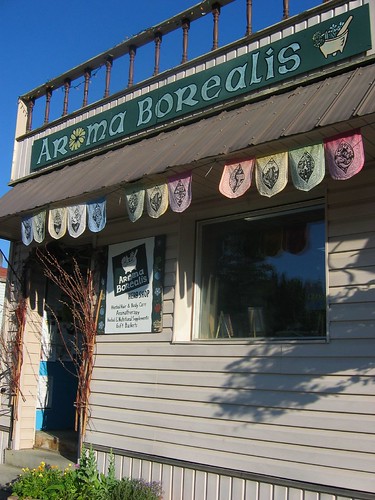
Aroma Borealis in Alberta, Edmonton (and elsewhere),
Brew Ha Ha of Phoenix, Arizona,

Espresso Yourself in Juneau, Alaska (and elsewhere; photo from Anchorage),
and Pony Espresso of Dubois, Wyoming . . .
to hot dog stands like
Franks for the Memories of Mundelein, Illinois,
Mustards Last Stand of Evanston, Illinois,
Puppy Love of Plymouth, New Hampshire, and
Relish the Thought of Chicago, . . .
to Asian restaurants
Beau Thai in Portland, Oregon, or
Seoul Food (Korean barbecue) in Denver, Colorado . . .
to establishments that indicate what they serve:
Adams Rib of Riverdale, Illinois,
the Crepevine in San Francisco,
Grateful Bread of Seattle, and
Jonathan Livingston Seafood of Chicago . . .
to places whose names leave you wondering:
Eaton Gogh in Norfolk, Virginia,
The Hearty Boys of Chicago, and
The Perfect Wife, Manchester, Vermont . . .
these and a hundred more all here for your bemusement!

Oh! But while looking for photos to grace this page . . . I came across some additional pages with fun names.

I didn't record them all. But here's one I enjoyed: Creative Shop Names.

Friday, August 08, 2008

Why the name "Jonadab"?

So we went up and visited Amy & Phil. And with them having given their newborn son a name like Jonadab Asaph--not exactly the kind of name popular with Americans today--I figured I should know what the name is all about.

"So, why did you choose Jonadab?" I asked.

Amy directed me to a story in the Old Testament. Actually, to two sections of Scripture. One, 2 Kings 10. There we read about Jehu and a guy named "Jehonadab son of Recab." 2 Kings 10 is where Jehu slaughters all the sons of the corrupt king of Israel, Ahab . . . and all the prophets or ministers of the false god Baal. And Jehonadab, it seems, is Jehu's right-hand man. In vv. 15-17 we read, "After [Jehu] left [Beth Eked], he came upon Jehonadab son of Recab, who was on his way to meet him. Jehu greeted him and said, 'Are you in accord with me, as I am with you?'

"'I am,' Jehonadab answered.

"'If so,' said Jehu, 'give me your hand.'"
So he did, and Jehu helped him up into the chariot.

Jehu said, “Come with me and see my zeal for the Lord.” Then he had him ride along in his chariot.

When Jehu came to Samaria, he killed all who were left there of Ahab's family; he destroyed them, according to the word of the Lord spoken to Elijah.

Then Jehu brought all the people together and said to them, “Ahab served Baal a little; Jehu will serve him much. Now summon all the prophets of Baal, all his ministers and all his priests. See that no one is missing, because I am going to hold a great sacrifice for Baal. Anyone who fails to come will no longer live.” But Jehu was acting deceptively in order to destroy the ministers of Baal.

Jehu said, “Call an assembly in honor of Baal.” So they proclaimed it. Then he sent word throughout Israel, and all the ministers of Baal came; not one stayed away. They crowded into the temple of Baal until it was full from one end to the other. And Jehu said to the keeper of the wardrobe, “Bring robes for all the ministers of Baal.” So he brought out robes for them.

Then Jehu and Jehonadab son of Recab went into the temple of Baal. Jehu said to the ministers of Baal, “Look around and see that no servants of the Lord are here with you—only ministers of Baal.” So they went in to make sacrifices and burnt offerings. Now Jehu had posted eighty men outside with this warning: “If one of you lets any of the men I am placing in your hands escape, it will be your life for his life.”

As soon as Jehu had finished making the burnt offering, he ordered the guards and officers: “Go in and kill them; let no one escape.” So they cut them down with the sword. The guards and officers threw the bodies out and then entered the inner shrine of the temple of Baal. They brought the sacred stone out of the temple of Baal and burned it. They demolished the sacred stone of Baal and tore down the temple of Baal, and people have used it for a latrine to this day.

So Jehu destroyed Baal worship in Israel.

--2 Kings 10:18-29


That's the sum of the historical record about Jonadab/Jehonadab as recorded in the history books. But then we come to Jeremiah. Jeremiah 35, to be exact.

Jonadab/Jehonadab apparently, was no ordinary man. He gave his son's a command that they work to keep all of their lives and to pass on to all of their descendents after them. It appears they kept that command for centuries.

In Jeremiah 35 we read:
This is the word that came to Jeremiah from the Lord during the reign of Jehoiakim son of Josiah king of Judah: “Go to the Recabite family and invite them to come to one of the side rooms of the house of the Lord and give them wine to drink.”

So I went to get Jaazaniah son of Jeremiah, the son of Habazziniah, and his brothers and all his sons—the whole family of the Recabites. I brought them into the house of the Lord, into the room of the sons of Hanan son of Igdaliah the man of God. It was next to the room of the officials, which was over that of Maaseiah son of Shallum the doorkeeper. Then I set bowls full of wine and some cups before the men of the Recabite family and said to them, “Drink some wine.”

But they replied, “We do not drink wine, because our forefather Jonadab son of Recab gave us this command: ‘Neither you nor your descendants must ever drink wine. Also you must never build houses, sow seed or plant vineyards; you must never have any of these things, but must always live in tents. Then you will live a long time in the land where you are nomads.’ We have obeyed everything our forefather Jonadab son of Recab commanded us. Neither we nor our wives nor our sons and daughters have ever drunk wine or built houses to live in or had vineyards, fields or crops. We have lived in tents and have fully obeyed everything our forefather Jonadab commanded us. But when Nebuchadnezzar king of Babylon invaded this land, we said, ‘Come, we must go to Jerusalem to escape the Babylonian and Aramean armies.’ So we have remained in Jerusalem.”

Then the word of the Lord came to Jeremiah, saying: “This is what the Lord Almighty, the God of Israel, says: Go and tell the men of Judah and the people of Jerusalem, ‘Will you not learn a lesson and obey my words?’ declares the Lord. ‘Jonadab son of Recab ordered his sons not to drink wine and this command has been kept. To this day they do not drink wine, because they obey their forefather's command. But I have spoken to you again and again, yet you have not obeyed me. Again and again I sent all my servants the prophets to you. They said, “Each of you must turn from your wicked ways and reform your actions; do not follow other gods to serve them. Then you will live in the land I have given to you and your fathers.” But you have not paid attention or listened to me. The descendants of Jonadab son of Recab have carried out the command their forefather gave them, but these people have not obeyed me.’

“Therefore, this is what the Lord God Almighty, the God of Israel, says: ‘Listen! I am going to bring on Judah and on everyone living in Jerusalem every disaster I pronounced against them. I spoke to them, but they did not listen; I called to them, but they did not answer.’ ”

Then Jeremiah said to the family of the Recabites, “This is what the Lord Almighty, the God of Israel, says: ‘You have obeyed the command of your forefather Jonadab and have followed all his instructions and have done everything he ordered.’ Therefore, this is what the Lord Almighty, the God of Israel, says: ‘Jonadab son of Recab will never fail to have a man to serve me.’”

"I was reading that passage one day," said Amy, "and when I got to the end, I found myself shaking. I knew, if this baby was a boy, this was to be his name."

I guess I would have to agree with Amy, Jonadab (or Jehonadab) himself is someone I would want in my family--or his descendants, certainly, are people I would want in my family!

This story is actually even more interesting and exciting than what I have said so far. I cut off the story of Jehu and Jehonadab one or two sentences too early.

Remember, we finished the story of Jehu and Jehonadab in 2 Kings 10 with the comment that Jehu "destroyed Baal worship in Israel." Look at the very next sentence:
However, [Jehu] did not turn away from the sins of Jeroboam son of Nebat, which he had caused Israel to commit--the worship of the golden calves at Bethel and Dan.

And, two sentences later,
Jehu was not careful to keep the law of the Lord, the God of Israel, with all his heart. He did not turn away from the sins of Jeroboam, which he had caused Israel to commit.

But Jehonadab . . . !

I think Phil and Amy picked a very good name, indeed.
*******

Oh, and as the name Asaph? --That comes from I Chronicles 15 and 16 and the book of Psalms. And I Chronicles you find that Asaph was a master musician. And then throughout the rest of the Old Testament history books you find his descendents are leaders in temple worship. And then throughout the book of Psalms, you'll often see the notice, "A psalm of Asaph," or, "Of Asaph."

Again, I like the name!